Introduction:
In today's digital battleground, being "cloud ready" has evolved from competitive advantage to baseline necessity. Organizations without a coherent cloud strategy now face existential threats from more agile competitors. The global pandemic only accelerated this reality, forcing enterprises to rapidly pivot toward distributed operations and digital-first customer experiences.
Cloud readiness encompasses a comprehensive organizational posture:
- Architectural Flexibility: Systems designed for horizontal scaling and resilience
- Operational Excellence: DevSecOps practices embedded throughout the application lifecycle
- Infrastructure Abstraction: Application logic decoupled from underlying compute resources
- Continuous Deployment: The ability to release enhancements with minimal friction
- Cost Optimization: Dynamic resource allocation based on actual demand patterns
Organizations achieving true cloud readiness report 37% faster time-to-market for new capabilities and 42% lower operational costs. However, these benefits remain elusive for enterprises struggling with application modernization, particularly those anchored to monolithic architectures and traditional development approaches.
Containerization: The Non-Negotiable Foundation
Containerization has definitively emerged as the linchpin technology enabling genuine cloud readiness. While virtualization revolutionized infrastructure utilization, containers have transformed application development and deployment paradigms by creating standardized, lightweight, portable runtime environments that abstract applications from the underlying infrastructure.
The advantages containerization offers are compelling and well-documented:
- Environment Consistency: Eliminating discrepancies between development, testing, and production environments
- Resource Efficiency: Consuming 4-8x fewer resources than equivalent virtual machines while providing similar isolation guarantees
- Deployment Velocity: Enabling near-instantaneous startup times compared to traditional VMs
- Platform Independence: Running consistently across any environment supporting container runtime standards
- Scalability: Supporting fine-grained, dynamic scaling through container orchestration platforms
- Resilience: Facilitating self-healing architecture through health monitoring and automated recovery
As Kubernetes has emerged as the de facto standard for container orchestration, organizations advancing their containerization strategies invariably gravitate toward Kubernetes-compatible approaches, whether self-managed, through managed services like EKS/AKS/GKE, or via higher-level abstractions built on Kubernetes.
The challenge, however, is that traditional development approaches require specialized expertise in containerization technologies, expertise that remains in critically short supply. This expertise gap has created a strategic opportunity for low-code application development platforms to democratize access to containerization capabilities, but not all vendors are responding equally to this opportunity.
The Low-Code Containerization Landscape:
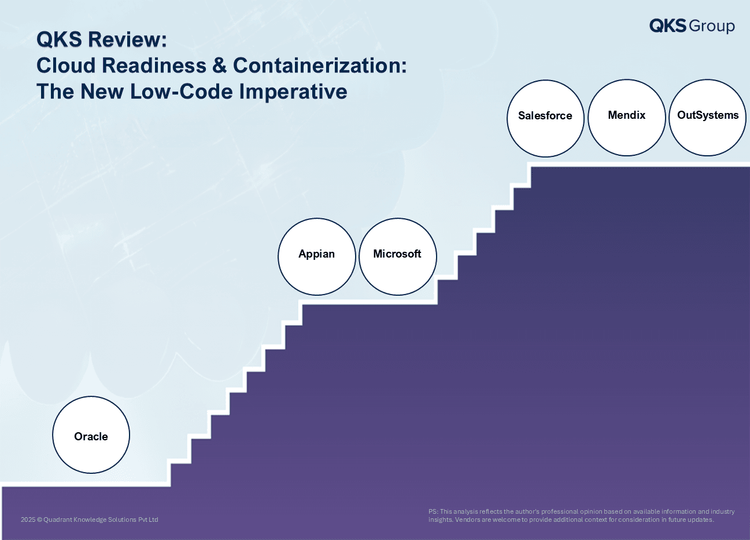
This analysis examines six major players, revealing stark contrasts in vision, execution, and value delivery through the varied approach to containerization that these vendors have adopted.
The Leaders: Setting the Pace
1. OutSystems: Pioneering True Enterprise-Grade Containerization
Container Strategy: OutSystems has fully embraced Kubernetes-native architecture with their O11 platform. Their tools seamlessly generate containerized microservices without requiring developers to understand Kubernetes manifests.
Implementation Excellence: OutSystems applications deploy as optimized containers in Kubernetes clusters with sophisticated auto-scaling policies. Their reference architecture implements proper name spacing, network policies, and resource quotas, critical elements many platforms overlook.
Key Innovation: Their "Experience Composition" framework enables developers to compose containerized microservices into cohesive applications while maintaining independent scalability and deployment lifecycle.
Analyst Verdict: OutSystems represents the gold standard for containerization in low-code platforms, demonstrating sophisticated understanding of enterprise container orchestration while abstracting complexity.
2. Mendix: Masterful Abstraction with Cloud-Native DNA
Container Strategy: Mendix has containerized its entire runtime environment, automatically packaging applications as optimized containers without requiring container-specific knowledge from developers.
Implementation Excellence: Mendix Cloud handles scaling, redundancy, and self-healing without developer intervention. Their container images are security-hardened and regularly patched—a critical consideration often overlooked.
Key Innovation: Their "Adaptive Cloud Services" automatically optimize container configurations based on application behavior patterns, adjusting resource allocations and scaling policies to match actual usage.
Analyst Verdict: Mendix represents the ideal approach for organizations seeking cloud-native benefits without requiring teams to develop container expertise.
3. Salesforce Platform: Enterprise Weight Limiting Container Agility
Container Strategy: Salesforce leverages modern cloud-native infrastructure through Hyperforce, its infrastructure architecture designed for the public cloud. While not Kubernetes-standard in portability, Salesforce’s containerization approach is tailored for security, scalability, and performance within its tightly integrated platform.
Implementation Excellence: Applications on the Salesforce Platform are highly optimized for Salesforce’s infrastructure, ensuring high resilience, consistent performance, and rapid scaling across regions. Hyperforce enables Salesforce to operate with the elasticity and compliance of leading public cloud providers while maintaining strict architectural control to support regulated industries and large global customers.
Key Innovation: Hyperforce combines the power of public cloud environments with Salesforce’s proprietary data residency and security frameworks, enabling enterprises to deploy apps closer to users without sacrificing control. The platform provides all cloud features including multi-tenancy, automated scaling, continuous delivery, and infrastructure abstraction, all within a governed and performant ecosystem.
Analyst Verdict: Salesforce’s approach represents a deliberate architectural choice: rather than prioritizing container portability, it maximizes cloud-native performance within its ecosystem. For enterprises invested in the Salesforce platform, this strategy delivers operational excellence and accelerated time-to-value. While the lack of Kubernetes-standard portability may limit organizations to migrate out of Salesforce ecosystem, it is a tradeoff favoring deep platform synergy and enterprise-grade reliability.
The Middle Ground: Work in Progress
4. Microsoft Power Platform: Enterprise Integration Over Container Innovation
Container Strategy: Power Platform uses containerization selectively, primarily on the server side. Significant portions still run on traditional Azure PaaS services rather than containers.
Implementation Reality: Microsoft's container approach emphasizes Azure integration over portability. Power Platform containers are optimized for Azure environments, with limited guidance for deployment to non-Microsoft clouds, creating potential vendor lock-in.
Current Limitations: Power Platform's containers lack sophisticated auto-scaling capabilities, with most scaling occurring at the Azure service level rather than the container level.
Analyst Verdict: Power Platform offers adequate containerization for Microsoft-centric enterprises but falls short for organizations seeking sophisticated container orchestration or multi-cloud flexibility.
5. Appian: Cautious Containerization for Risk-Averse Enterprises
Container Strategy: Appian provides a "Cloud Application Manager" supporting both containerized and traditional deployments, allowing gradual migration to containerization.
Implementation Reality: While Appian supports container deployments, their architecture isn't fully optimized for Kubernetes environments, with limited support for advanced features like Operators, CRDs, or service meshes.
Current Limitations: Appian's container implementations often require more resources than container-native platforms, and their scaling models don't fully leverage container orchestration capabilities.
Analyst Verdict: Appian offers a reasonable compromise for risk-averse enterprises with significant legacy investments, prioritizing gradual migration over container optimization.
The Laggards: Missing the Containerization Opportunity
6. Oracle APEX: Retrofit Containerization Missing the Mark
Container Strategy: Oracle has retrofitted containerization onto APEX as a deployment option, but the underlying architecture remains fundamentally at odds with container principles.
Implementation Problems: APEX containers exhibit poor resource efficiency, often requiring entire Oracle Database instances within containers, essentially virtualizing a monolith rather than embracing microservice principles.
Critical Shortcomings: APEX container deployments lack proper orchestration integration, with limited support for Kubernetes features beyond basic pod deployment. Scaling remains tied to database scaling rather than application-level container orchestration.
Analyst Verdict: Oracle's approach demonstrates superficial implementation without embracing fundamental container principles, creating significant risks for enterprises seeking genuine cloud readiness.
Strategic Recommendations: Navigating Containerization Choices
Several strategic imperatives emerge for organizations seeking genuine cloud readiness:
- Prioritize Container Philosophy Over Features: Evaluate whether containerization is fundamental to a platform's architecture or merely a deployment option.
- Assess Container Ecosystem Alignment: Platforms adhering to industry container standards enable integration with the broader cloud-native toolkit rather than creating isolated implementations.
- Evaluate Container Portability Realistically: Test whether containerized applications can actually run in different environments or are effectively locked to vendor infrastructure.
- Consider Team Readiness: Match container abstraction level to organizational capabilities, fully abstracted approaches may suit teams without container expertise, while flexible approaches accommodate varying knowledge levels.
- Balance Immediate Needs with Strategic Direction: Organizations early in cloud journeys may benefit from hybrid approaches, while those pursuing cloud-native transformation should prioritize container-native platforms.
The Future of Low-Code Containerization:
Looking ahead, several emerging trends will reshape how low-code platforms approach containerization:
- Container Composition Standards: Leading platforms will adopt emerging standards for container composition to improve portability.
- AI-Driven Container Optimization: Machine learning will optimize container configurations based on application behavior, reducing expertise requirements.
- Zero-Trust Container Security: Platforms will integrate zero-trust security principles directly into container management, addressing enterprise security concerns.
- Edge-Ready Containers: Low-code platforms will extend containerization to edge computing scenarios, enabling consistent development across cloud and edge.
- Container-Native Governance: Platforms will incorporate container-specific governance capabilities addressing unique compliance challenges.
Conclusion: The Containerization Imperative
After comprehensively studying low-code evolution alongside cloud transformation, one conclusion stands inescapable: containerization represents the definitive foundation for genuine cloud readiness, and platforms failing to embrace container principles will increasingly constrain their customers' cloud journeys.
Organizations must evaluate low-code platforms not merely on current features but on their fundamental container philosophy and architecture. The divergence between leaders like OutSystems, Salesforce Platform and Mendix versus laggards like Oracle APEX reveals not just implementation differences but fundamental disparities in cloud-native understanding.
As containerization standards mature and container expertise becomes increasingly essential, enterprises should prioritize platforms demonstrating authentic container commitment: those building on container foundations rather than bolting containers onto legacy architectures. The future belongs to platforms embracing containerization as an architectural principle rather than deployment afterthought.
In the race toward genuine cloud readiness, containers aren't just the vehicle, they're the road itself. Choose wisely.
Disclaimer:
This blog is based on independent research and publicly available information. The insights presented reflect the views of QKS Group and are for informational purposes only. While we strive for accuracy, we do not guarantee completeness or absolute correctness. Vendors are welcome to provide clarifications or updates. If any vendor listed in this analysis wishes to provide additional context or clarification, we welcome a briefing call and will consider incorporating relevant updates. This analysis is not intended to disparage any vendor but to provide an informed, balanced perspective. We encourage open and constructive dialogue to foster transparency and a deeper understanding of the industry.
Author: Abhishek Anant Garg, Analyst – Application Development & Deployment at QKS Group