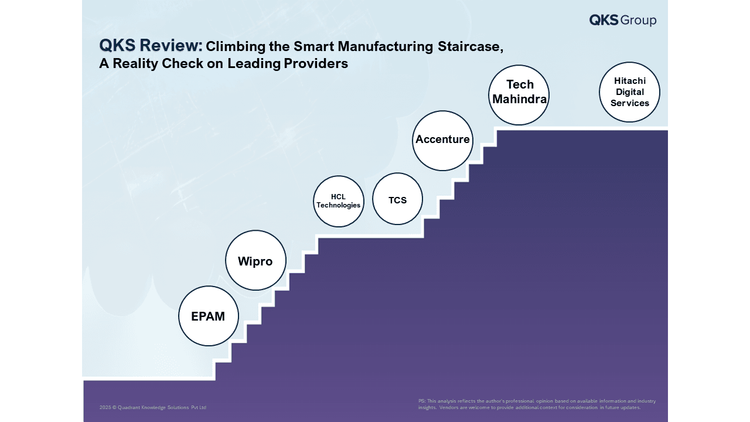
While enterprises race toward Industry 4.0 transformation, a striking pattern emerges among the world's leading large-tier IT service providers. Despite similar marketing messages about "smart factories" and "digital transformation," major vendors operate at fundamentally different maturity levels creating a paradox where choosing the wrong partner can trap manufacturers in capability gaps for years. This analysis examines seven industry titans and reveals why their Smart Manufacturing maturity positioning matters more than their brand recognition.
The Smart Manufacturing journey isn't linear, it's a staircase where each level demands distinct capabilities, and most vendors excel at only specific steps. Understanding where providers truly operate becomes critical as manufacturers discover that Industry 4.0 success depends not just on technology deployment, but on climbing the right maturity ladder with the right guide.
The Maturity Staircase: Beyond the Marketing Facade
Traditional vendor evaluations focus on feature checklists and pricing models, missing the fundamental reality that Smart Manufacturing transformation follows distinct maturity stages. Our analysis reveals five critical levels, each requiring different technological foundations and organizational capabilities.
- Level 1: Connected Assets represents basic digitization, sensors, IoT connectivity, and data collection.
- Level 2: Data Integration involves unified platforms and basic analytics capabilities.
- Level 3: Intelligence & Automation introduces AI/ML, predictive analytics, and advanced manufacturing execution systems.
- Level 4: Cognitive Operations encompasses digital twins, autonomous systems, and self-optimizing processes.
- Level 5: Adaptive Ecosystem delivers Industry 5.0 readiness with human-AI collaboration and sustainable operations.
The critical insight: vendors positioned at Level 2 cannot successfully deliver Level 4 transformations, regardless of their promises. Yet most procurement processes evaluate all providers against identical criteria, missing these fundamental capability gaps.
The Apex Leaders: Hitachi Digital Services and Tech Mahindra
Hitachi Digital Services stands uniquely positioned at the highest maturity levels through their unparalleled convergence of IT, OT, and AI capabilities. With over 110 years of operational technology expertise and 60+ years in digital enablement, Hitachi operates genuine Level 5 capabilities through their Industry 5.0 framework that combines human-AI collaboration with sustainable manufacturing operations.
Hitachi's differentiation emerges from their HARC-OT accelerators & a collection of tools, applications, and cloud services bundled with templates of repeatable solutions optimized for specific industry use cases. Their R2O2.ai framework (Reliable, Responsible, Observable and Optimal AI) demonstrates advanced maturity by delivering responsible AI deployment at enterprise scale, addressing the critical governance challenges that separate mature providers from technology-focused competitors.
The company's real-world validation through their Omika Works lighthouse factory recognized as an "Advanced 4th Industrial Revolution Lighthouse", proves their Level 5 capabilities. They achieved reduction in production lead times, capacity increase, and CO2 emissions reduction while improving inspection efficiency. This isn't theoretical framework implementation, it's proven transformation methodology.
Hitachi's GenAI-powered industrial solutions further demonstrate Level 5 positioning. Their collaboration with NVIDIA and Microsoft on generative AI acceleration, combined with proprietary solutions like RITA (Sustainability AI) and HMAX (Hyper Mobility Asset Expert), showcase adaptive ecosystem capabilities that extend beyond traditional manufacturing into sustainable, human-centric operations.
Tech Mahindra operates at the Level 4-5 transition through their comprehensive NXT.NOW™ framework and deep focus on cognitive manufacturing solutions. Their TechM AMBIT platform demonstrates advanced digital twin capabilities and AI-driven optimization that positions them among the cognitive operations leaders.
Tech Mahindra's strength lies in their engineering-led transformation approach combined with strong partnerships across hyperscalers and technology providers. Their Smart Manufacturing 4.0 solutions encompass predictive maintenance, quality analytics, and supply chain optimization through advanced AI/ML models, demonstrating genuine Level 4+ capabilities.
The company's Innovation Labs and Centers of Excellence focus specifically on Industry 4.0 technologies, developing proprietary solutions that address complex manufacturing challenges. Their Digital Twin implementations and AR/VR-enabled maintenance solutions show progression toward Level 5 adaptive ecosystem capabilities.
The Cognitive Tier: TCS and Accenture
TCS’ Neural Manufacturing™ Framework represents sophisticated Level 4 positioning through their Digital Manufacturing Platform (DMP). Unlike vendors offering point solutions, TCS delivers what they term "neural information fabric", a comprehensive ecosystem connecting assets, operations, supply chain, and workforce into autonomous systems.
TCS’ platform demonstrates Level 4 maturity through proven results: reduction in unplanned downtime, decrease in maintenance costs, and improvement in quality metrics. Their Value Discovery methodology addresses the organizational transformation required for genuine Industry 4.0 adoption, a capability that separates mature providers from feature-focused competitors.
Accenture's Industry X.0 Framework positions the company at Level 4 capabilities through their comprehensive transformation approach. Their Digital Services Factory (DSF) methodology demonstrates genuine Level 4 capability through proven transformation examples, achieving cost reductions while simultaneously improving operational efficiency.
The Intelligence Bridge: HCL Technologies
HCL Technologies occupies the Level 3-4 transition zone through their MVision framework, which addresses connected assets, operations, supply chain, and workforce across four strategic pillars. Their approach demonstrates understanding that Smart Manufacturing transformation requires more than technology deployment, it demands comprehensive business process redesign.
HCL's Xpand 4.0 methodology simplifies digital transformation journeys by managing entire product lifecycles from ideation to launch. However, their focus remains primarily on process optimization rather than the autonomous, self-optimizing systems that characterize Level 4+ maturity.
The Integration Foundation: Wipro and EPAM
Wipro operates primarily at Level 3 through their S.M.A.R.T. Manufacturing and Smart Twin platforms. Their approach focuses on AI-enabled optimization and predictive capabilities, positioning them in the intelligence tier without reaching full cognitive operations maturity.
Wipro's strength lies in their engineering-led approach to manufacturing transformation, leveraging their product development heritage to deliver solid Level 3 capabilities. However, they haven't demonstrated the business model innovation and ecosystem orchestration capabilities of advanced maturity providers.
EPAM Systems operates, leveraging their digital transformation and engineering expertise to deliver manufacturing solutions, further strengthened by their 2024 acquisition of NEORIS, which expanded their domain-specific capabilities and client base in manufacturing and related industries. Their strength lies in software development, system integration, and advanced technologies like AI, ML, and IoT, enabling robust digital engagement and transformation projects across sectors including manufacturing.
EPAM's engineering-centric approach, enhanced through NEORIS's expertise in complex digital projects and industry-specific solutions, positions them well for implementations involving custom application development, system modernization, and data-driven analytics. They continue to demonstrate growing manufacturing domain expertise through this acquisition and ongoing initiatives in Industry 4.0 adoption.
The Future Staircase: Where can Smart Manufacturing Climb Next
The Smart Manufacturing maturity staircase continues evolving as Industry 5.0 concepts introduce human-AI collaboration, sustainability integration, and resilience capabilities. Only providers already operating at Level 4+ positioning can credibly deliver these emerging capabilities.
Hitachi Digital Services' Industry 5.0 evolution through their GenAI partnerships with NVIDIA and Microsoft, combined with their sustainability AI platform RITA, positions them for continued Level 5+ leadership. Tech Mahindra's NXT.NOW framework similarly incorporates sustainability and workforce collaboration elements that suggest advanced maturity development.
Level 2-3 providers face increasing pressure to advance their capabilities or risk competitive displacement. The maturity gap will likely widen as Level 4+ providers leverage their transformation experience to develop even more sophisticated capabilities.
Manufacturers must recognize that Smart Manufacturing vendor selection isn't just about current needs, it's about choosing partners capable of guiding the entire maturity journey. The providers who understand this staircase will shape the next decade of industrial transformation.
The Smart Manufacturing revolution rewards those who climb the maturity staircase strategically, with partners who understand not just where they are, but where they need to go. In this transformation game, maturity positioning matters more than marketing promises and the right guide makes all the difference between genuine transformation and expensive digitization theatre.
Disclaimer:
This blog is based on independent research and publicly available information. The insights presented reflect the views of QKS Group and are for informational purposes only. While we strive for accuracy, we do not guarantee completeness or absolute correctness. Vendors are welcome to provide clarifications or updates. If any vendor listed in this analysis wishes to provide additional context or clarification, we welcome a briefing call and will consider incorporating relevant updates. This analysis is not intended to disparage any vendor but to provide an informed, balanced perspective. We encourage open and constructive dialogue to foster transparency and a deeper understanding of the industry.
Author: Akaash R, Principal Analyst at QKS Group