

07.07.2025
QKS Review
QKS Review: Business Continuity Management - Who’s Enabling Resilience, and Who’s Just Recycling Compliance?
Author:
Sahil Dhamgaye


Executive Summary:
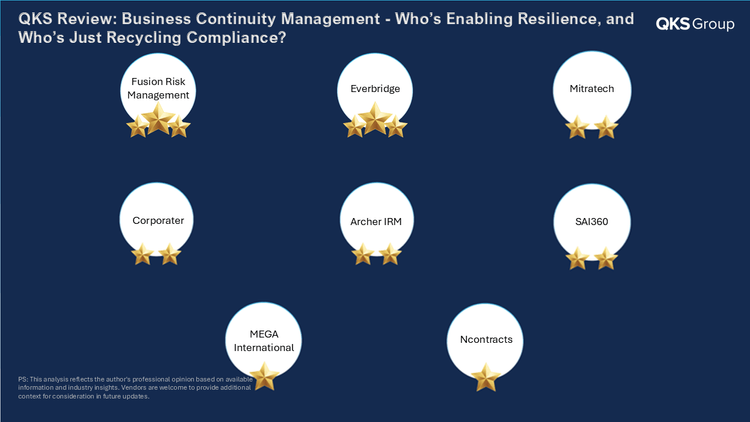
Business Continuity Management (BCM) has shifted from a compliance checkbox to an operational imperative. In an era defined by systemic disruptions, from cyberattacks to climate events, organizations need real-time resilience, not static recovery plans. This blog evaluates how key BCM vendors are evolving to meet that demand. Fusion Risk Management and Everbridge lead with platforms that integrate continuity, testing, and live response. Mitratech and Corporater are gaining ground, the former via TAP-powered automation and the latter with its performance-first GRC approach. Archer IRM and SAI360 bring legacy strength but still struggle with usability. MEGA International and Ncontracts serve distinct segments well, though their broader BCM reach is limited. Bottom line: resilience must be operationalized. Vendors that can’t deliver adaptable, intelligent, and action-ready continuity will struggle to stay relevant.
Introduction:
The Business Continuity Management (BCM) market is in flux. While the risk landscape is escalating with growing cyber incidents, rising third-party disruptions, unpredictable climate events, most business continuity tools remain frozen in pre-cloud mindsets. BCM is no longer about checking off templates or dusting off plans once a year. Executives now expect resilience to be measured, tested, and activated on demand, with automated workflows, real-time testing, crisis dashboards, and clear links to strategic outcomes. Many vendors are still delivering static recovery templates when organizations need dynamic, testable, and automatable resilience programs. Yet some platforms are finally stepping up: integrating AI, streamlining plan testing, and embedding continuity into enterprise workflows. Others, weighed down by legacy design or siloed development, are struggling to keep up. This blog explores where eight leading BCM vendors stand, who’s evolving, who’s coasting, and who’s falling behind.
Fusion Risk Management
Fusion remains the resilience leader: deeply integrated continuity with crisis and risk, real-time scenario simulation, dev-grade no-code workflows, and early generative AI assistants. It's built to be the operational backbone for BCM. Turnkey? No. Demanding? Absolutely. But large enterprises that embed continuity into everyday processes will struggle to find a more capable platform short of building in-house.
Everbridge (BC in the Cloud)
Everbridge’s integration of Infinite Blue’s planning capabilities with its industry-leading mass-notification engine offers one of the fastest paths to operational readiness at scale. Launch a plan, notify field teams, and track global response — all in real time. The platform outperforms most BCM tools in terms of speed and reach, though it lacks the deep configurability offered by solutions like Fusion. For global enterprises that prioritize rapid mobilization in critical events, Everbridge stands out as a highly execution-ready option.
Mitratech (Preparis)
Mitratech’s acquisition of Preparis Continuity Planning brought a user-friendly, pragmatic BCM solution into its broader GRC ecosystem —covering BIAs, plan testing, incident management workflows, and mass notification. What truly sets it apart, though, is the TAP Workflow Automation platform, Mitratech’s no-code engine that brings automation to continuity and crisis processes without needing a dev team. This pairing of operational simplicity with enterprise-grade process control gives Mitratech an edge in mid-market and enterprise scenarios alike. And with AI-driven enhancements under its ARIES™ roadmap, it’s not standing still. While Preparis has always delivered as a focused continuity platform, automation now powers it with backbone and real-time workflows, putting Mitratech firmly in the “rising fast” category.
Corporater
Corporater is taking a different route to redefining Business Continuity Management (BCM), not as an IT response plan, but as a strategic performance driver. Its platform lets organizations embed continuity KPIs directly into leadership dashboards, aligning preparedness with outcomes. That vision gives it strong boardroom appeal, especially for organizations tired of disconnected compliance tools. However, its operational depth in real-time testing, automated execution, alerting is still maturing. For buyers seeking a strategic-first platform and who see BCM as a leadership-level function, not just IT’s problem, Corporater is worth watching.
Archer Integrated Risk Management
Archer remains a structured and risk-aligned BCM solution, offering continuity planning, testing, and recovery workflows backed by deep enterprise risk context. Its recent AI initiatives, Assurance AI, RMIS AI, and Evolv AI, bring natural language processing, automated control mapping, and scenario analysis into the mix, setting it apart from many legacy peers. Yet despite these innovations, Archer still suffers from a dated UX and heavy configuration burden. It’s highly capable, especially for compliance-driven organizations, but for teams seeking agility and UX-driven simplicity, other platforms are evolving faster.
SAI360
SAI360 supports the full Business Continuity Management (BCM) lifecycle including BIAs, testing, incident response, and internal mass notification out of the box. Great for highly regulated sectors. Yet it's slowed by a steep learning curve, dated interfaces, and sluggish release cycles. Despite having the "complete toolkit," it rarely excites. Until it overhauls usability and execution, SAI360 risks being outpaced by platforms that prioritize speed and user experience.
MEGA International (HOPEX)
MEGA’s HOPEX platform has fully embraced AI, incorporating Hexa, a generative AI companion, and HOPEX Aquila, which supports text-to-model generation, automated data collection, and predictive analysis. This makes HOPEX one of the few BCM-adjacent platforms with genuinely integrated generative AI. MEGA continues to serve enterprises that treat continuity as part of a larger architecture strategy. However, HOPEX is still better suited for modeling and planning, not operational testing or crisis response. It excels in vision, AI, and governance but often requires pairing with executional tools for complete BCM readiness.
Ncontracts
Ncontracts delivers a robust BCM solution tailored to regulated sectors, particularly, finance. It supports automated BIAs, dependency mapping, guided plan-building, tabletop exercises, and report generation, with AI capabilities such as the Ntelligent Contracts Assistant already deployed in its broader suite. While not a full-spectrum enterprise continuity engine, its strength lies in tight execution for mid-market buyers who need results without complex deployment. It doesn’t chase hype but executes its niche exceptionally well, and it’s evolving faster than many give it credit for.
BCM Challenges and the Gaps Vendors Must Address
- Usability vs. Complexity: Some mature platforms such as Archer and SAI360, still bury power behind admin-heavy workflows and dated UX. The market increasingly wants speed and depth.
- Operational vs. Strategic Balance: Tactical tools struggle to align with enterprise performance, while strategy-first platforms often lack operational muscle.
- AI and Automation Reality Check: While everyone markets “AI,” only a few vendors are embedding generative capabilities into BCM planning and crisis simulation meaningfully.
- Time-to-Value: Buyers want continuity visibility in weeks, not quarters. Platforms that can’t deploy rapidly will fall behind.
Final Verdict: Who’s Leading, Who’s Losing Ground?
Fusion and Everbridge lead the Business Continuity Management (BCM) space with real-time, scalable platforms that turn plans into action. Mitratech and Corporater are rising fast; one through workflow accessibility, the other through strategic innovation. Archer and SAI360 still serve governance-heavy buyers well but face mounting pressure to modernize. MEGA and Ncontracts continue to thrive in focused domains but must evolve further to compete broadly.
In the next wave of BCM, visibility, automation, and adaptability will define winners. Legacy checklists won’t cut it anymore; the market demands resilience in motion.
Disclaimer:
This blog is based on independent research and publicly available information. The insights presented reflect the views of QKS Group and are for informational purposes only. While we strive for accuracy, we do not guarantee completeness or absolute correctness. Vendors are welcome to provide clarifications or updates. If any vendor listed in this analysis wishes to provide additional context or clarification, we welcome a briefing call and will consider incorporating relevant updates. This analysis is not intended to disparage any vendor but to provide an informed, balanced perspective. We encourage open and constructive dialogue to foster transparency and a deeper understanding of the industry.
Author: Sahil Dhamgaye, Analyst - Risk & Compliance at QKS Group
Vendors: