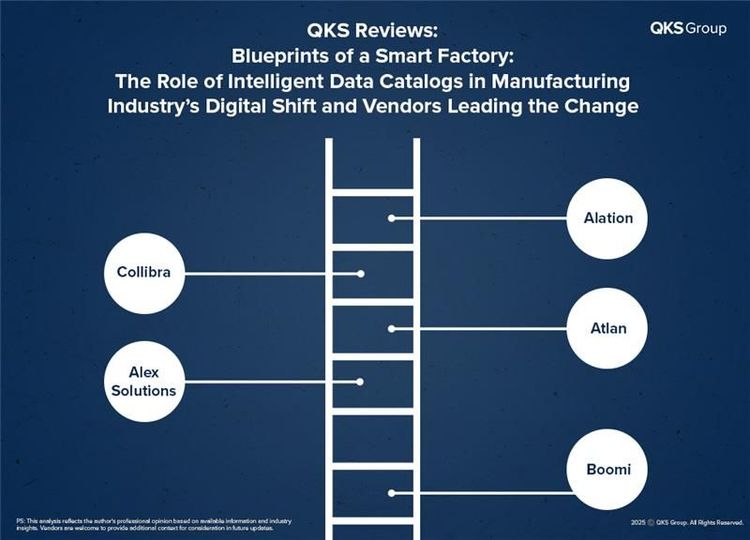
Key Platforms Driving Data Intelligence in Smart Manufacturing
The Fourth Industrial Revolution is no longer trending; it's in full maturity phase. Manufacturers have largely embraced digital platforms, linking sensors, automation, and data analytics in their processes. The agenda has shifted from testing technology to scaling smarter systems that drive efficiency, resilience, and innovation along the value chain. This is where intelligent data catalogs come in. They are not just nice-to-have tools; they are necessary for the next level of emerging manufacturing industry.
Market Landscape: Manufacturing’s Shift to Data-Driven Intelligence
Data is changing the way machines, materials, and markets work in the manufacturing industry right now. Smart factories are no longer just ideas for the future; they are things that need to happen right now. Every choice now depends on real-time, reliable, and contextualized data, from predictive maintenance to automated quality control.
However, most of these manufacturers continue to struggle with siloed systems, SCADA platforms, ERP suites, MES applications, and legacy databases that create disjointed data trails. Without a unifying layer to catalog, contextualize, and govern this data, even the most sophisticated analytics tools run on unstable ground.
Intelligent data catalogs platforms act as the nervous system of the modern factory, linking producers of data to consumers of data, tracing lineage between machines and processes, and applying governance without hindering innovation. As factories go more autonomous and AI-based, intelligent data catalogs are quickly becoming the unsung driver behind smarter, faster, and safer industrial workflows.
Alation: Human-Centered Intelligence for the Factory Floor
Alation stays ahead of the curve. With its renowned intuitive search, behavioral intelligence, and solid metadata architecture, Alation packs a serious punch in the factory setting. For manufacturing teams, this translates into faster data discovery, real-time insights into equipment or supply chain information, and enhanced cross-team collaboration.
What sets Alation apart is its ability to bridge human context with machine data. . It doesn't merely catalog metadata; it learns how users use it and provides smarter recommendations as a result. For international manufacturers coping with multiple ERPs, MES systems, and IoT pipelines, this sort of adaptive smarts is pure gold. It's no wonder that Alation continues to experience robust adoption in industries with sophisticated data ecosystems.
Collibra: Governance at Industrial Scale
Collibra excels where governance meets scale. It flourishes in harmonizing data from disparate sources while maintaining compliance and data quality paramount, essential in regulated manufacturing industries such as aerospace, automotive, and pharmaceuticals.
For large-scale digital transformation by manufacturers, Collibra provides not only cataloging but an enterprise data governance platform. Its lineage features, cloud-native flexibility, and role-based access controls make engineers as well as executives comfortable working with the data they operate on. Collibra's control and clarity focus makes it a compelling option for enterprises where accountability and auditability can't be sacrificed.
Atlan: Agile, API-First, and Built for Speed
Atlan is the rising star in this space, and for good reason. Built for contemporary distributed data teams, Atlan offers quick implementation, AI-driven metadata enrichment, and an incredibly approachable user experience. For companies that want to see a quick return on investment and be able to change their operations quickly, it gives value in weeks, not quarters.
Its open architecture and API-first design work well in hybrid settings, and its GenAI-driven assistants make it easy to trace lineage and create SQL. Atlan makes governance feel light, which is a big win in situations where time-to-value is most important, whether your company is scaling IIoT data or trying to make access more equal across business units.
Alex Solutions: Quietly Competent, Technically Robust
Alex Solutions may not command the same market spotlight as the others, but it holds its own with serious metadata muscle. With sophisticated lineage features, smart tagging, and a complete metadata model, it's a good fit for organizations that prioritize technical depth over flash.
However, it’s worth noting that Alex remains less prominent in global manufacturing deployments and ecosystem integrations Its applications are nicely designed but will take more initial investment in onboarding and customization than more agile players.
Boomi: Strong on Integration, Weaker on Catalog Depth
Boomi, long recognized for its integration prowess, offers a data catalog solution that’s serviceable, but not standout. In manufacturing environments where machine data must flow across edge devices, SCADA systems, and cloud analytics platforms, Boomi’s data prep and connectivity are strong assets.
That said, when it comes to the richness of catalog features, metadata discovery, governance workflows, AI augmentation, Boomi lags behind the curve. For organizations to advance their data practices past pipeline integration, Boomi can be the place to begin but not the strategic platform of choice for future data intelligence.
Final Take: Smart Factories Need Smart Catalogs
In the race to digitize operations and modernize supply chains, manufacturers can’t afford to let data sit in silos or remain misunderstood Intelligent data catalogs are not just organizational aids, they're becoming the foundation of next-generation manufacturing data strategy.
- Alation is the user experience and contextual intelligence leader.
- Collibra provides scalability for governance in complex, regulated operations.
- Atlan provides agility and rapid ROI with a new-generation developer-first approach
- Alex Solutions provides a solid technical foundation, if with a lesser market profile.
- Boomi remains a strong integrator, though it’s time the catalog caught up with the platform’s ambitions.
In a smart factory, all sensors, systems, and stakeholders rely on trusted, discoverable, and actionable data. The catalog you select might very well decide how smart your factory gets.
Disclaimer:
This blog is based on independent research and publicly available information. The insights presented reflect the views of QKS Group and are for informational purposes only. While we strive for accuracy, we do not guarantee completeness or absolute correctness. Vendors are welcome to provide clarifications or updates. If any vendor listed in this analysis wishes to provide additional context or clarification, we welcome a briefing call and will consider incorporating relevant updates. This analysis is not intended to disparage any vendor but to provide an informed, balanced perspective. We encourage open and constructive dialogue to foster transparency and a deeper understanding of the industry.
Author: Arun U, Analyst - Data Architecture at QKS Group
Amandeep S. Khanuja, Associate Director & Principal Analyst at QKS Group