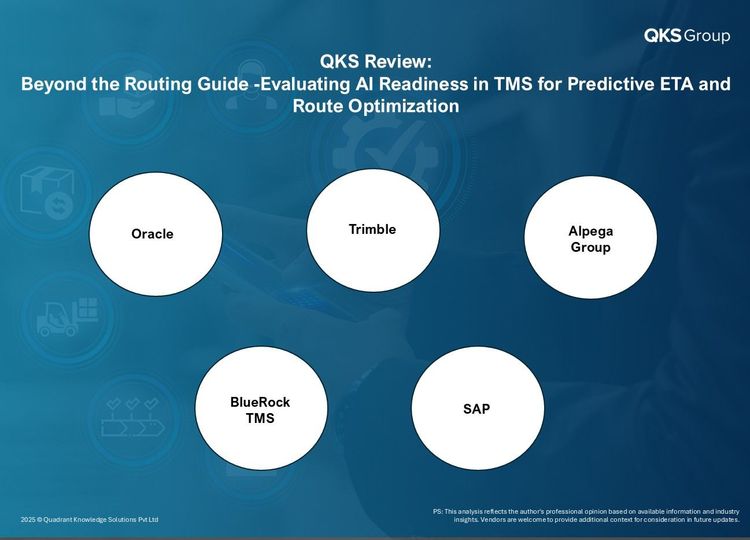
Leading the Pack: Oracle and Trimble
Oracle: Embedded Intelligence with Proven Results
Oracle Transportation Management (OTM) leads the charge with native machine learning built into its routing engine. It doesn’t just store routes, it improves them. Oracle's ML algorithms constantly learn from historical and live shipment data, enabling dynamic ETA adjustments and predictive disruption alerts. One enterprise client reported a leap in ETA accuracy. Oracle also supports automated spot bidding and re-routing suggestions, making it a truly execution-ready AI engine. While decisions are still planner-guided, Oracle has set the benchmark for embedded AI in TMS.
Trimble: Data-Rich AI, Gaining Ground Fast
Trimble’s edge lies in its connected ecosystem Transportation Management Systems (TMS), telematics, visibility (via Transporeon), and fleet intelligence all feeding its AI core. It offers predictive ETA, automated procurement, and dynamic load planning features across its platforms. The recent focus on autonomous procurement and real-time disruption alerts shows Trimble’s push toward self-optimizing transport. However, some capabilities remain distributed across acquired platforms like Kuebix or TMW, meaning execution consistency depends on deployment context. Still, Trimble’s AI momentum is undeniable.
The Middle Ground: Alpega Group and BlueRock TMS
Alpega Group: Capable AI, But Lacks Guided Execution
Alpega’s TMS includes predictive analytics for route planning, carrier scoring, and exception flagging. It supports real-time visibility integrations and dynamic forecasting. However, these capabilities are highly user-driven, buyers must configure rules, connect external data, and tune the system to their needs. It’s a flexible AI toolkit, not a prescriptive engine. For experienced teams, Alpega offers solid optimization power, but it's not turnkey for predictive logistics.
BlueRock TMS: Born Modern, Still Scaling
BlueRock TMS enters the market as a cloud-native, microservices-based platform with built-in features like real-time tracking, ETA alerts, and anomaly detection. Its AI capabilities are intuitive and fast-improving, focused on alerting rather than autonomous rerouting. While early customers praise usability and innovation speed, BlueRock hasn’t yet proven performance at global scale. The potential is clear, but enterprise buyers should test predictive accuracy and automation depth in pilot deployments.
Falling Behind: SAP
SAP: Modular Power, but AI Requires Assembly
SAP TM is robust for planning and ERP integration, but AI-driven capabilities like predictive ETA and route optimization are largely modular or third-party dependent. Real-time visibility typically comes via external networks, and SAP’s own AI toolkit sits outside the core Transportation Management Systems (TMS). While the platform can be made smart, intelligence isn't native. Buyers need additional tools, configurations, and integrations to activate AI-based decisioning. For SAP users, the road to AI is possible but not paved.
Strategic Outlook
As supply chains grow more dynamic, static planning is no longer sufficient. Buyers now demand intelligent execution Transportation Management Systems (TMS) platforms that monitor conditions, predict delays, and take action. In the future, the battleground will shift to native AI: platforms that embed predictive models, auto-adjust plans, and handle exceptions autonomously. Vendors who treat AI as a bolt-on will lag. The winners will be those who deliver real-time, execution-ready intelligence where the TMS becomes not just a planner, but a proactive logistics partner.
Disclaimer:
This blog is based on independent research and publicly available information. The insights presented reflect the views of QKS Group and are for informational purposes only. While we strive for accuracy, we do not guarantee completeness or absolute correctness. Vendors are welcome to provide clarifications or updates. If any vendor listed in this analysis wishes to provide additional context or clarification, we welcome a briefing call and will consider incorporating relevant updates. This analysis is not intended to disparage any vendor but to provide an informed, balanced perspective. We encourage open and constructive dialogue to foster transparency and a deeper understanding of the industry.
Author: Nithin Bhaskaran, Senior Analyst at QKS Group
Co-Author: Kumar Anand, Associate Director & Principal Industry Analyst at QKS Group