

25.06.2025
QKS Review
QKS Review: Beyond the Maintenance Clipboard: Navigating the EAM Maturity Staircase
Author:
Akaash R


Executive Summary:
As the Enterprise Asset Management (EAM) market faces rising pressure from bold vendor claims of AI-driven insights, persistent reactive maintenance cycles, and the gap between marketing hype and operational reality, organizations are moving beyond traditional spreadsheet-based tools.
This review blog by QKS Group assesses whether EAM vendors are truly innovating to meet these demands - or merely making incremental updates.
What Modern Enterprise Asset Management Systems Should Deliver:
Today’s platforms must offer more than basic work order digitization. Critical next-gen capabilities include:
- AI-powered predictive analytics and IoT integration for proactive maintenance and real-time insights
- Comprehensive asset lifecycle management with seamless ERP and system integrations for standardized processes
- Strategic tools for organizational readiness, change management, and measurable business outcomes beyond technical features
Key Findings:
Leading vendors (Pragma On Key, IBM Maximo, SAP EAM) stand out with comprehensive, enterprise-grade solutions that enable strategic asset optimization and proven scalability.
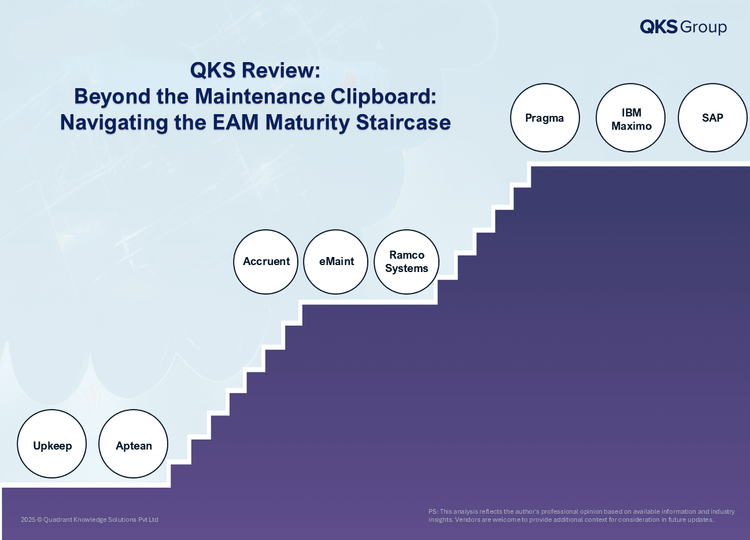
Capable vendors (Accruent, eMaint, Ramco) show promise in niche areas like compliance and integration but lack full strategic depth.
Lagging vendors (UpKeep, Aptean) remain focused on outdated foundational approaches and risk losing relevance as enterprises demand mature EAM excellence.
The Enterprise Asset Management market has witnessed an unprecedented surge in vendor claims about "next-generation" capabilities, AI-powered insights, and digital transformation outcomes. Yet beneath the marketing veneer lies a more sobering reality: most organizations remain trapped in reactive maintenance cycles, struggling to extract genuine business value from their EAM investments. This analysis examines the stark divide between vendor promises and operational realities, using the metaphor of a maturity staircase to illustrate where different solutions deliver measurable results.
The EAM Hype Cycle: Digital Promises Meet Operational Reality
The current wave of EAM evangelism mirrors the predictive maintenance hype we've witnessed across asset-intensive industries. Vendors routinely promise "47% reduction in unplanned downtime" and "26% productivity improvements" without acknowledging the fundamental prerequisite: organizational readiness to climb beyond spreadsheet-based maintenance management.
The market reality reveals a troubling gap between aspiration and execution. While vendors showcase sophisticated dashboards and AI-powered analytics, many prospects lack the basic data hygiene necessary to support such advanced capabilities. This disconnect creates a dangerous cycle where organizations purchase enterprise-grade solutions to solve foundational problems, inevitably leading to underutilization and disillusionment.
The Foundation: Where Most Organizations Actually Begin
The bottom rungs of our Enterprise Asset Management (EAM) maturity staircase represent the harsh reality of where most maintenance operations start chaotic, reactive, and largely manual processes. Organizations at this level typically rely on spreadsheets, paper-based work orders, and tribal knowledge to manage critical assets.
UpKeep exemplifies the foundational digitization approach, offering mobile-first CMMS capabilities that excel at getting technicians away from clipboards. With hundreds of thousands of users globally, UpKeep has successfully addressed the immediate pain point of work order digitization. However, our analysis reveals that while UpKeep delivers on its core promise of mobile accessibility, it operates primarily as a sophisticated work order system rather than a comprehensive asset strategy platform. The vendor's strength lies in user adoption and ease of deployment, making it suitable for organizations seeking to establish basic maintenance workflows without the complexity of enterprise EAM functionality.
Aptean EAM represents another foundational approach, launched in 2022 as a cloud-based solution specifically targeting manufacturing organizations. Aptean's TabWare edition focuses on streamlining work requests and approval workflows, offering browser-based accessibility and automated notifications. While Aptean provides solid CMMS functionality with configurable dashboards and analytics capabilities, our evaluation suggests it lacks the asset lifecycle depth required for strategic maintenance programs. The solution serves best as a stepping stone for manufacturers transitioning from paper-based processes to digital workflows.
The Middle Ascent: Integration and Standardization Challenges
The middle section of our maturity staircase represents perhaps the most critical and most overlooked phase of Enterprise Asset Management (EAM) evolution: the transition from reactive digitization to proactive asset management. Organizations at this level face the complex challenge of integrating disparate systems while building standardized processes across multiple sites.
Accruent positions itself squarely in this middle tier with its Maintenance Connection CMMS and comprehensive EAM suite. The vendor's strength lies in compliance management and document integration, making it particularly valuable for highly regulated industries. Accruent's EAM + IoT suite combines maintenance management with engineering document management and remote monitoring capabilities. However, our assessment indicates that while Accruent excels at process standardization and compliance tracking, it requires significant implementation expertise to realize its full potential.
eMaint, now part of Fluke Corporation, operates in this middle space with a focus on IIoT integration and global multi-site capabilities. With over 150,000 users across 116 countries, eMaint has established itself as a reliable platform for organizations seeking to bridge basic CMMS functionality with predictive maintenance capabilities. The vendor's integration with Fluke's IIoT sensors provides a pathway toward condition-based maintenance, though success requires substantial investment in sensor infrastructure and data analytics expertise.
Ramco Systems Ramco EAM , with its ERP-integrated approach, leverages advanced AI/ML capabilities to deliver comprehensive asset lifecycle management across industries such as industrial machinery, facilities management, power generation, manufacturing, and fleet management. Its platform stands out for offering GIS integration and robust mobile field service capabilities, enhancing efficiency and enabling data-driven decision-making within a unified business system.
While implementation of Ramco EAM can involve complexity, Ramco tackles this with a nimble partnership philosophy, providing clients with a holistic transformation experience. This includes consultative selling, guided product implementation, and ongoing multi-year support to ensure a smooth transition and sustained success.
Importantly, Ramco EAM is available as a standalone solution. Organizations do not need to purchase the entire Ramco ERP suite to benefit from its asset management capabilities, making it a flexible choice for both end-to-end ERP environments and pure-play EAM initiatives.
The Summit: Strategic Asset Lifecycle Excellence
At the apex of our EAM maturity staircase, we find solutions that enable true strategic asset management—where maintenance decisions directly drive business value and long-term operational optimization. This summit level demands more than software functionality; it requires deep industry expertise, proven methodologies, and the capability to transform organizational culture around asset reliability.
Pragma's On Key platform exemplifies this summit approach through its comprehensive EAMaaS+ offering. What distinguishes Pragma from other vendors is its integration of consulting expertise with technology deployment. The platform manages over 1.8 million maintenance items globally across more than 5,000 users, demonstrating proven scalability in complex, multi-site environments. Pragma's intelligent asset hierarchy and configurable maintenance planning capabilities enable organizations to standardize asset strategies while accommodating site-specific requirements.
The vendor's approach extends beyond software licensing to include comprehensive change management support, asset management maturity assessments, and ongoing optimization services. This consulting-led methodology addresses the fundamental challenge that has plagued EAM implementations: the gap between technology capability and organizational readiness. Pragma's client portfolio, including multinational manufacturers like Tetra Pak and healthcare networks spanning multiple countries, demonstrates the platform's capability to support enterprise-scale asset strategies.
Pragma's technical architecture supports both cloud and on-premises deployment with robust API capabilities for industrial software integration. The platform's offline mobile functionality and multi-language support enable global maintenance standardization while accommodating local operational requirements. Most significantly, Pragma's asset information management capabilities and procurement integration enable organizations to align maintenance activities with financial planning and capital asset strategies.
IBM Maximo sits at the top tier of the EAM landscape, recognized for its comprehensive asset lifecycle management and deep industry expertise. The platform, now delivered as IBM Maximo Application Suite (MAS), leverages watsonx™ AI, advanced analytics, and IoT integration to enable predictive maintenance, real-time insights, and optimized resource allocation, making it a preferred choice for asset-intensive sectors such as utilities, oil & gas, and manufacturing.
MAS is offered through three SaaS editions, Essentials, Standard, and Premium, each tailored for varying degrees of customization and complexity. The Essentials edition provides rapid adoption with limited customization, including streamlined modules like Maximo Manage, Health, Mobile, and AI-powered visual inspections. The Standard and Premium editions offer greater configurability, single-tenant control, and flexible upgrade scheduling for more complex operational needs.
Key benefits of MAS SaaS include managed services (provisioning, installation, security), a consumption-based licensing model (AppPoints) that scales with usage, cloud agility for faster feature access, and robust security and compliance frameworks. These cloud-native features reduce infrastructure overhead and enable IT teams to focus on strategic initiatives, while still accessing modern AI, mobile, and advanced analytic functionalities.
However, the platform’s breadth and depth come with notable challenges. Implementations can be complex and resource-intensive, requiring specialized expertise and strong organizational commitment. The richness of Maximo’s capabilities may also introduce a steep learning curve for new users, and the total cost of ownership can be significant, particularly for smaller enterprises.
Despite these hurdles, Maximo remains a benchmark in strategic asset management, offering unmatched scalability, integration flexibility, and functional depth for enterprises aiming to maximize asset reliability and operational efficiency across large-scale, mission-critical environments.
SAP EAM is designed for large, complex enterprises seeking tightly integrated asset management within an ERP ecosystem. The solution excels at supporting preventive, corrective, and predictive maintenance across diverse asset hierarchies, leveraging AI, IoT, and advanced analytics to enable data-driven decision-making and real-time performance monitoring. SAP EAM’s seamless integration with core SAP modules, such as finance, procurement, and supply chain, enables organizations to align maintenance activities with broader business objectives and regulatory requirements. The platform offers industry-specific solutions and supports both cloud and on-premises deployments, providing flexibility for global operations. However, SAP EAM’s extensive functionality can result in complex implementations, especially when integrating with existing ERP landscapes, and may require significant customization and internal resources to fully realize its benefits. The solution is best suited for organizations with mature IT environments and the capacity to manage the intricacies of enterprise-wide asset management, rather than those seeking a standalone or lightweight EAM system.
They provide comprehensive implementation methodologies, proven change management approaches, and ongoing optimization support. These vendors understand that EAM success depends as much on organizational transformation as technical capability.
What Buyers Should Demand from EAM Vendors
The Enterprise Asset Management (EAM) market’s maturity demands more sophisticated vendor evaluation criteria beyond feature comparisons and cost analyses. Buyers should prioritize vendors that demonstrate proven implementation methodologies, provide comprehensive change management support, and offer measurable business outcomes rather than technical specifications.
Successful EAM initiatives require vendors who understand the operational realities of asset-intensive industries and can bridge the gap between technological capability and organizational readiness. The summit of our EAM maturity staircase represents not just advanced software functionality, but the convergence of technology, expertise, and proven methodologies that enable sustainable asset management transformation.
The choice between vendors should ultimately depend on your organization's current position on the maturity staircase and your commitment to the comprehensive change management required to reach strategic asset management excellence. Only then can the promises of improved asset performance, reduced maintenance costs, and enhanced operational reliability become measurable business realities rather than marketing aspirations.
Disclaimer:
This blog is based on independent research and publicly available information. The insights presented reflect the views of QKS Group and are for informational purposes only. While we strive for accuracy, we do not guarantee completeness or absolute correctness. Vendors are welcome to provide clarifications or updates. If any vendor listed in this analysis wishes to provide additional context or clarification, we welcome a briefing call and will consider incorporating relevant updates. This analysis is not intended to disparage any vendor but to provide an informed, balanced perspective. We encourage open and constructive dialogue to foster transparency and a deeper understanding of the industry.
Author: Akaash R, Senior Analyst at QKS Group
Vendors: