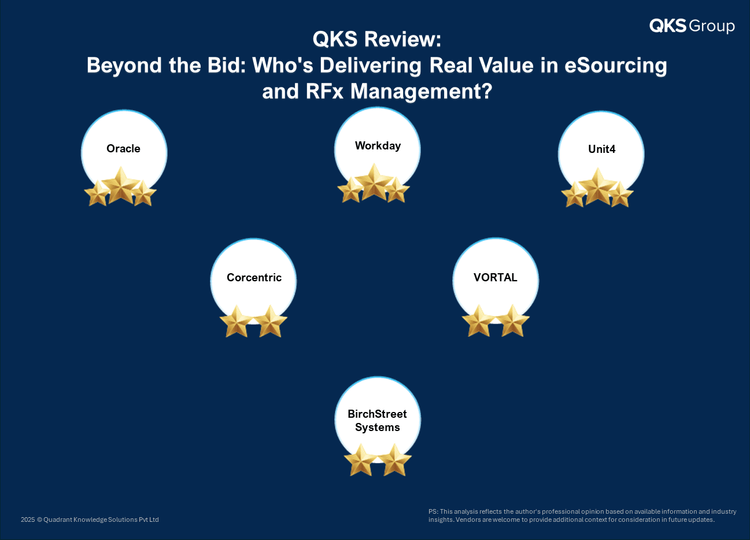
Strategic sourcing has evolved, but vendor capability maturity has not kept pace evenly. While some vendors deliver advanced functionality such as AI-assisted bid creation, auction flexibility, and deep optimization modeling, others merely support the essentials. There's a clear divide between platforms built for modern sourcing operations and those retrofitted to tick boxes. This review focuses on who’s actually solving problems and who’s just patching them.
Leading with Purpose and Precision
Oracle: Engineering Intelligence into Every Negotiation
Oracle's Fusion Cloud Sourcing stands out for its technical depth and product maturity. The platform supports guided negotiation creation, reusable templates, and multi-stage RFx with embedded analytics that enable smarter award decisions. One of the biggest differentiators is its use of generative AI to automate supplier recommendations and draft negotiation summaries capabilities that reduce manual effort and accelerate outcomes. Oracle also supports structured collaboration with internal stakeholders and external suppliers through team scoring, messaging, and surrogate bidding. While it lacks niche auction types like Dutch or Japanese formats, its robust optimization and analytics tools, combined with tight integration across Oracle's procurement suite, make it a best-in-class solution for global enterprises managing complex sourcing operations at scale.
Workday: Elevating Sourcing with Collaboration, Not Complexity
Workday Strategic Sourcing (formerly Scout RFP) has earned its position by prioritizing usability, adoption, and stakeholder collaboration. Designed to streamline the intake and execution of sourcing events, it simplifies the RFx lifecycle with templates, guided workflows, and automated routing. The system’s ability to consolidate project requests, align with business units, and track pipeline progress through dashboards makes it highly valuable for organizations prioritizing alignment and agility. Workday supports reverse auctions and bid comparisons, with a clean and intuitive UI that enables non-procurement stakeholders to participate in supplier evaluation. While it does not emphasize AI or optimization features, its strength lies in making sourcing accessible and impactful across departments, a crucial factor for enterprise-wide engagement.
Unit4 (Scanmarket): Auction Agility with Enterprise-Ready Depth
Unit4’s acquisition of Scanmarket has injected a high level of sourcing sophistication into its portfolio. The platform delivers advanced capabilities such as multiple auction types (reverse, Dutch, Japanese), configurable bidding rules, and dynamic lot-based bidding formats (Cherry Picking, CherryLot, etc.). This breadth gives procurement teams unmatched flexibility in negotiation strategy. Unit4 also supports collaborative scoring, scenario modeling, and automated bid analysis, allowing multiple stakeholders to score independently while preserving transparency. The analytics suite includes instant dashboards, configurable reporting, and historical event tracking. Its sourcing platform is not only highly customizable but also intuitive, a rare balance that helps reduce cycle time and drive higher adoption across enterprises. Unit4 stands out for enabling tactical and strategic control with equal strength.
Functional, But Falling Short of Strategic
Corcentric: Legacy Optimization with an Eye on AI
Corcentric brings sourcing experience and optimization depth inherited from its Determine Inc. acquisition. The platform covers a wide range of sourcing formats including RFI, RFP, RFQ, and auction management with reusable templates and automated workflows. It offers solid bid analysis, with support for constraint-based scenario modeling that helps optimize awards across pricing, risk, and supplier performance variables. However, its progress toward AI-driven sourcing remains aspirational. While Corcentric promotes its AI vision for RFx generation and supplier intelligence, many of these capabilities are not fully embedded in the sourcing workflow yet. Additionally, the platform’s user interface and auction configurations remain less modern than top-tier competitors. Corcentric’s strength lies in mature core functions, but its market leadership depends on whether it can successfully modernize and operationalize its AI ambitions.
VORTAL: Tail-Spend Efficiency, Not Enterprise Strategy
VORTAL’s sourcing suite is focused on quick execution for tail-spend and public-sector events. The platform enables fast RFx setup, reverse auctions, and basic bid evaluation through preconfigured templates. Its value lies in volume efficiency, which allows organizations to conduct more sourcing events with fewer resources. However, VORTAL lacks the strategic tooling required for high-stakes enterprise sourcing: there is minimal use of AI, no robust optimization engine, and limited support for multi-dimensional supplier analysis. Collaboration and configurability are adequate, but not standout. VORTAL is well-suited for cost-focused environments and tactical savings, but its feature set does not yet support complex sourcing strategies or enterprise-scale governance.
Niche Fit, but Not Built to Lead
BirchStreet Systems: Industry-Aligned, But Capability-Light
BirchStreet Systems caters primarily to the hospitality sector, and its eSourcing functionality reflects this specialization. It offers reverse auctions, standard RFx templates, and automated bid scoring for high-frequency procurement categories. The sourcing module integrates with BirchStreet’s broader P2P suite, making it convenient for existing users to manage purchasing and sourcing from a single interface. However, it lacks key elements expected in modern sourcing platforms: no support for advanced auction types, no AI-driven automation, and only limited analytics for bid evaluation. Customization and scenario modeling capabilities are also limited. For organizations operating outside hospitality or seeking a standalone sourcing tool, BirchStreet’s offering may feel insufficiently robust or forward-looking. The solution serves its purpose in structured, volume-based sourcing environments, but outside that niche, it struggles to justify itself as a standalone sourcing engine.
Conclusion: From Feature to Function
Sourcing teams today don’t need more features they need outcomes. Whether it’s reducing negotiation cycles, automating event setup, or making supplier decisions with confidence, the value lies in execution. Oracle, Workday, and Unit4 are enabling that execution through configurability, collaboration, and specialization. Others like Corcentric and VORTAL are improving, but still constrained by legacy decisions. BirchStreet Systems, while useful within its vertical, lacks the reach or ambition to compete head-on.
Disclaimer:
This blog is based on independent research and publicly available information. The insights presented reflect the views of QKS Group and are for informational purposes only. While we strive for accuracy, we do not guarantee completeness or absolute correctness. Vendors are welcome to provide clarifications or updates. If any vendor listed in this analysis wishes to provide additional context or clarification, we welcome a briefing call and will consider incorporating relevant updates. This analysis is not intended to disparage any vendor but to provide an informed, balanced perspective. We encourage open and constructive dialogue to foster transparency and a deeper understanding of the industry.
Author: Vishal Poduri, Analyst at QKS Group