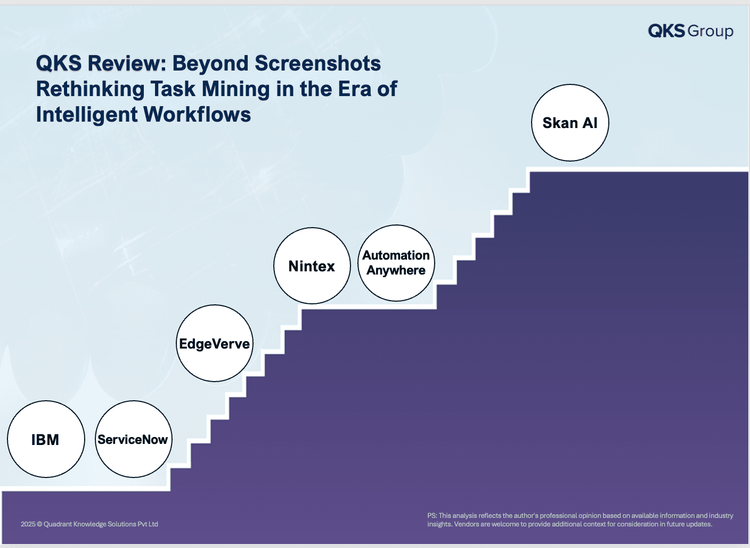
QKS Group evaluates six vendors, in this analysis, including Skan AI, Nintex, Automation Anywhere, EdgeVerve, ServiceNow, and IBM, based on platform maturity, AI proficiency, behavioural intelligence and alignment to enterprise transformation ambitions. Every vendor is measured not only by what it offers today but by the direction it's taking to support the requirements of tomorrow’s enetrprise needs.
- Skan.ai emerges as a GenAI-native innovator, redefining task intelligence with its cognitive modelling of digital work and zero-integration design.
- Nintex demonstrates strong low-code credentials, but must better integrate task mining into its core platform strategy to unlock greater automation synergy.
- Automation Anywhere is in transition, merging early discovery tools with enterprise-grade capabilities, yet clarity in the roadmap and GenAI deployment will be critical.
- EdgeVerve continues to excel in operational consistency but risks falling behind without a bolder AI strategy and improved user-centric design.
- ServiceNow, while strong in IT workflows, must extend its vision to support cross-functional use cases that reflect broader enterprise process realities.
- IBM offers deep capabilities across its automation portfolio, but lacks cohesion in task mining, which limits its ability to deliver unified, actionable intelligence.
Across the board, the next frontier of task mining is no longer about what happened, but about what should happen next, a leap from observation to orchestration. Enterprise buyers now expect:
- GenAI copilots that trigger next-best actions.
- Integrated simulation models to optimize workforce design.
- Task-to-process linkage that informs real-time decisioning.
- Explainable and actionable intelligence across hybrid work environments.
The gap between pioneers and laggards is growing. Vendors that treat task mining as a strategic discipline, deeply embedded in their orchestration, RPA, and decisioning layers, are laying the foundation for truly intelligent operations. Those that continue to treat it as a feature add-on risk commoditization and customer disengagement. As task mining matures into a pillar of enterprise intelligence, the focus must now shift to operationalization at scale: how to turn granular user behaviour into system-level transformation without disrupting the workforce or existing IT investments. For platform providers, this is a defining moment. For enterprise buyers, it is a call to elevate expectations.
Skan AI - Redefining Task Mining Through Cognitive Work Intelligence
Skan.ai brings a transformative perspective to task mining, powered by its patented approach to building a Digital Twin of Human Work™. Rather than relying on conventional keystroke capture or rigid screen-level telemetry, Skan creates a cognitive model of enterprise work by continuously observing digital interactions across applications, teams, and systems. At the heart of Skan’s platform is its GenAI-native architecture, which enables the system to synthesize fragmented, unstructured work patterns into coherent, business-readable narratives. These insights are then used to inform decision-making, surface automation potential, and uncover friction in even the most exception-heavy, knowledge-driven workflows. Skan’s zero-integration, system-agnostic design makes it especially suited for modern enterprises dealing with hybrid workforces, high compliance standards, and legacy-plus-cloud environments.
By abstracting context from raw behaviour and offering dynamic, role-specific insights, Skan empowers transformation leaders with a real-time, scalable view of how work actually happens, without disrupting the business. Skan is not simply building features, it is shaping the language of modern task intelligence. This rich data foundation is training the next generation of AI agents that will work alongside humans more intelligently. Its vision, architecture, and enterprise traction collectively place it among the most forward-looking vendors in this category.
Nintex - Platform Strength, Task Mining Still Finding Its Place
Nintex continues to be a respected leader in the low-code automation space, delivering robust solutions for workflow design, digital forms, and document generation. The platform is highly regarded for its usability, Microsoft ecosystem alignment, and overall time-to-value. However, when it comes to task mining, the story is less mature. While the capability exists, it has yet to become a visible centrepiece of the Nintex platform strategy. There is an untapped potential, including the opportunity to bring task-level insights into tighter integration with the workflow builder, embed GenAI-based behavioural modelling, and offer a more prescriptive automation path. At present, the task mining function appears more adjacent than embedded, functionally sound, but not deeply synergized with the rest of the automation lifecycle.
The GenAI vision remains abstract, and task behaviour modelling lacks the sophistication seen in newer players. As organizations look for task intelligence that fuels orchestration and decision augmentation, Nintex will need to define a stronger roadmap. With a strong heritage and an extensive enterprise customer base, Nintex is well-positioned to make task mining a more proactive, first-class capability. The opportunity is clear, the execution needs clarity and commitment.
Automation Anywhere - Steady Progress Amidst Platform Evolution
Automation Anywhere’s journey in task mining reflects both early ambition and evolving maturity. As one of the first RPA players to integrate task discovery through Discovery Bot, the company quickly recognized the value of user-level insights in automation design. Its acquisition of FortressIQ marked a deliberate shift toward a more scalable and enterprise-grade offering. The newly unified, cloud-native platform has introduced enhanced visibility, real-time analytics, and AI-infused capabilities, but the transformation has required ongoing calibration. Customers navigating from legacy tooling to the new task mining suite have at times encountered challenges related to roadmap clarity, feature readiness, and consistent GenAI deployment. Yet, the promise remains strong. Automation Anywhere’s integration with Automation 360 and its focus on closed-loop process intelligence create a compelling foundation. However, to fully realize that vision, the company must bridge the gap between platform capability and user accessibility. Task mining cannot remain a partially unlocked potential; it must mature into a frictionless and insight-rich capability that accelerates automation outcomes.
EdgeVerve - Operationally Proven, Yet Strategically Conservative
EdgeVerve’s AssistEdge Discover has built a reputation as a dependable solution in structured, high-volume operations, particularly in BFSI, telecom, and shared services. Its contributions to task capture, compliance tracking, and performance optimization within the Infosys ecosystem are commendable. However, in today’s rapidly shifting market dynamics, operational resilience alone is no longer sufficient. While AssistEdge Discover provides a structured framework for discovery, it has yet to reflect a transformative leap in AI-native evolution or business-user-centric design. Compared to emerging leaders that are embedding GenAI, conversational guidance, and behavioural intelligence into their platforms, EdgeVerve appears measured in its innovation cadence.
The architecture remains anchored in conventional models of task interpretation, effective for compliance-driven use cases, but less adaptive for dynamic, knowledge-intensive, or exception-heavy workflows. Moreover, low-code accessibility and intuitive visualization, hallmarks of modern enterprise platforms, remain areas for meaningful improvement. EdgeVerve has demonstrated strength in execution and discipline in delivery. Yet, if it seeks to elevate from a service-aligned toolset to a platform that drives enterprise intelligence, it must rethink its position in the task mining market. Strategic boldness, not just procedural reliability, will define its future relevance.
ServiceNow - Strength in IT Workflows, Room to Expand Enterprise Reach
ServiceNow’s task-level capabilities are rooted in IT service management, where the platform delivers strong value by analyzing support agent productivity, accelerating incident resolution, and optimizing service desk operations. These functions are tightly integrated with the Now Platform and enhance outcomes in IT-centric environments. However, as enterprises increasingly seek cross-functional process intelligence, ServiceNow's task mining strategy remains relatively focused on IT workflows. While its GenAI investments are advancing in areas like chat summarization and document intelligence, broader applications across finance, HR, or customer operations are still evolving. With its platform strength and enterprise footprint, ServiceNow is well-positioned to scale beyond IT and into end-to-end work intelligence. As use cases diversify, expanding behavioural modelling and task analysis into adjacent business domains will be key to unlocking their full potential.
IBM - Capable Portfolio, Disconnected Experience
IBM brings to the table a vast automation portfolio, spanning process modelling, process mining (via myInvenio), decision automation, and RPA. The suite offers the flexibility and power expected from a global enterprise technology leader. That said, task mining as a discrete capability is not a central focus within IBM’s current approach. Rather than offering a dedicated, standalone task intelligence product, IBM surfaces task-level insights through extensions of its existing automation tools. This limits its ability to deliver real-time behavioural intelligence across varied workflows. Yet, the pieces are all there. With stronger integration, simplified user experience, and clearer messaging around task-level visibility, IBM has the foundation to build a more unified view of digital work. As enterprise clients seek precision insights across both structured and unstructured work, this could be a timely next move.
The Road Ahead: Where the Market Is Headed
To lead the next wave of enterprise automation, task mining platforms must evolve from diagnostic to prescriptive isolated recordings to intelligent orchestration triggers. Buyers now expect:
- GenAI copilots that contextualize behaviour and trigger actions
- Embedded simulation engines to model workforce interactions
- Tight integration with RPA, DPA, and decisioning hubs
- Rich task-level metadata for performance benchmarking and compliance
Today's task mining landscape reveals a growing divide: vendors who treat it as a strategic discipline are building platforms that align with business outcomes. Others, still viewing it as a technical feature or RPA accessory, are falling behind.
The coming phase will separate visionaries from laggards, not just based on features, but on their ability to embed task intelligence into the broader business fabric. Enterprise leaders are no longer asking if they need task mining; they're asking how to operationalize it across distributed teams, fragmented systems, and evolving service models. The winners in this market will be those who understand that task mining is not merely about the visibility of transformation.
They will build platforms that drive continuous improvement, not one-time discovery. They will deliver intelligence that supports not just automation, but human-centric workflows. And they will embrace AI not as a layer, but as the language through which work is reimagined.
Vendors that fail to meet this bar may still serve as tactical enablers-but they risk irrelevance in a market shifting toward intelligence-first design. In contrast, those that move swiftly to align their roadmaps with enterprise-scale priorities-interoperability, explainability, adaptability, and speed-will lead the evolution of task mining into a foundational pillar of intelligent business operations.
Disclaimer:
This blog is based on independent research and publicly available information. The insights presented reflect the views of QKS Group and are for informational purposes only. While we strive for accuracy, we do not guarantee completeness or absolute correctness. Vendors are welcome to provide clarifications or updates. If any vendor listed in this analysis wishes to provide additional context or clarification, we welcome a briefing call and will consider incorporating relevant updates. This analysis is not intended to disparage any vendor but to provide an informed, balanced perspective. We encourage open and constructive dialogue to foster transparency and a deeper understanding of the industry.
Author: Pranjal Singh, Principal Industry Analyst at QKS Group