Introduction:
Unified Communications as a Service (UCaaS) has evolved well beyond its initial role as a cloud-based PBX alternative. Today, it serves as a foundational layer for enterprise communication infrastructure, integrating voice calling, video conferencing, messaging, mobility, presence detection, device interoperability and more, into a single platform delivered over the cloud. As organizations diversify across geographies and hybrid work environments gains prevalence, UCaaS plays a pivotal role in ensuring continuity, scalability, and centralized administration. It also enables IT teams to streamline costs, reduce on-premises dependency, and adopt a more agile operational posture aligned with modern digital transformation goals.
As the current workplaces evolve beyond conventional communication, collaboration capabilities have become a critical differentiator within UCaaS offerings. Users now seek solutions that move beyond facilitating meetings or managing voice traffic, they expect environments where teams can brainstorm in real time, share and co-edit documents seamlessly, track conversations across asynchronous channels, and capture institutional knowledge without disruption. In this landscape, collaboration is no longer a feature set but a strategic enabler of productivity and decision-making. The ability to support diverse work styles across departments, time zones, and workflows has become the key to how these platforms are evaluated. Unified Communications as a Service (UCaaS) solutions that embed collaboration natively, rather than bolting it on, are increasingly seen as critical infrastructure for modern digital workplaces.
The Collaboration Advantage: Why It’s More Than Just Meetings:
At the core of today’s UCaaS environments lies a set of baseline collaboration functionalities that are rapidly evolving into foundational requirements. Capabilities such as content sharing, real-time screen sharing, and basic team messaging have become universal expectations, enabling seamless information flow during meetings and asynchronous conversations. Presence status, once considered a utility feature, now plays a pivotal role in coordinating distributed teams. Similarly, real-time whiteboarding and integrated call recordings are no longer limited to specialized use cases. They have becoming central to workflows that demand visual communication and auditability. While these features are broadly available across vendors, the differentiation often lies in their implementation depth on how naturally they integrate with the user’s workflow, how secure and searchable the data is post-session, and whether they are natively embedded or delivered through patchwork integrations.
Beyond these foundational offerings, many new advanced collaboration capabilities are emerging, ones that are redefining the competitive landscape. AI-driven assistants are being leveraged to automate mundane meeting tasks such as note-taking, action tracking, and contextual reminders. Real-time co-editing and transcription are enabling knowledge capture to occur as discussions unfold, not after the fact. Features like meeting summarization and in-meeting translation (often spanning dozens of languages) are broadening inclusivity while reducing post-meeting overhead. Meanwhile, video messaging and polling functionalities are enhancing engagement in hybrid and asynchronous settings, while emerging capabilities like quizzes and AR-based experiences are gaining traction in training heavy or design-oriented use cases. The true value of these offerings lies not just in their presence, but in their maturity, usability, and ability to adapt to a variety of enterprise collaboration patterns across industries and team sizes.
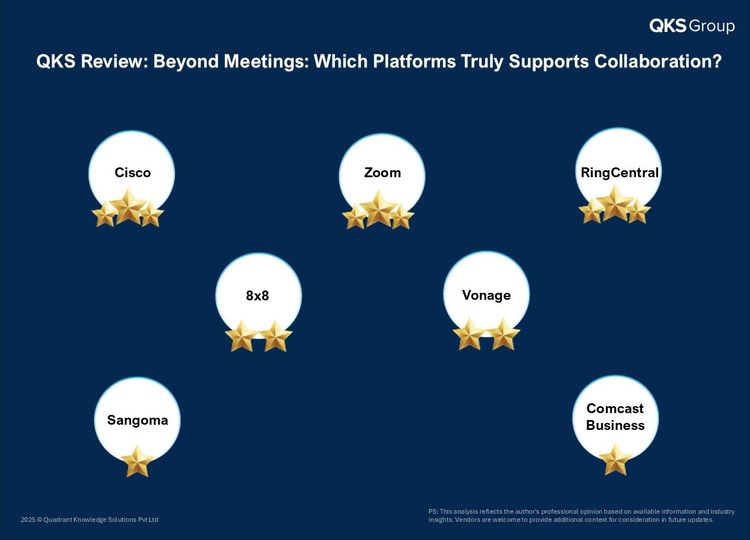
Leaders: Webex by Cisco, Zoom, and RingCentral
Webex continues to demonstrate a robust and well-integrated collaboration portfolio, enhancing its position as a leader in the UCaaS space. Its strength lies in offering a comprehensive suite of mature offerings across collaboration including team messaging, content sharing and storage, presence technology, screen sharing, and call recording, all of which are not only well-developed but deeply embedded into its broader Webex ecosystem. Notably, capabilities like whiteboarding and in-meeting transcription are natively supported with some refinements, including native transcription in five languages and an add-on for over a hundred more, reflecting a scalable multilingual strategy. Cisco’s AI Assistant and meeting summarization capabilities show considerable maturity, indicating a strategic focus on productivity augmentation through intelligent automation. While Webex lacks a proprietary office editor for real-time co-editing, it advances immersive collaboration through innovations like Cisco Spatial Meetings, a 3D, depth-rich meeting experience for Apple Vision Pro powered by Cisco’s AI-enabled video devices to render participants and objects with striking realism. Overall, Webex’s portfolio reflects a deliberate convergence of mature foundational tools with advanced experiential features, tailored to meet both enterprise-grade needs and evolving user expectations.
Zoom Workplace maintains its leadership position in the UCaaS market through a consistently evolving and user-centric suite that spans both essential and advanced capabilities. Foundational tools such as content sharing, call recording, presence technology, transcription, and polling are delivered at a high level of maturity, ensuring that Zoom remains dependable for a wide range of business communication needs. Zoom’s real-time co-editing (via Zoom Docs) and AI assistant capabilities are particularly well-integrated, streamlining productivity within meetings and asynchronous workflows. While features like whiteboarding offer up to three concurrently editable boards, indicating a semi-mature state, they are functionally mature enough to meet the needs of most collaborative use cases. Team messaging, although semi-mature, benefits from tight integration with Zoom's broader meeting and scheduling functionalities. On the innovation front, Zoom delivers AI-powered noise cancellation and sophisticated meeting summarization, both contributing to cognitive ease for users. Video messaging is natively supported and well-aligned with evolving user needs, whereas quiz-based interactions rely more on integrations, reflecting a gap in native learning-centric engagement. AR-based features remain basic and exploratory. Overall, Zoom’s collaboration stack strikes a balance between operational completeness and new enhancements, making it a compelling choice for organizations seeking both maturity and innovation in unified communications.
RingCentral’s collaboration capabilities reflect a strong emphasis on core functionalities and messaging centric integration, positioning it as a robust UCaaS provider. The platform delivers mature execution across foundational pillars such as content sharing, call recording, presence technology, screen sharing, and transcription. Notably, its team messaging stands out with built-in task tracking, allowing contextual collaboration to extend beyond messaging into nascent project workflows, a differentiator in the crowded UCaaS space. While real-time co-editing remains mediocre due to the absence of a proprietary office suite like most, RingCentral mitigates this with collaborative note-taking features embedded in meetings. Advanced capabilities such as AI assistants, noise cancellation, and meeting summarization are well-integrated, contributing to more focused and intelligent interactions. However, in-meeting translation while transcription-based is limited to three native languages, suggesting a narrower linguistic reach compared to peers like Zoom or Cisco. The absence of native quizzes and video messaging capabilities reflects a small gap in informal and training engagements. AR overlays signal early-stage experimentation, hinting at future immersive collaboration potential. Overall, RingCentral demonstrates a high degree of operational maturity while showing selective innovation, particularly in converging messaging with workflow utilities.
Adopters: 8x8 & Vonage
8x8’s collaboration capabilities, delivered through its Unified Communications as a Service (UCaaS) platform 8x8 Work, reflects a balanced approach that caters effectively to foundational workplace communication needs. Core features such as content sharing, screen sharing, presence detection, call recording, and transcription are mature and reliable, supporting a consistent user experience across distributed teams. The platform also includes team messaging and meeting summarization, helping users streamline interactions and maintain continuity across workflows. Notably, its whiteboarding functionality supports up to 25 participants sufficient for many SMB use cases and select mid-market scenarios. While several capabilities are fully realized, others are implemented with a more conservative scope, reflecting 8x8’s measured approach to innovation in advanced collaboration. Real-time co-editing and AI assistant functionality, for instance, are currently positioned as supplemental rather than deeply embedded experiences. Emerging or experiential features such as quizzes, video messaging, and AR-based interaction are not yet part of the native suite. Still, for organizations seeking stability, integrated communications, and reliable collaboration across core functions, 8x8 offers a dependable platform with room for progressive enhancements aligned to evolving enterprise demands.
Vonage’s collaboration capabilities within the Vonage Business Communications (VBC) suite reflect a steadily evolving platform that effectively supports the core needs of modern, distributed teams. Key features such as presence technology, whiteboarding, screen sharing, and transcription are implemented with a commendable degree of maturity, while AI assistants and team messaging add value through automation and streamlined workflows. Call recording is available with reasonable limits, supporting compliance and reference use cases for most mid-market scenarios. While the platform does not yet offer native real-time co-editing or advanced content management, it provides sufficient capabilities for document exchange through standard file attachments. More specialized collaboration tools such as in-meeting translation, polling, or video messaging are currently limited or in early stages, but the foundational framework is in place. Overall, Vonage stands out as an adopter in the UCaaS collaboration landscape, with a dependable feature set and a clear trajectory toward deeper functionality as enterprise requirements continue to expand.
Laggards: Sangoma & Comcast Business
Sangoma’s collaboration portfolio, primarily offered through its UCaaS offering delivers several foundational capabilities that serve the core needs of small to mid-sized businesses with reliability. Features like content sharing, presence technology, whiteboarding, screen sharing, and team messaging are implemented with a reasonable level of maturity, ensuring consistent day-to-day communication. Noise suppression is enhanced with AI-based noise cancellation, which supports clearer interactions across variable network conditions. However, the depth of advanced collaboration features appears limited when compared to broader market expectations. Real-time co-editing, for instance, relies on external tools with no native editing environment, and transcription capabilities are currently constrained to English, reducing accessibility for multilingual use cases. Additionally, capabilities like quizzes, video messaging, and immersive AR-based tools are notably absent, and meeting recording functionality lacks integrated storage, relying instead on local downloads. While Sangoma has built a dependable UCaaS foundation, its collaboration stack reflects a more utilitarian approach that may not yet align with the more advanced, dynamic expectations of larger enterprises or hybrid-first teams.
Comcast Business’s UCaaS offering, i.e. its VoiceEdge platform, delivers a foundational set of collaboration capabilities but remains heavily reliant on third-party integrations particularly with Webex for many advanced features. While baseline capabilities like screen sharing and basic voice call presence are present, more sophisticated collaboration tools such as real-time co-editing, transcription, and team messaging are either limited, absent or only accessible via external platforms. Meeting summarization, in-meeting translation, and video messaging, all increasingly standard in enterprise environments are notably not supported natively. Even content sharing and storage are restricted unless paired with Webex, highlighting the limited standalone depth of VoiceEdge. AI-driven enhancements such as virtual assistants or intelligent meeting recaps are similarly missing. Although VoiceEdge may serve traditional telephony needs adequately for SMBs, its collaboration toolkit lacks the cohesion, maturity, and embedded intelligence that define today’s enterprise-ready UCaaS leaders. The platform's current approach reflects more of a carrier-grade utility model than a modern collaboration-first architecture, which may constrain its appeal in a hybrid and innovation-driven workplace landscape.
Conclusion:
The Unified Communications as a Service (UCaaS) market is undergoing a meaningful evolution as collaboration features transition from being optional add-ons to becoming core to the platform value. Vendors such as Webex by Cisco, Zoom, and RingCentral have clearly invested in building mature, integrated collaboration ecosystems that address a wide spectrum of enterprise needs from everyday messaging and content sharing to advanced AI-driven automation and immersive experiences via spatial meetings. These leaders are not only delivering completeness across capabilities but also refining user experience through tighter integration and scalability. On the other hand, adopters like 8x8 and Vonage are enhancing their position with strong core features and selective investments in intelligent tools, though with varying depth. Meanwhile, providers like Sangoma and Comcast Business, while reliable in delivering core communication needs, have yet to fully embed next-generation collaboration experiences, which may limit their appeal in highly digital or hybrid-first enterprise settings.
Having a robust, integrated collaboration layer within a UCaaS platform is no longer just about enabling communication it’s about driving productivity, accelerating decision-making, and creating inclusive work environments that span geographies and time zones. Features like real time co-editing, whiteboarding, AI summarization, and multilingual support serve as force multipliers, helping teams not only connect, but meaningfully collaborate in real time and asynchronously. As hybrid work gains relevance and digital workflows grow in complexity, organizations will increasingly lean toward platforms that treat collaboration not as an ancillary function, but as a native, deeply embedded capability aligned with strategic business outcomes.
Disclaimer:
This blog is based on independent research and publicly available information. The insights presented reflect the views of QKS Group and are for informational purposes only. While we strive for accuracy, we do not guarantee completeness or absolute correctness. Vendors are welcome to provide clarifications or updates. If any vendor listed in this analysis wishes to provide additional context or clarification, we welcome a briefing call and will consider incorporating relevant updates. This analysis is not intended to disparage any vendor but to provide an informed, balanced perspective. We encourage open and constructive dialogue to foster transparency and a deeper understanding of the industry.
Author: Abhishek Ghosh, Principal Analyst - CPaaS & UCaaS at QKS Group
Co- Author: Amandeep S. Khanuja, Associate Director & Principal Analyst at QKS Group