

23.09.2025
QKS Review
QKS Review: Benchmarking SaaS Security Posture Management Solutions for Policy Automation and Access Governance
Author:
Aiyaz Ahmed


Executive Summary:
As enterprises expand their SaaS ecosystems, managing access governance and enforcing consistent policies across diverse applications has become a critical challenge. Misconfigured permissions, excessive privileges, and unmanaged third-party integrations increase both security and compliance risks. While many SaaS Security Posture Management vendors highlight monitoring and reporting, the real distinction lies in their ability to automate enforcement and reduce reliance on manual remediation.
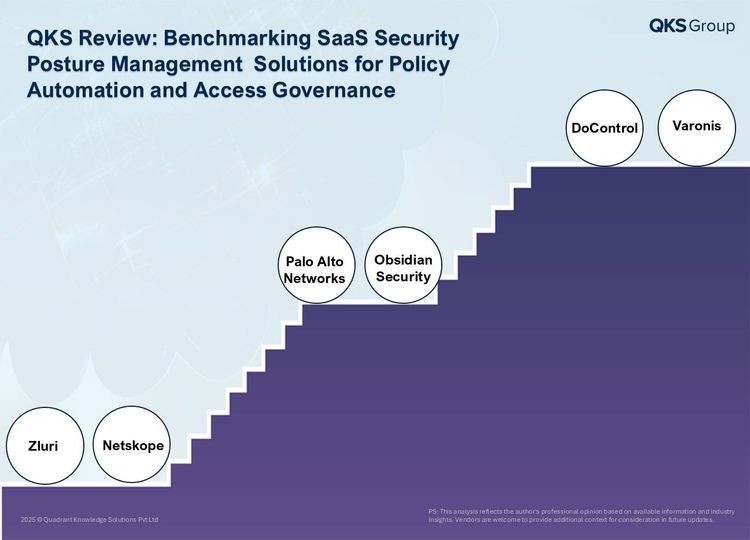
This QKS Group review benchmarks six leading SSPM vendors on their capabilities in policy automation, access governance, and enterprise readiness. The vendors are grouped into three tiers, Advanced Platforms offering end-to-end automation and governance, Mid-Tier Platforms delivering oversight with partial automation and Foundational Platforms providing monitoring and reporting with minimal enforcement.
What Modern SSPM Platforms Should Deliver:
To address policy enforcement and access governance challenges, SSPM solutions should provide:
- Automated remediation of over-privileged accounts and risky OAuth integrations
- Consistent enforcement of access and permission policies across core and niche SaaS applications
- Guided or workflow-driven remediation to reduce manual intervention
- Compliance-ready reporting and audit logs to track governance actions
Key Findings:
- DoControl and Varonis provide advanced automation and governance capabilities: DoControl automates remediation workflows for permissions, OAuth integrations, and policy compliance across a wide range of SaaS applications, helping teams reduce manual oversight. Varonis emphasizes data-centric risk analysis, mapping user privileges to sensitive data exposure, and supports corrective automation on key platforms, though manual adjustments are required for less common SaaS environments.
- Obsidian Security and Palo Alto Networks offer strong visibility with partial automation : Obsidian identifies over-privileged accounts, OAuth connections, and anomalous access patterns, but remediation remains guided rather than fully automated. Palo Alto Networks tracks SaaS configurations and permissions with some automation for core platforms, while integrating findings into its broader ecosystem. Both platforms deliver valuable oversight but rely on manual intervention for full enforcement.
- Netskope and Zluri primarily focus on monitoring and compliance reporting: Netskope surfaces risky OAuth apps and policy deviations with guided remediation workflows but minimal automated enforcement. Zluri maps SaaS applications, permissions, and integrations while highlighting access risks, yet remediation actions are manual and depend on internal processes. Both platforms help organizations track and prioritize risks but fall short of delivering policy automation at scale.
Understanding Policy Enforcement and Access Management in SaaS
Enterprises today depend on a multitude of SaaS applications to support critical business operations, making access management and consistent policy enforcement increasingly complex. Misconfigured permissions, over-privileged accounts, and unmanaged third-party applications introduce significant security and compliance risks. While SaaS Security Posture Management (SSPM) vendors often emphasize monitoring and reporting capabilities, the true differentiator lies in a platform’s ability to automate policy enforcement, govern user access effectively, and minimize the need for manual remediation.
In this review, QKS benchmarks six leading SSPM vendors based on their capabilities in policy automation, access governance, and enterprise readiness. Vendors are classified into three tiers: Advanced Platforms, which deliver end-to-end automation and governance; Mid-Tier Platforms, which provide strong oversight with partial automation; and Foundational Platforms, which focus primarily on monitoring, compliance insights, and alerts. This evaluation aims to help organizations understand which SSPM solutions can actively enforce policies versus those that primarily provide visibility.
Advanced Platforms
DoControl provides automated policy enforcement across multiple SaaS applications. It identifies over-privileged accounts, detects risky OAuth connections, and enables remediation workflows that can run without manual intervention. The platform covers both core and niche applications, though multi-tenant environments may require additional configuration to align with enterprise workflows. Automation includes account permissions, third-party integrations, and policy compliance, allowing security teams to systematically reduce access risk.
Varonis focuses on mapping permissions and monitoring identity-related risks. It identifies over-privileged accounts and supports automated corrective actions for supported SaaS platforms. Coverage for less common or newly adopted SaaS applications may require manual adjustments. The platform emphasizes data-centric access risk analysis, correlating user privileges with potential exposure to sensitive information. Audit logs and reports allow teams to track remediation activities and maintain compliance.
Mid-Tier Platforms
Obsidian Security
Obsidian provides visibility into account-level risks, including OAuth connections and third-party app access. Remediation is guided rather than fully automated, requiring teams to review and implement changes manually. The platform tracks over-permissioned accounts, suspicious access patterns, and identity anomalies. While it does not enforce policies automatically across all SaaS apps, it surfaces actionable insights to support access governance decisions.
Palo Alto Networks SaaS Security Posture Management (SSPM) monitors SaaS access and policy configurations, highlighting over-permissioned accounts and risky third-party integrations. Automation is limited to certain core SaaS applications, with manual steps required for other apps. Integration with the broader Palo Alto security ecosystem allows correlation of SaaS access risks with network and endpoint events. The platform emphasizes monitoring and informed decision-making rather than full-scale automated enforcement.
Foundational Platforms
Netskope SSPM provides visibility into OAuth applications and third-party integrations. Policy compliance is reported and tracked, but remediation is manual and relies on guided workflows. The platform helps teams identify risky applications and misconfigurations and prioritize them for operational follow-up. Automation is minimal, making the platform primarily suitable for structured monitoring and compliance reporting.
Zluri tracks SaaS applications, user access, OAuth connections, and third-party integrations. It highlights over-permissioned accounts and policy deviations, but remediation is manual. The platform provides visibility and reporting, allowing teams to identify high-risk applications and plan follow-up actions. Automated enforcement is limited, so policy implementation relies on internal processes or complementary tools.
Final Insights
The assessment of these SaaS Security Posture Management platforms reveals distinct differences in their approach to policy enforcement and access governance. DoControl and Varonis provide automated remediation workflows and structured control over user permissions, allowing organizations to address over-privileged accounts and risky third-party integrations proactively. Obsidian and Palo Alto Networks deliver comprehensive visibility and guidance but require manual intervention for less common SaaS applications or complex permission scenarios. Netskope and Zluri primarily focus on monitoring and reporting, helping teams identify potential access risks but offering limited automation for direct enforcement. Ultimately, the choice of platform should align with an organization’s needs for automation, breadth of SaaS coverage, and ability to enforce consistent policies across diverse environments.
Disclaimer:
This blog is based on independent research and publicly available information. The insights presented reflect the views of QKS Group and are for informational purposes only. While we strive for accuracy, we do not guarantee completeness or absolute correctness. Vendors are welcome to provide clarifications or updates. If any vendor listed in this analysis wishes to provide additional context or clarification, we welcome a briefing call and will consider incorporating relevant updates. This analysis is not intended to disparage any vendor but to provide an informed, balanced perspective. We encourage open and constructive dialogue to foster transparency and a deeper understanding of the industry.
Author: Aiyaz Ahmed, Analyst - Cloud Security at QKS Group
Vendors: