

09.09.2025
QKS Review
QKS Review: Artificial Intelligence for Journey Optimization: Who is leading in Customer Journey Management Platforms
Author:
Tanuj Paulose


Executive Summary:
Customer Journey Management (CJM) platforms are evolving beyond static dashboards and rule-based workflows. Today’s enterprise marketers, CX strategists, and digital leaders expect real-time intelligence, predictive foresight, and generative capabilities embedded directly into the journey layer, allowing them to optimize journeys to enhance overall customer experience, leading to better outcomes. AI is no longer an optional enhancement but a core enabler for journey optimization through anomaly detection, predictive modelling, and hyper-personalized orchestration. This review by QKS Group assesses how CJM vendors are incorporating AI in how CJM platforms use AI to optimize journeys, turning signals into decisions and live changes.
What Today’s Customer Journey Management Platforms Ought to Provide
Next-generation CJM platforms must extend beyond reporting and segmentation. Key AI-driven features include:
- Event-time triggers & anomaly detection that convert behavioral shifts into immediate decisions.
- Propensity & value scoring for churn of conversions, applied at the profile level for real-time branching.
- Next-best-action/offer that combines rules with ML models, with fatigue caps, eligibility, and priority handling.
- Test-and-learn at scale (A/B/n) with automatic winner selection and guardrails.
- Generative assistance for segment definitions, journey drafts, and channel-ready content with approvals/audit.
Key Findings
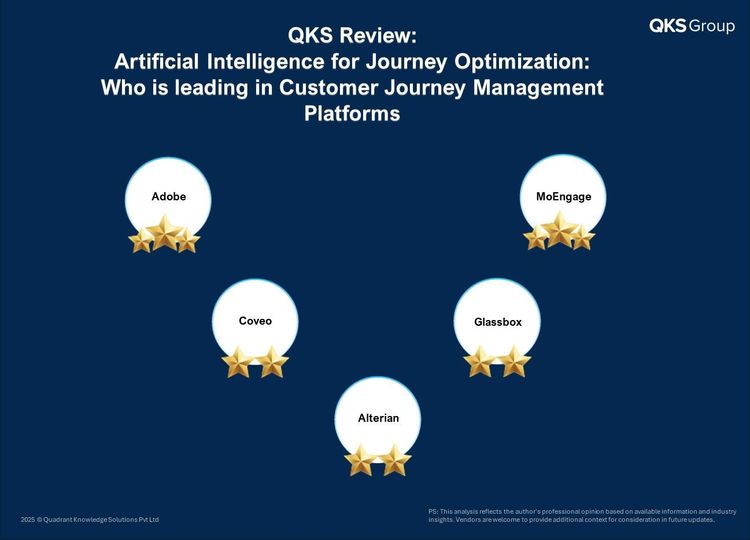
- Leading vendors (Adobe, MoEngage) combine predictive AI, generative assistants, and journey intelligence, setting the standard for end-to-end optimization from signal to actions.
- Capable vendors (Glassbox, Coveo) deliver strong predictive and personalization capabilities, balancing usability with innovation for engagement-driven use cases but require other systems for execution.
- Lagging vendors (Alterian) excel in journey intelligence and anomaly detection but remain more specialized in scope compared to broader orchestration leaders.
Adobe
Adobe provides AI capabilities that help with journey optimization through analytics, orchestration, and content. In Customer Journey Analytics, anomaly detection calls out real changes such as order dips, revenue spikes, odd traffic swings, without burying teams in noise, and “Intelligent Captions” explain what moved and why using natural language prompts. Journey Optimizer ties those insights to action using Customer AI, providing information such as the likelihood of churn or conversion at the profile level, allowing marketing teams to optimize individual journeys based on these scores. For content creation, Adobe provides Firefly, which generates the content and images needed to personalize at scale. This results in a wide coverage across insight, decision, orchestration, and content. It is suitable for organizations that are already using or are considering using other Adobe Experience Cloud products with controls for multi-brand environments, while smaller teams may find the breadth heavy unless they have clear processes and owners for each piece.
MoEngage
MoEngage combines two AI engines, Sherpa and Merlin, acting as a copilot for marketers, allowing them to accelerate content creation and planning while ensuring personalized journeys for each customer. Sherpa offers churn and conversion likelihood scores, predictive segmentation, and optimal send-time identification. Sherpa analyses past campaigns and reports which messages and channels are best-suited so teams can take informed decisions and proactively optimize journeys in small steps. Merlin offers generative AI capabilities in journey planning, enabling marketers to utilize natural language prompts for journey creation tailored to specific outcomes and content generation. It’s well-suited to lean teams that want to move quickly from idea to live journey. It doesn’t try to be a heavyweight orchestration system; it aims for fast personalization with enough control to stay on brand. When compared to enterprise stacks in the market, MoEngage does not offer features such as sophisticated decisions between budgets/offers for optimizing customer journeys.
Coveo
Coveo’s AI stack utilizes multiple ML models to rank and personalize search results in the moment, providing accurate answers quickly for questions using natural language prompts. Generative Answering goes beyond a result list and produces a direct response from knowledge bases, which shortens resolution time for customers and agents. Because customer context and content are in one place, recommendations shift as behavior shifts, allowing marketers to deliver personalized journeys at each touchpoint, aligning content, product recommendations, and answers based on each user’s behavior in real-time. This pays off in service portals and commerce journeys where a quick, correct answer enhances metrics, such as deflection, CSAT, and conversion, thus enhancing engagement and achieving better outcomes. Coveo lags behind leaders in the market as it is less about orchestrating cross-channel journeys and more about removing friction wherever people come looking for information and users would need an additional system for journey branching, offer arbitration, and content rollout.
Glassbox
Glassbox captures every session across web and mobile apps and identifies specific, fixable issues, resulting in fewer stuck sessions, smoother checkout, and better task completion. Its models flag where users struggle with errors, repeated taps, slow forms, and estimate the impact on conversion or experience, allowing teams to prioritize these issues. The assistant (GIA) lets non-technical marketers ask direct questions through a conversational interface, “Where do signups stall most this week?” and get an answer with the right view attached. Automatic page grouping helps large sites stay readable, and “Voice of the Silent” pulls signals from users who left without giving feedback by extrapolating issues, allowing organizations to enhance the experience of all users. For digital-first businesses, this level of behavioral clarity connects directly to enhanced user experiences, reduced drop-offs, and enhanced conversions. Glassbox is suitable only for digital journeys and lags behind others due to the lack of cross-channel decisioning, content generation, and execution of optimized journeys at scale.
Alterian
Alterian’s Real-Time CX Platform looks ahead rather than only describing what happened with dashboards projecting likely outcomes, surface clusters, and makes it clear where churn or drop-off is forming. Built-in automated A/B testing and continuous optimization let teams take actions to achieve business goals, and external models can plug in when data science teams want to extend the approach. The practical value shows up in two places: finding the exact points where people leave and proposing the next step to keep them moving. Alterian is best-suited for mid-market organizations that need prediction, they can act on it without adding a lot of tooling, but lags behind others as it won’t replace a full orchestration stack, which is important for executing next best actions in real-time.
Analyst Take: What to weigh before choosing?
For marketers and CX strategists, selecting the right AI-powered platform for optimizing customer journeys is about the platform that best suits the requirements, as each platform has its benefits. Adobe offers end-to-end journey optimization and scales with enterprise complexity, helping marketers with profile-level decisions and high-volume content, and is suited for organizations that are already using or planning to use other Adobe Experience Cloud products, although smaller teams might struggle with the breadth of the platforms without having defined processes and owners for each piece.MoEngage acts as a copilot of teams, best-suited for lean teams that want to quickly move from ideation to actual execution even though it is lighter on complex decision arbitration and enterprise controls.
Glassbox offers good visibility into user behavior and is best-suited to organizations where digital behavior is important and small fixes lead to better engagement and revenue but lags in orchestrating the optimized journeys. Coveo caters to the needs of both marketers and customers the need for quick and precise information but won’t handle branching, offer management, and orchestration. Alterian is a strong pick for teams that want a prediction they can use without adding a large platform, yet automated decisioning and execution require another platform. Ultimately, choosing the right AI-powered Customer Journey Management Platform comes down to what is required for journey optimization: end-to-end optimization, scale and governance, speed, knowledge resolution, or actionable guidance. The leaders aren't simply delineated by what their AI can do, but how easily that smarts fits into the cadences of actual marketing work and enhances metrics and overall engagement.
Disclaimer:
This blog is based on independent research and publicly available information. The insights presented reflect the views of QKS Group and are for informational purposes only. While we strive for accuracy, we do not guarantee completeness or absolute correctness. Vendors are welcome to provide clarifications or updates. If any vendor listed in this analysis wishes to provide additional context or clarification, we welcome a briefing call and will consider incorporating relevant updates. This analysis is not intended to disparage any vendor but to provide an informed, balanced perspective. We encourage open and constructive dialogue to foster transparency and a deeper understanding of the industry.
Author: Tanuj Paulose, Analyst – MarTech at QKS Group
Vendors: