

25.06.2025
QKS Review
[QKS Review: Are Traditional BPM & Automation Players up for the Current Global IPO Battle? (Case in Point – Pegasystems & GBTEC)]
Author:
Apoorva Dawalbhakta


Executive Summary:
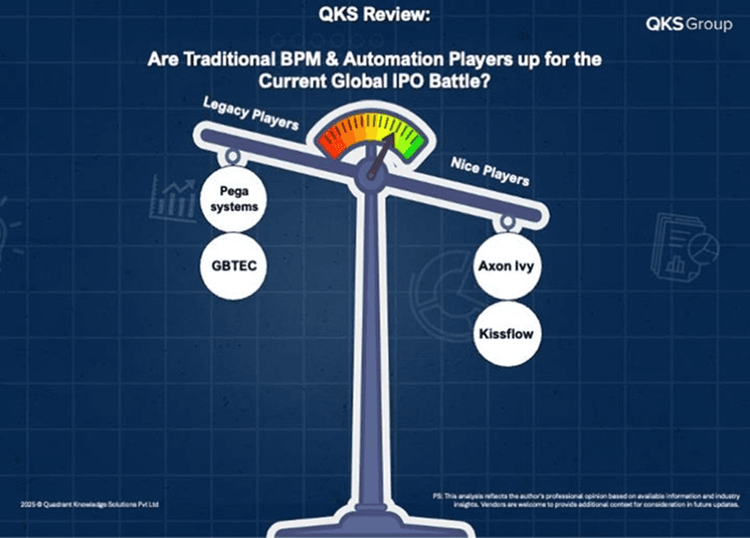
As the global Intelligent Process Orchestration (IPO) market is shifting at a considerable pace from ‘rule-based automation’ to more of ‘AI-native, context-aware orchestration’, the spotlight inadvertently would now turn to whether the legacy BPM and automation giants are actually prepared for this rapidly evolving battlefield. In this critical review by QKS Group, we examine two such traditional players – namely Pegasystems and GBTEC, for assessing whether their offerings do remain competitive in a market that is increasingly getting shaped by aspects like agility, composability, and real-time adaptability.
What Modern IPO Platforms Must Deliver Now:
Today’s IPO platforms are expected to go far beyond mere process control, and as such, the critical must-haves do include:
- Agentic AI and embedded decisioning, at the very point of action
- Composable architectures, coupled with low-code extensibility
- Business-user-first UX, and a steadfast rapid time-to-value
Key Findings:
- Pegasystems, with its deep decisioning and adaptive case management, does definitely remain powerful, but as such, its developer-heavy architecture and slower deployment cycles, considerably reduce its overall agility.
- GBTEC excels considerably in aspects like governance, process documentation, and compliance, but also lacks big time in real-time adaptability, in addition to being regionally constrained in terms of its visibility.
- In contrast, niche players within the global IPO market like Axon Ivy and Kissflow, seem to be outpacing the typical legacy giants in terms of aspects like business-user accessibility, rapid deployment, and context-aware orchestration, thereby delivering relatively higher relevance in today’s agile enterprise environment.
IPO Market Is Shifting Rapidly
The Intelligent Process Orchestration (IPO) market is undergoing a fundamental structural realignment. Notably, this landscape is no longer defined primarily by rule-based automation or mere siloed RPA deployment. On the contrary, it is being redrawn by the platforms which demonstrate robust agentic behaviour, AI-native orchestration, and composable architecture frameworks as a whole. The enterprises in today’s day and age, expect that the orchestration engines to not only enable connections of the required workflows, but that they should also be enabled to think, adapt, and evolve, in line with the changing business contexts as well. As such, the Agentic AI, embedded decision making, steadfast contextual responsiveness, and critical modular deployment capabilities – all are becoming primary baseline expectations, and not mere key differentiators like the earlier times. In this emerging situation, vendors leaning for long solely on the legacy of automation excellence doesn’t seem viable and feasible as well. We at the QKS Group observe that, the competitive edge which would set users apart, now hinges on the fact ‘whether platforms could seamlessly blend aspects like intelligence, agility, and governance, into a single orchestration fabric.
The Four Vendors under Consideration: Strengths/ USPs in Focus
- Pegasystems (USP - Deep Decisioning, and Event-Driven Orchestration)
Pegasystems as always, does remain a significant force to reckon with in the global IPO landscape, particularly for enterprises that are demanding aspects like real-time decisioning, adaptive case management, in addition to the AI-infused workflows. With a strong legacy within the Business Process Management and CRM offerings space, the Pega’s ‘Decision Hub’ and ‘GenAI Blueprint’ tools seem architected especially for high-stakes and rule-heavy environments and sectors including insurance, telecom, and banking, amongst others. The company’s ability to managing complex and event-triggered processes through an integrated decisioning engine is highly valued especially by large enterprises. However, it must be noted that, the Pega’s architecture leans more towards deep customization, as is also more developer-dependent, thereby increasing its overall time-to-value compared to the newer low-code competitors. In all fairness, the Pega’s ability to operationalize AI at the exact ‘point of decision’ surely makes it a heavyweight withing the orchestration circles.
- GBTEC (USP – End-to-end Integrated Process Stack coupled with Governance Depth)
The GBTEC’s BIC Platform is a robust Intelligent Process Orchestration (IPO) offering which uniquely combines aspects like process modelling, process execution, process mining, and GRC capabilities - all within one ecosystem. As a traditional European automation player, the company’s actual strength falls under its governance-first design, in addition to its visibly detailed process documentation, apart from its compliance orientation approach as well. Through curated strategic partnerships with market available tools like Apromore (for process mining) and LeanIX (focussed on enterprise architecture), the company promotes a pragmatic and enterprise-ready orchestration suite as a whole. Furthermore, its native AI infusion in process modelling, monitoring, and optimization – as a whole is substantially progressive, and as such, its focus on regulated industries promotes a visible edge within sectors like the finance and public sector environments. However, it should be noted that GBTEC’s broader adoption has been heavily skewed regionally towards the DACH markets, and thus, its global visibility remains an important area for potential development.
- Axon Ivy (USP - Niche Focus coupled with High Configurability)
While Axon Ivy may not be as widely recognized as some of the global giants, it has carved out a strong presence in delivering innovative automation solutions tailored for regulated and mid-market environments.. With the recent launch of Axon Ivy Version 12, it effectively combines task mining, AI-driven decisioning, coupled with tight integration of RPA and IDP into an end-to-end composable orchestration platform. The company’s BPMN 2.0-compliant modelling, end-to-end extensibility, apart from its enterprise marketplace for connectors – all positively reflect on a mature platform, which seems highly adaptable towards the mid-market and curated and regulated use cases. Also, Axon Ivy seems to particularly excel in aspects like the operational transparency, in addition to the real-time optimization of orchestration workflows. Its ability to deliver tightly governed, AI-enriched automation flows, coupled with considerably lower time-to-value - makes it a highly competitive vendor in the market, even against the bigger legacy giants.
- Kissflow (USP - Simplified Orchestration for varying Business Users)
Kissflow positions itself as precisely an intuitive and no-code IPO platform, that is tailored for the business users an especially for the SMBs. It primarily offers a single visual interface for managing the critical workflows, forms, key integrations, and associated predictive analytics - thereby making it particularly suitable for the non-technical users. The Kissflow’s orchestration model prominently emphasizes on the quick deployment coupled with the ease-of-use, along with a strong ultimate focus on citizen development, on the back of minimal IT dependency. While Kissflow might not match the end-to-end enterprise-scale depth of other legacy and mega automation players like Pegasystems or GBTEC, however its more than capable agile orchestration engine, along with its speedy learning curve – do make it especially highly appealing for the fast-moving end user teams. Additionally, the Kissflow’s native integration capabilities coupled with its cloud-first design, do promote allow effective scaling within the distributed digital ecosystems of the end users.
Niche Players Outperforming aspects like ‘Agility and Contextual Relevance’ of the Traditional Automation Players
Where and Why do Pegasystems and GBTEC Lag, as compared to the niche market players like Axon Ivy and Kissflow ?
1. Deployment Agility and Time-to-Value
- Pegasystems – Does require heavily skilled developers and their appropriate involvement for enabling the platform customization, which particularly holds true within the complex sectors like the insurance and telecom. Furthermore, the overall implementation cycles could be multi-month or even longer. In these cases, bespoke development is often needed for aligning the business rules and case management logic. In case of limited ease-of-use scenario for the non-technical users, the barrier for entry especially for citizen developers remains consistently high.
- GBTEC - While strong in aspects like process modelling and governance, the GBTEC’s ‘BIC Platform’ has a better structured, and a process-heavy deployment lifecycle. In this, the initial setup and configuration cycle does require considerable expert-level involvement, which especially holds true in the regulated environments. Ultimately, the platform is clearly optimized for precision coupled with compliance, and definitely not rapid agility.
If compared to Vendors like Axon Ivy and Kissflow, its particularly observed that -
- Axon Ivy – The company offers a lightweight, BPMN 2.0-compliant modelling environment, which considerably shortens the onboarding and deployment cycles. It definitely allows both the developers and advanced business users in configuring and deploying the required orchestration flows efficiently. Furthermore, its prebuilt connectors and the low-code interfaces reduce the overall IT overhead, thereby delivering faster time-to-value.
- Kissflow - Entirely functioning on a no-code operandi and designed specifically for the business users who possess little to no technical background, with the backing of rapid prototyping and deployment, the Kissflow app go live in days, not even in multiples weeks. The Kissflow, is clearly optimized for use cases that would require speed and simplicity, which particularly holds true in the mid-market and line-of-business environments.
2. Composability coupled with a Modular Architecture
- Pegasystems - Though considerably powerful, the Pega’s platform tends to be more monolithic, along with tightly coupled rule engines, case management, and the orchestration layers. The Pega’s modularity appears particularly limited, unless it’s being custom-built by certain experienced developers. For the Pega, it’s visibly difficult to plug-and-play the new components, or the third-party tools minus any significant integration work.
- GBTEC – Its designed more of as a unified stack which tightly binds the process modelling, mining, and the GRC – as one. While integrated quite robustly internally, the BIC platform appears less API-first as compared to other established composable platforms. There also appears visibly limited flexibility especially for the users that are looking to insert niche tools (e.g., customized and curated AI/ML models, apart from the external decision engines) into the critical orchestration flows.
If compared to Vendors like Axon Ivy and Kissflow, its visibly observed that -
- Axon Ivy – It embraces a composable, API-first architecture backed by strong support for service orchestration and modular deployment as well. It enables steadfast integration of external AI, curated analytics, IDP, and the decisioning components, without the requirement for reengineering the core. Additionally, it promotes scalability by allowing the individual services to evolve absolutely independently, well within the orchestration layer.
- Kissflow – It offers an all-in-one platform wherein the components (workflows, forms, analytics and the integrations) are decoupled, but are still interoperable. Furthermore, the users could reconfigure the flows, rules, and the interfaces, without actually rewriting the backend, thereby aligning with the agile business needs. It ultimately, simplifies the orchestration for the distributed teams through plug-and-play templates and relevant connectors.
3. Contextual Relevance and Adaptability to Dynamic Business Needs
- Pegasystems – It has been optimized for structured, and rules-heavy environments, but is still less agile while adapting to the changing process flows or the associated informal work patterns. It appears heavily geared towards the large enterprises with the deep customization requirements, which are less ideal for the mid-market or specifically fluid operational models. Also, its complex exception handling scenarios often do require reconfiguration of the decision trees or the logic layers.
- GBTEC – While, it is quite strong in the governance-heavy process frameworks, but is definitely not inherently adaptive within the fast-changing business contexts. Thus, the real-time adjustments or the self-optimizing flows are clearly not natively supported, and as such, the external modules (like mining or AI) are critically needed for adjusting the processes dynamically.
If compared to Vendors like Axon Ivy and Kissflow, its often observed that -
- Axon Ivy – Does support context-aware and context induced orchestration, made possible through the integration with AI, task mining, and other relevant monitoring tools. It thereby enables real-time workflow reconfiguration, in addition to intelligent exception handling without actually needing to restart the orchestration lifecycle. It further offers extensive native support towards adaptive process management, which is especially useful in scenarios of the supply chain and manufacturing use cases.
- Kissflow – Primarily built with a major business-first orientation, Kissflow greatly assists the non-technical users in iterating and adjusting the processes clearly on the fly. It’s definitely ideal for departments containing fluid requirements (e.g., those like HR, marketing, and procurement), wherein the agility does trump rigid compliance, thereby allowing the workflows to be easily adjusted, primarily based on the real-time needs, without actually breaking the downstream dependencies.
4. User Experience and Accessibility Quotient
- Pegasystems – Is primarily designed for the technical and process-heavy users, and is not basically optimized for the average citizen developers or other occasional users. While, its UI/UX has definitely improved by some degrees over the years, but it still lacks the actual consumer-grade simplicity, which is expected by the today’s workforce.
- GBTEC - Focuses primarily more on the governance, documentation, and modelling discipline, which are powerful and important traits, but which also means not so easy access of the system for the non-experts. The BIC platform also, offers a genuine steeper learning curve for those users who are without a significant background of Business Process Management or compliance.
If compared to Vendors like Axon Ivy and Kissflow, its routinely observed that -
- Axon Ivy – The company promotes a good balancing act, between its developer-friendly capabilities which are coupled with the clean and intuitive interfaces. Additionally, its marketplace and community support push for faster onboarding and adoption, even by the supposed semi-technical users. We feel that niche players like Axon Ivy were built way later in the evolution of the automation revolution, in the wake of the modern enterprise challenges and their potential pitfalls in mind (which could include aspects like rapid digitization, business-user empowerment, and the agile orchestration, amongst others.)
- Kissflow – It definitely seems purpose-built for the cause of simplicity and accessibility - what with the drag-and-drop interfaces, apart from the near zero-training curve. Kissflow pushes for the business teams in designing and managing the end-to-end workflows completely independently, without waiting on the IT Team.
What This Signals About the global IPO Market as a whole, and the Key Players Operating Within?
The observed and visualised dynamics across these vendors, does reflect and hint at a broader reordering of the global IPO hierarchy -
- Notably, legacy automation expertise clearly seems to be no longer sufficient. Rather, the functional breadth must now be matched head-to-head (if not exceeded) with the intelligence, composability, and the user-centric design approach.
- Additionally, AI nativity and agentic orchestration are becoming inevitable having a very high stake and decision making value for the end-users, for indulging in their vendor adoption criteria. In short, platforms must demonstrate their capability to think wisely and adapt appropriately, not just automate on the go.
- Also, aspects like composability and layered governance are critical competitive levers that should be looked out for. Vendors who would be offering granular, modular and curated deployment models in addition to real-time control, would surely lead the next phase of the enterprise adoption.
- The traditional leaders seem to be challenged not because they apparently lack the core capabilities, but rather because they’re potentially way slower in adapting to the modern orchestration expectations, which now generally prioritize aspects like context-awareness, steadfast agility, and an overall UX-driven design.
Why could the Gap actually Exist ?
- Notably, based on our extensive at the QKS Group, we feel that the legacy platforms like Pegasystems and GBTEC were essentially designed in an era which valued and prioritised control, customization, an steadfast compliance, ultimately relatively favouring stability substantially over the speed.
- Niche players like Axon Ivy and Kissflow were built way later, in the wake of the modern enterprise challenges and their potential pitfalls in mind (which could include aspects like rapid digitization, business-user empowerment, and the agile orchestration, amongst others.)
Last Word -
It seems clearly, that the niche vendors in the global Intelligent Process Orchestration (IPO) market, are outpacing the traditional players especially in aspects like adaptability, usability, and time-to-impact, which appear as the key traits in the current fast-moving global IPO market. It’s time for the traditional leaders to appropriately modernize their architectures and relevant product strategies in meeting this shift. Else, these would highly risk of losing their own relevance to other more nimble challengers. Ultimately, the IPO market seems to be evolving into a full-fledged battleground which appears to be defined not by the past automation success, but rather by the respective platform’s ability to effectively orchestrate the required intelligence, needed adaptability, and the value at speed. Ultimately, in this new playing field, the legacy players are now necessitated to reinvent themselves on priority. Not doing this would definitely risk them into staying in oblivion.
Disclaimer:
This blog is based on independent research and publicly available information. The insights presented reflect the views of QKS Group and are for informational purposes only. While we strive for accuracy, we do not guarantee completeness or absolute correctness. Vendors are welcome to provide clarifications or updates. If any vendor listed in this analysis wishes to provide additional context or clarification, we welcome a briefing call and will consider incorporating relevant updates. This analysis is not intended to disparage any vendor but to provide an informed, balanced perspective. We encourage open and constructive dialogue to foster transparency and a deeper understanding of the industry.
Author: Apoorva Dawalbhakta, Associate Director (Research) at QKS Group
Vendors: