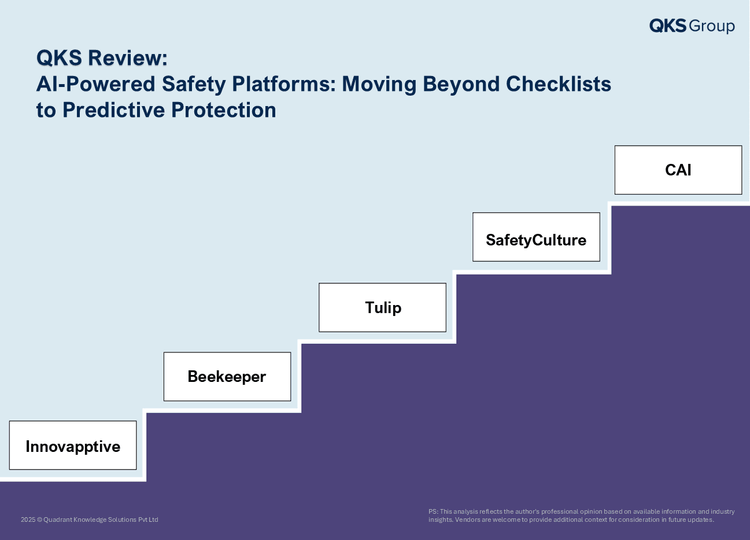
CAI: Redefining Safety with Parsable and AI co-pilot
CAI Software, through its acquisition of Parsable, offers a Connected Worker platform that digitizes frontline tasks with step-by-step work instructions while embedding safety directly into workflows. The system standardizes procedures such as PPE checks, lockout/tagout, inspections, and incident reporting, ensuring that safety protocols are followed consistently and reducing the chances of oversight. Real-time visibility allows supervisors to track adherence and respond quickly to hazards.
The platform’s strength lies in combining operational efficiency with safety by making compliance part of everyday work rather than an add-on process. Its AI capabilities further extend this approach. Parsable’s analytics engine uses generative AI to identify patterns and anomalies in frontline data, while the AI co-pilot enables workers and managers to query the system in natural language. This allows teams to surface trends, anticipate risks, and receive clear visual insights without needing technical expertise.
CAI is best at integrating safety into digital workflows while providing AI-powered insights that help organizations move from reactive to preventive safety management. However, adoption may require change management, as digitizing traditional safety practices can take time in industries reliant on paper-based methods. CAI best suited for manufacturers seeking an AI-driven platform that unifies safety, compliance, and frontline productivity.
SafetyCulture: Simplifying Safety with AI-Driven Inspections and Training
SafetyCulture applies AI to make frontline safety practical and accessible. Its AI-powered template generator allows teams to turn plain text into inspection checklists in seconds, while the Course Creator converts documents into interactive training. Translation tools break language barriers, supporting over different languages so critical safety knowledge reaches every worker. The platform also automates reporting, incident documentation, and dashboard insights, giving leaders faster visibility into hazards and compliance gaps. Mobile-first workflows ensure workers capture risks on the spot, preventing delays that often compromise protection.
Where the platform falls short is in deeper predictive capabilities. While AI streamlines documentation and knowledge delivery, it does not yet extend into advanced predictive analytics, IoT sensor integrations, or real-time monitoring of worker conditions that many organizations now expect from intelligent safety systems. This limits its ability to move from reactive safety management toward truly proactive risk prevention.
SafetyCulture is strong for digitizing inspections, training, and communication, but organizations seeking advanced AI-driven risk prediction and sensor-based safety intelligence may need to look at it as a starting point rather than a complete solution.
Beekeeper: Enhancing Safety Communication Through AI Assistant Maia
Beekeeper positions itself as a digital platform that brings AI into the daily routines of frontline workers to enhance safety. Its AI assistant, Maia, provides instant answers from company resources, translates information into multiple languages, and moderates team conversations to maintain a safe and respectful communication environment. By digitizing paper-based processes, Beekeeper makes incident reporting, safety checklists, and compliance forms accessible on mobile devices. This ease of use has encouraged higher reporting rates of near misses and streamlined safety workflows. Automated maintenance reminders and inspections further reduce risks by preventing equipment failures.
On the operations side, the platform centralizes safety training, SOPs, and urgent alerts, ensuring workers are consistently informed. Digital storage of reports and checklists supports audits and compliance without administrative burden.
However, its AI focus leans more on knowledge retrieval and moderation than predictive analytics or advanced hazard prevention. The platform currently lacks deeper AI capabilities like real-time sensor integration or predictive safety insights that other intelligent safety platforms emphasize. Organizations seeking practical, mobile-first safety digitization will find Beekeeper effective, but those needing predictive or sensor-driven AI may need to complement it with other solutions.
Tulip Interfaces: Digitizing Shop Floor Safety with No-Code Apps and AI Copilot
Tulip Interfaces applies AI and no-code apps to digitize safety on the shop floor. Its Safety Cross and Audit Checklist apps replace paper logs with mobile workflows, letting operators record incidents, near misses, and safety inspections in real time. Supervisors can attach photos, assign corrective actions, and track follow-ups on dashboards, ensuring compliance and accountability. Tulip’s Visual Quality Inspection uses computer vision to detect defects, reducing human fatigue and mistakes that can compromise safety. Through its Frontline Copilot, workers can ask questions about SOPs, machine errors, or safety steps and get instant answers, while AI Composer turns manuals into interactive apps.
The platform also connects directly to machines and sensors, enabling automated alerts, equipment checks, and integration with broader EHS systems. By digitizing processes and providing AI-driven guidance, Tulip makes safety tasks easier to execute and monitor.
However, Tulip’s AI focus remains centered on productivity, quality, and compliance rather than advanced hazard prevention. Tulip’s AI capabilities extend to vision-based PPE detection, allowing manufacturers to verify safety gear such as gloves, helmets, or glasses before operations begin. However, its AI focus remains primarily centered on productivity, quality, and compliance rather than advanced predictive safety analytics or environmental monitoring, which may still require integration with specialized tools. Tulip suits organizations seeking flexible, digital-first safety workflows, but those requiring advanced hazard detection will need complementary tools
Innovapptive: Connecting Safety and Operations with IoT and Mobile Workflows
Innovapptive positions its connected worker platform as a safety enabler by digitizing inspections, incident reporting, and compliance workflows. Mobile apps allow frontline workers to capture hazards in real time, initiate work orders, and conduct digital safety checklists. Its integration with IoT sensors and wearables helps supervisors track worker location, monitor equipment status, and issue alerts during unsafe conditions. By consolidating safety data into a central platform, Innovapptive reduces paperwork delays and enables faster corrective actions.
AI is applied in limited areas, mainly through predictive analytics that forecast equipment failures and potential safety risks. Automated workflows guide workers step by step, ensuring compliance with safety protocols. Managers gain dashboards for visibility into near misses, audits, and corrective maintenance helping to prevent incidents before they escalate.
What Innovapptive currently lacks is a deeper layer of AI-driven intelligence. Unlike platforms that provide automated hazard detection or real-time AI-powered coaching, its use of AI remains more supportive than transformative. Features like computer vision for PPE detection, adaptive training personalization, or dynamic risk modeling are not yet integrated.
Innovapptive reduces safety friction through digitization but falls short of delivering a fully intelligent safety ecosystem.
Disclaimer:
This blog is based on independent research and publicly available information. The insights presented reflect the views of QKS Group and are for informational purposes only. While we strive for accuracy, we do not guarantee completeness or absolute correctness. Vendors are welcome to provide clarifications or updates. If any vendor listed in this analysis wishes to provide additional context or clarification, we welcome a briefing call and will consider incorporating relevant updates. This analysis is not intended to disparage any vendor but to provide an informed, balanced perspective. We encourage open and constructive dialogue to foster transparency and a deeper understanding of the industry.
Author: Divya Prakash, Analyst - Internet of Things (IoT) at QKS Group