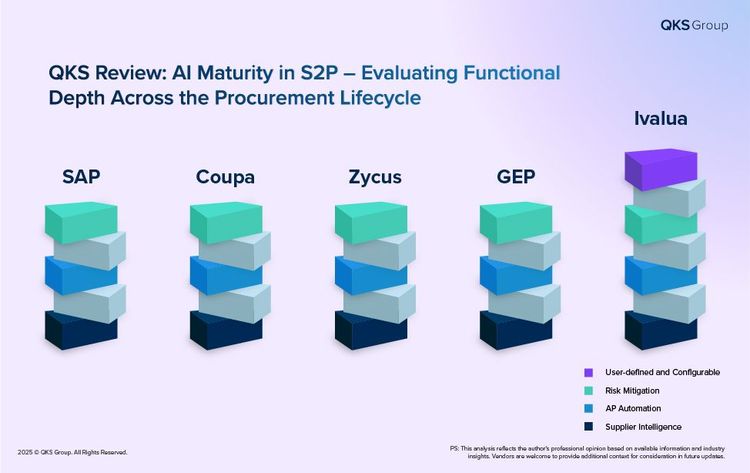
Platform Analysis:
Coupa: Autonomous Matching with Ecosystem-Led Expansion
Coupa’s AI capabilities are fueled by over $8 trillion in community spend and a network of 10 million suppliers. Its Navi™ AI agents autonomously match sourcing requirements with suppliers and support real-time optimization in sourcing.
Coupa’s contract intelligence engine automates clause extraction, version tracking, and interactive analysis. In P2P, Coupa emphasizes automation of requisition and AP processes with anomaly detection to reduce fraud and leakage.
The platform also supports external AI integration via a “Bring Your Own AI” approach. However, Coupa’s AI operates largely within a prescriptive environment, with less flexibility for user-specific experimentation or no-code innovation.
SAP: ERP-Integrated Intelligence with Phased Rollout
SAP’s Joule AI, embedded within Ariba and integrated across the Business Network and Business Data Cloud, aims to deliver contextual recommendations from sourcing through payment. Current development focuses on autonomous supplier evaluation, bid analysis, and predictive insights across the requisition-to-payment lifecycle.
By mid-2025, SAP plans to offer Joule functionality within Microsoft 365 environments such as Teams and Outlook, enabling AI access through everyday productivity tools. While the roadmap is ambitious, most advanced capabilities are in progress or early rollout, and adoption will vary based on enterprise readiness.
SAP’s vision of an “omnipresent AI assistant” positions it well for long-term enterprise alignment, but in the short term, it reflects a functionally evolving maturity.
GEP:Process-Oriented Intelligence with Operational Depth
GEP Smart’s sourcing optimizer and supplier risk engine leverage AI to drive process orchestration across sourcing, contracting, and P2P. The platform is designed to minimize manual intervention and ensure consistent policy enforcement across transactions.
Rather than focusing on front-end user interaction, GEP’s AI strength lies in operational scale and reliability, particularly in high-volume environments. GEP’s AI enables predictive decision-making around spend optimization, supplier risk, and trade compliance.
While generative AI features are in development, GEP’s current offering reflects a robust and mature transactional foundation that appeals to CPOs prioritizing control and compliance.
Zycus:Workflow Automation with a User-Centric Interface
Zycus’s Merlin AI suite combines GenAI-powered supplier discovery, RFx automation, and intelligent supplier risk monitoring. Through integrations with Microsoft Teams and the Zycus app, the Merlin Assist bot provides access to sourcing data, response summaries, and even real-time drafting assistance.
In contract lifecycle management, Zycus focuses on self-service capabilities which allows business users to draft and review contracts using chat-based interactions. This aligns with the vendor’s broader strategy of automating tactical work to free up strategic bandwidth.
While Zycus’s AI focus on usability and automation makes it attractive for mid-market organizations, its data model and network maturity are still catching up with larger players.
Ivalua:Configurable Intelligence and Enterprise Flexibility
Ivalua’s IVA assistant extends AI capabilities across sourcing, contracting, and supplier intelligence with practical applications such as clause drafting, contract summarization, and procurement communication support. One of its key differentiators lies in no-code customization of GenAI use cases, allowing organizations to design and deploy tailored AI solutions aligned with strategic goals.
In supplier management, Ivalua was among the early adopters of AI to summarize performance insights and analyze ESG-related supplier documents. Its writing assistant and research functions enhance user productivity while ensuring strategic alignment.
Ivalua’s strength lies in enabling user-driven innovation without sacrificing governance, thus making it particularly suited for complex, regulated environments across both public and private sectors.
Disclaimer:
This blog is based on independent research and publicly available information. The insights presented reflect the views of QKS Group and are for informational purposes only. While we strive for accuracy, we do not guarantee completeness or absolute correctness. Vendors are welcome to provide clarifications or updates. If any vendor listed in this analysis wishes to provide additional context or clarification, we welcome a briefing call and will consider incorporating relevant updates. This analysis is not intended to disparage any vendor but to provide an informed, balanced perspective. We encourage open and constructive dialogue to foster transparency and a deeper understanding of the industry.
Author: Sujan Thomas Mathew, Practice Director, QKS Group