

30.06.2025
QKS Review
QKS Review:AI Integration and Innovation Ambition: Who’s Really Leading Process Intelligence
Author:
Pranjal Singh


Executive Summary:
Executive Summary
The growing landscape of process intelligence is moving beyond mere dashboards and conformance checks. The demand within enterprises has increasingly focused on integrating embedded intelligence, actionable insights, and establishing AI-native transformation pathways. In the landscape of numerous platforms competing for significance, only a select few exhibit a level of architectural sophistication, reliable AI integration, and a forward-thinking innovation strategy that resonates with the requirements of enterprises. This review critically examines Celonis, SAP Signavio, ARIS, UiPath, IBM, and Microsoft platforms that may be established across enterprise domains, but vary significantly in their process mining readiness.
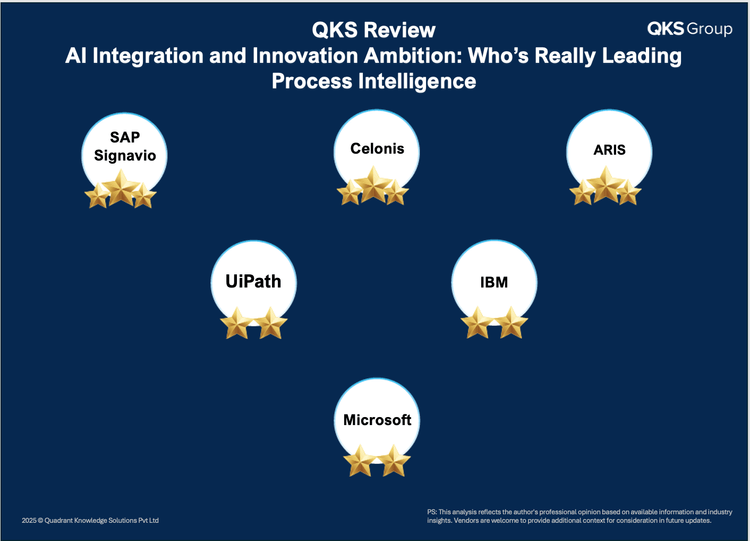
- SAP Signavio emerges as the most structured and business-aligned, with deep ERP-native context and value accelerators.
- Celonis remains the architectural benchmark, pushing boundaries with object-centric data models and predictive guidance.
- ARIS stays deeply relevant with its GenAI-powered modelling and governance suite.
- UiPath continues to treat process mining as an automation enabler, not a strategic intelligence layer.
- IBM’s roadmap is long on AI vision but short on immediate product maturity.
- Microsoft benefits from ecosystem reach, but its process intelligence remains basic, modular, and highly dependent on external tooling and structured data.
The real differentiator now isn’t whether a platform includes AI, it is whether that AI is context-aware, embedded, enterprise-ready, and aligned with transformation goals. This blog offers a critical lens on how leading platforms are (or aren’t) meeting that bar.
SAP Signavio: Enterprise-Grade Intelligence Built for Structured Transformation
SAP Signavio is continually evolving, establishing itself as a fundamental component of SAP’s comprehensive transformation strategy. Now incorporated into the Business Transformation Suite, Signavio consolidates process mining, modelling, governance, and benchmarking inside a unified platform designed for enterprise scalability. SAP Signavio's AI functionalities are highly sophisticated and contextually relevant. SAP's generative AI assistant, Joule, now provides process recommendations and KPI suggestions that accelerate the time from discovery to actionable insights.
SAP Signavio's most significant asset is its repository of value accelerators. This covers thousands of pre-defined KPIs, process reference models, and industry benchmarks across core industries such as finance, procurement, supply chain, and sustainability. It provides a pre-structured framework for transformation, helping organizations move from insight to action with agility and governance. SAP Signavio is seamlessly connected into SAP’s extensive AI and data ecosystem, enabling clients to incorporate intelligence directly into S/4HANA migrations, ESG tracking projects, and operational resilience programs. Through substantial investment from SAP and a well-defined execution strategy, Signavio is establishing itself as the operational hub for enterprise process transformation.
- Key strengths: Strong ERP-native context, embedded AI to provide process and KPI recommendations, structured transformation routes through accelerator content, and profound integration with enterprise governance frameworks.
- Takeaway: SAP Signavio leads in offering business-driven and structured transformation. It brings contextual intelligence to the forefront of organizational change, making process intelligence operationally efficient at scale.
Celonis: The Process Intelligence Blueprint
Celonis’ Process Intelligence Platform is built on a modern, microservices-based architecture centred around its proprietary Process Intelligence Graph. This object-centric data model allows for flexible, end-to-end process analysis across complex enterprise environments. This architectural maturity includes containerized services, open APIs for data integration, and an extensive partner ecosystem. On AI, Celonis now offers Process Copilots, GenAI chatbots that let business users ask questions in natural language and instantly get answers and improvement suggestions from their process data. Celonis also acquired Symbio, a process modelling company, to extend its AI-driven process mapping capabilities. In essence, Celonis provides not only analytics but predictive guidance and action-driving AI on a strong platform.
- Key strengths: Celonis is an established leader with a substantial enterprise clientele. It features a contemporary architectural design that includes containerized, microservices, a graph data model, and possesses an extensive partner network. The GenAI initiatives, including Process Copilot and automated insights, are tangible and commercialized, demonstrating a solid AI strategy.
- Takeaway: Celonis is distinguished by the platform's richness and authentic AI integration. It perpetually innovates, for instance, by enhancing AI assistants and object-centric functionalities.
ARIS: GenAI-Powered Governance with Modelling Depth
ARIS, with its long-standing foundation in business process management, has undergone significant modernization to align with evolving enterprise needs. With the integrated suite of Process Modelling, Mining and GRC, currently at version 10 Service Release 28 (April 2025), it stands ready to deploy it capabilities on cloud, on-prem or hybrid, either as standalone modules or as integrated components within the broader ARIS suite. The platform has also incorporated Generative AI for task acceleration, analysis augmentation and intelligent information retrieval, and continues to develop new use cases for its "AI Companion" to better support enterprise process improvement. In addition to modelling and mining capabilities, the ARIS platform comes with a powerful relational database repository to act as a business knowledge warehouse, has strong alignment with industry standard frameworks and accelerators to support key use cases. This makes the platform particularly valuable for organizations seeking both operational intelligence and governance-driven process design.
Across the process improvement lifecycle, ARIS has been both innovative and pragmatic with its introduction of AI capabilities, ensuring control and governance for this technology. Its upcoming enhancements to legacy simulation capabilities and its strong alignment with popular process automation platforms are helping its users better deliver on evidence-based transformation initiatives. This is particularly relevant in highly-regulated and complex industries/use cases, such as Banking & Insurance, Manufacturing, Government, Energy, and Transportation. In those sectors, ARIS helps to overlay Risks and Controls onto process blueprints, and use Process Mining to check compliance against standards and regulatory obligations.
- Key strengths: ARIS has a deep modelling heritage as an originator of the digital modelling space, yet with the introduction of GenAI, it remains more relevant than ever. Its open platform and comprehensive offerings, from mining to modelling to GRC to key accelerators, help complex and regulated enterprises address process-driven challenges at scale.
- Takeaway: ARIS' investments in GenAI have enabled it to democratize Process Intelligence, supporting a wide variety of core enterprise use cases and driving innovation along its credible roadmap towards augmented BPM / Agentic AI. It remains a leader in the marketplace, with its integrated suite putting it well ahead of more bit players and automation front-ends.
UiPath: RPA Pioneer, Process Intelligence in Progress
The development of the process intelligence capabilities at UiPath is recent and simultaneous with its major upgrades, but it does reflect an architecture built that prioritizes automation orchestration before placing process intelligence as a strategic platform layer. Integrating Maestro, an orchestration layer to manage long-running, multi-agent processes, and Agent Builder for the creation of AI-driven automation agents is a crucial step towards broadening UiPath's view of the platform beyond traditional RPA. However, these enhancements focus mostly on better coordination amongst agents, robots, and human participants, rather than on changing the perception of process intelligence as a primary engine for business transformation.
Process mining within the UiPath platform operates as a component within the wider Business Automation suite. Functional improvements have been implemented, including better process templates and Task Mining enhancements to boost usability and insights; however, the overall positioning suggests that process intelligence is still viewed as an enabler to automation and not an intelligence layer. The core platform is very much focused on task automation and workflow orchestration, but process mining is often used to further inform and expedite these activities.
The organization’s strategy regarding AI highlights the importance of regulated automation. AI agents are designed with contextual grounding, regulated interactions, and mechanisms that involve human-in-the-loop. The integration of GenAI, including natural language interfaces and agentic automation features, is progressing but remains in the early stages compared to platforms that have established process intelligence and predictive analytics as core capabilities.
- Takeaway: UiPath’s process intelligence is progressing toward greater integration and orchestration, especially with the launch of Maestro and Agent Builder. However, its strategy remains rooted in automation enablement. For enterprises evaluating process intelligence platforms, UiPath offers a cohesive automation environment with growing intelligence capabilities, but may require complementary solutions for advanced, insight-driven transformation use cases.
IBM: Architecture Present, Intelligence Missing
IBM’s process mining offering is positioned as an integrated component of its Cloud Pak for Business Automation, with a broad value proposition centred on delivering complete process visibility, AI-driven diagnostics, and seamless handoff to its wider automation ecosystem. The platform is characterized as a central nervous system that identifies inefficiencies within business systems and initiates remedial actions in real time. However, a significant portion of this narrative persists as more aspiration than reality. In practical implementations, IBM’s process mining solution is intricately integrated with its Cloud Pak infrastructure, which is constructed on Kubernetes and functions within the IBM Cloud. This integration provides benefits for organizations established in the IBM ecosystem; however, it also contributes complexity and rigidity, making the platform considerably more complex and less agile than more modular, cloud-native SaaS options.
IBM's generative AI narrative predominantly emphasizes future potential, with its position primarily based on future promises rather than existing capabilities. The company's 2025 vision highlights the revolutionary capabilities of generative AI and sets long-term goals, including the implementation of digital twins by 2026; however, the actual deployment of GenAI features in the process mining layer has been limited. In comparison to its competitors, IBM has been somewhat cautious in introducing user-oriented generative AI tools like copilots or conversational assistants. The platform’s real strength continues to lie in its integration with Watson and its broader automation and decision-making engines. However, this is also shaped by its legacy in business process management and decision automation, where the platform’s underlying architecture, rooted in products like BPM and Operational Decision Manager, offers a high degree of customization but also results in a slower pace of innovation and adaptability in areas like GenAI.
- Key limitations: IBM's process mining solution is characterized as enterprise-grade and robust; nonetheless, its extensive scope and strong integration with the wider IBM technology stack may lead to complexity. A primary drawback of the platform is strategic inertia, as innovation is dispersed across various products instead than being concentrated inside the mining offering. Despite IBM's focus on AI-driven functionalities like digital process mapping, dedicated generative AI helpers for process mining are predominantly lacking. Moreover, in contrast to more modular SaaS alternatives, the implementation of Cloud Pak solutions frequently necessitates increased work and infrastructure alignment, thereby diminishing agility and time to value.
- Takeaway: IBM demonstrates strength in articulating a forward-looking vision, particularly around AI and enterprise automation, but its current productized AI capabilities generate less enthusiasm in real-world use. For enterprise buyers, the platform offers reliability, scale, and integration depth, yet it often lacks the immediacy and innovation edge seen in peers that are more aggressively advancing AI-driven process intelligence.
Microsoft: Ecosystem over Execution
Microsoft entered the process mining market with Minit's acquisition in March 2022. After the acquisition, Microsoft announced the public preview of new process mining functionalities within Power Automate built on Minit's technology. Through this integration, process insights could also be explored conversationally by end users using natural language search powered by the OpenAI models. Despite several smaller enhancements after acquisition, Minit's core has remained largely the same, offering a solid set of process mining capabilities. Perhaps, after its integration into the broader Power Automate ecosystem, Microsoft's process mining solution still does not match the depth or innovation of specialized stand-alone process mining platforms.
Microsoft's primary strength in process mining is its native task mining capabilities through Power Automate Desktop, which are combined with its extensive integration across the Power Platform ecosystems. It seamlessly integrates with Azure-based data and other components of the Microsoft cloud infrastructure, and the solution is enterprise-ready, making it highly accessible to organizations that have already invested in the Microsoft stack. Moreover, Microsoft's advancements in the process intelligence sector have been significantly influenced by acquisitions and external partnerships. Even though natural language querying, which is facilitated by large language models, improves accessibility, more sophisticated AI-driven features, such as embedded process recommendations, vertical accelerators, and autonomous optimization capabilities, are still emerging and lack the depth as compared to more specialized platforms.
- Key limitations: Microsoft's process intelligence offering is predominantly an extension of its Power Suite and does not yet exhibit the cross-application depth that is observed in more mature platforms that natively integrate with systems such as ERP, CRM, and ITSM. The integration of GPT-3.5 enhances user accessibility; however, it is dependent upon a large language model that is widely accessible and readily replicable by others. Furthermore, organizations frequently discover that Microsoft's process mining remains heavily dependent on the availability of clean, structured event records, requiring manual exports from Excel. This underscores the fact that the platform fails to address the fundamental challenges of data preparation.
- Takeaway: Microsoft is leveraging its wider Copilot and AI positioning, as well as the Minit acquisition, to strategically establish its presence in the process intelligence space. It is anticipated that the company will continue to evolve rapidly through iterative enhancements. However, the platform's current state is relatively limited, as it is heavily dependent on the Azure and Power Platform ecosystems. This can restrict the flexibility of organizations that operate in more diverse IT environments. Although the AI features, such as GPT-based conversational interfaces, improve usability, they are still somewhat basic and do not yet exhibit the architectural sophistication or depth of a purpose-built generative AI engine that is specifically designed for end-to-end process intelligence.
Final Analyst Takeaways
In process intelligence, the competitive edge is no longer between players who can visualize data. The strength now lies in how well a platform embeds AI into enterprise workflows, delivers business-contextual recommendations, and accelerates transformation pace through insights aligned with governance. Strategically co-leading, SAP Signavio directly pursues structured enterprise transformation, contextual AI features, and an extensive value accelerator library. Meanwhile, Celonis stays in its own right as the architectural leader, with its object-centric process intelligence model and execution management layer. ARIS continues to remain relevant with its process modelling heritage, strong governance alignment, and pragmatic AI integration through GenAI assistants and calculated fields.
On the other hand, UiPath continues to treat process mining as a feeder for automation rather than as an independent intelligence layer. IBM’s offering is broad and technically deep, but its AI capabilities often remain in planning rather than in active productization. Microsoft’s process intelligence capabilities are improving, but they still rely on third-party technologies and ecosystem lock-in rather than on purpose-built innovation. The real winners are platforms that convert process data into enterprise-ready intelligence, enable transformation at speed, and do so in a way that is scalable, transparent, and guided by AI.
Disclaimer:
This blog is based on independent research and publicly available information. The insights presented reflect the views of QKS Group and are for informational purposes only. While we strive for accuracy, we do not guarantee completeness or absolute correctness. Vendors are welcome to provide clarifications or updates. If any vendor listed in this analysis wishes to provide additional context or clarification, we welcome a briefing call and will consider incorporating relevant updates. This analysis is not intended to disparage any vendor but to provide an informed, balanced perspective. We encourage open and constructive dialogue to foster transparency and a deeper understanding of the industry.
Author: Pranjal Singh, Principal Industry Analyst at QKS Group
Vendors: