


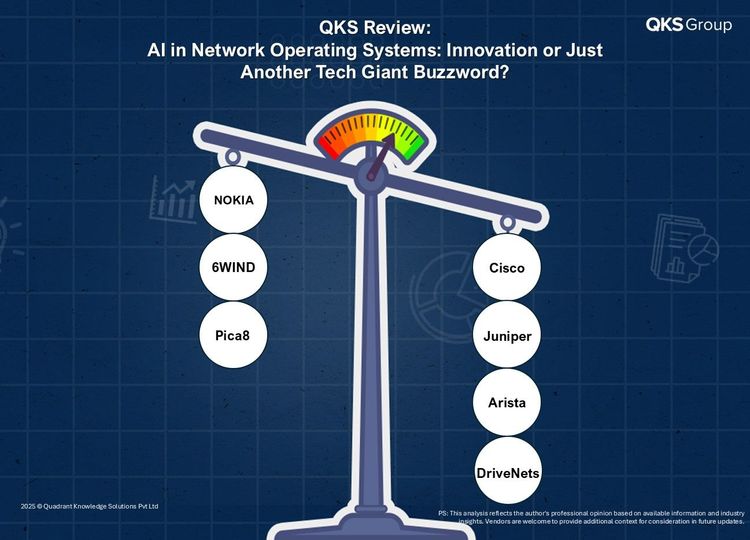
This blog explores the integration of Artificial Intelligence (AI) in Network Operating Systems (NOS), assessing whether it marks a true technological advancement or is merely industry hype. It highlights how AI is enhancing NOS capabilities through predictive analytics, intent-based networking, anomaly detection, and automated troubleshooting. Vendors like Cisco, Juniper Networks, Arista Networks, and DriveNets are leading the way with advanced AI features that enable proactive and autonomous network operations. Meanwhile, companies such as Nokia, 6Wind, and Pica8 are slower in adopting AI, often relying on more traditional network management approaches. The analysis concludes that AI is becoming essential to modern NOS platforms, and vendors embracing this shift are better positioned to meet the demands of increasingly complex and dynamic network environments.
17.07.2025
QKS Review
QKS Review: AI in Network Operating Systems: Innovation or Just Another Tech Giant Buzzword?
Author:
Akshay Singh
Executive Summary:
Imagine your network as a sprawling city-thousands of intersections (routers), roads (cables), traffic rules (protocols), and of course, traffic (data). Now, imagine managing this metropolis manually-adjusting every signal, rerouting traffic in real time, monitoring congestion, predicting failures before they happen. Sounds impossible, right? This is where Network Operating Systems (NOS) come in. NOS are the brains behind network devices-providing the services, control, and policies that keep our digital highways humming. But recently, there's been a new sheriff in town: Artificial Intelligence (AI).
AI is being hailed as a game-changer for NOS. With promises of predictive maintenance, autonomous traffic optimization, and even self-healing networks, tech giants are eager to integrate AI into their NOS offerings. But the question remains: is this a true evolution of networking, or just another flashy term meant to dazzle IT buyers?
How AI is Changing the Game in NOS
AI in Network Operating System isn’t about robots taking over your data center-it’s about using machine learning models to analyze enormous amounts of network telemetry and make smarter, faster decisions.
Some examples include:
- Predictive Analytics: AI models predict when a switch might fail or when a link will become congested.
- Intent-Based Networking (IBN): AI translates high-level business intent (like “prioritize video traffic”) into network configurations automatically.
- Anomaly Detection: Spotting network threats or unusual patterns far faster than human admins.
- Automated Troubleshooting: AI can diagnose and even resolve certain issues without waiting for a ticket to be opened.
Top NOS Providers: Who’s Leading the AI Charge (and Who’s Falling Behind)?
Top Performers:
1. Cisco (IOS-XR / NX-OS with Cisco AI Network Analytics)
Cisco remains the undisputed heavyweight in the networking space, and its Network Operating Systems-IOS-XR and NX-OS-are evolving fast with AI integration. With platforms like Cisco DNA Center and AI Network Analytics, Cisco has introduced advanced features such as intent-based networking, anomaly detection, and predictive telemetry. These systems can proactively alert administrators to potential issues, suggest remediation steps, and even automate policy enforcement across vast, distributed networks. The depth of AI features is impressive, and Cisco’s large enterprise customers benefit from a mature support ecosystem and robust security frameworks. However, this level of sophistication comes at a cost-both in terms of licensing and operational complexity. For organizations with smaller IT teams or limited budgets, the learning curve and investment may outweigh the benefits.
2. Juniper Networks (Junos OS with Mist AI)
Juniper is making bold moves with its integration of Mist AI into the Junos OS ecosystem, particularly revolutionizing wireless and edge networking. Mist AI uses machine learning to provide dynamic insight into user experiences, automate troubleshooting, and enable self-healing capabilities within the network. One of its standout features is the ability to translate vast volumes of telemetry data into actionable insights-identifying performance degradations before they impact users. This level of automation is especially useful in campus networks and enterprise environments with high user mobility. Juniper’s design ethos is also more user-centric compared to traditional CLI-driven models, which makes it easier for teams to adopt. While not as dominant as Cisco in global enterprise infrastructure, Juniper is quickly becoming a top choice for organizations prioritizing AI-driven efficiency and simplicity.
3. Arista Networks (EOS with CloudVision)
Arista’s Extensible Operating System (EOS), combined with CloudVision, offers a clean, cloud-native approach to AI in networking. CloudVision streams real-time telemetry, performs deep traffic analysis, and enables proactive automation. Arista’s AI approach is more data-centric than vendor-locked, allowing organizations to scale out their automation and visibility without proprietary barriers. It’s a favorite in high-performance and hyperscale environments for good reason: its AI-driven NOS helps networks stay fast, stable, and secure with minimal manual input.
A newer player with a bold strategy, DriveNets offers a disaggregated, cloud-native Network Operating Systems that leverages AI to deliver scalability and automation at telco-grade levels. Its Network Cloud architecture decouples hardware from software, letting service providers build carrier networks with hyperscale economics. AI is baked into its control layer, which dynamically allocates network functions, monitors health, and adjusts routing paths in real time. DriveNets is proving that innovation in NOS doesn’t have to come from legacy giants-it can come from purpose-built, software-first challengers too.
Falling Short:
Nokia has a long history in networking, and its SR OS (Service Router Operating System) is still widely deployed. However, while Nokia talks about automation and intent-based networking, its progress in practical AI integration feels slow and fragmented. Its AI capabilities, while present in tools like NSP (Network Services Platform), are often siloed and not deeply embedded into the NOS itself. Much of the work still relies on operator input and traditional static routing. Nokia has the legacy and technical chops, but its AI journey seems more cautious than cutting-edge.
2. 6Wind
6Wind is best known for its high-performance packet processing software, particularly in virtualized environments. While it's lightweight and efficient-especially for network functions virtualization (NFV)-it lacks the kind of deep AI integration that defines modern NOS innovation. There's minimal presence of telemetry-driven analytics, predictive behaviors, or self-operating features. For specialized use cases like vRouters or edge devices, 6Wind works well. But in terms of AI capabilities and automation, it doesn’t stand out as a forward-thinking NOS solution.
3. Pica8
Pica8 positions itself as a disruptor with open networking solutions, offering a Linux-based NOS (PicOS) designed to work on white-box hardware. While openness and flexibility are strengths, Pica8’s AI story is weak. Automation tools like AmpCon offer centralized control, but lack the intelligence, adaptability, and predictive analytics seen in more mature AI-driven NOS platforms. The focus is still on configuration management rather than autonomous network behavior. For users focused on cost-effective SDN solutions, Pica8 works. But if AI is a priority, it’s not leading the pack.
Conclusion: Buzzword or Breakthrough?
AI in Network Operating Systems isn’t just a buzzword-but that doesn’t mean everyone’s doing it well. For leaders like Cisco, Juniper, Arista, and DriveNets, AI is transforming network management into a proactive, intelligent service that reduces downtime and improves performance. These vendors are pushing the envelope with self-healing, intent-based, and highly automated network systems.
On the flip side, vendors like Nokia, 6Wind, and Pica8 still operate in a more conventional model-where automation may exist, but true AI-driven adaptability and intelligence are either nascent or missing altogether.
As network demands grow more complex and real-time, AI won’t just be a “nice-to-have” in NOS-it will be table stakes. The vendors that embrace it now are building the backbone of tomorrow’s digital infrastructure. The rest? They risk becoming legacy before they even realize it.
Disclaimer:
This blog is based on independent research and publicly available information. The insights presented reflect the views of QKS Group and are for informational purposes only. While we strive for accuracy, we do not guarantee completeness or absolute correctness. Vendors are welcome to provide clarifications or updates. If any vendor listed in this analysis wishes to provide additional context or clarification, we welcome a briefing call and will consider incorporating relevant updates. This analysis is not intended to disparage any vendor but to provide an informed, balanced perspective. We encourage open and constructive dialogue to foster transparency and a deeper understanding of the industry.
Author: Akshay Singh, Analyst - Enterprise Networking at QKS Group
Vendors: