As companies come under increasing pressure to do more with fewer resources, the use of artificial intelligence (AI) in marketing automation has become from "nice-to-have" to necessary. But in an environment where AI hype tends to drown out the everyday benefits, marketing leaders are seeking beyond sci-fi promises and concentrating on platforms that provide useful, results-driven automation.
Marketers these days do not just want chatbots or content generators; they require features that serve as a virtual assistant that facilitates the execution of cross-channel campaigns, scores leads wisely, automates processes, and personalizes interactions at scale, providing personal experiences for their customers and increased satisfaction. In this context, some vendors have capabilities that cater to marketers in all the above areas, keeping up with the demands of the times, while others need to enhance their capabilities to keep up with the demands of the times.
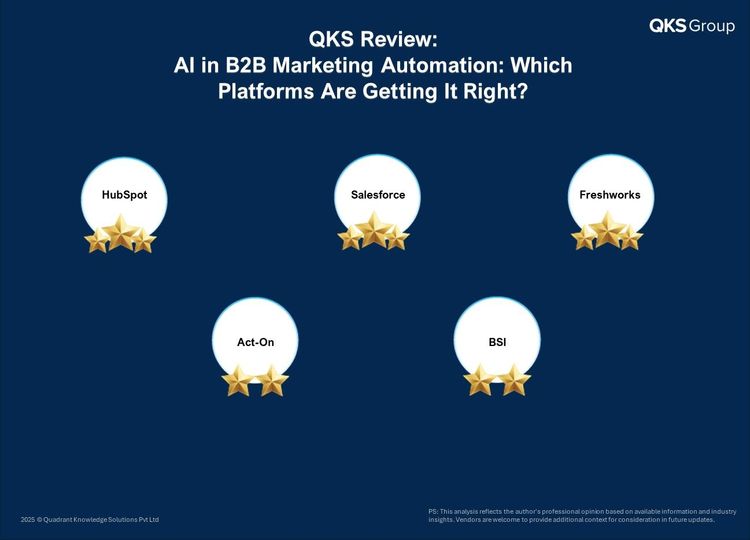
Salesforce's strategy towards AI is characterized by its depth, scalability, and integration. Agentforce, which is at the center of its platform and a part of Marketing Cloud Next, allows users to pre-built or custom agents that work like a virtual teammate instead of being a mere tool. These agents utilize semantic search and Retrieval Augmented Generation (RAG) models, enabling them to extract the most accurate information from structured as well as unstructured datasets, enabling the agents to interact with customers with accurate responses to their queries. The Atlas Reasoning Engine further enhances agent performance by decomposing complicated tasks and adapting in real-time, ensuring the proper execution of each prompt. The platform enables end-to-end campaign automation, ranging from creating briefs, customer journeys, custom messages, and summaries, thus taking away less work from marketing teams. With features such as dynamic ad optimization, dynamic content personalization, and two-way engagement across channels, Salesforce turns AI from an enabler or supporting member on the backend into a frontline force that proactively fuels marketing decisions. This makes Salesforce a strong option for businesses looking to integrate AI as a strategic co-pilot or a virtual team member across their B2B marketing life cycle.
HubSpot's AI features are embedded within its CRM and marketing automation tools, providing a balance of ease of use and features. The Breeze AI agent facilitates real-time interaction through managing customer questions, sending users the right and required content, and qualifying leads for marketers to take further actions, all within a fairly straightforward interface. The AI capabilities also facilitate campaign deployment and adjust outreach methods according to user response, while predictive analytics simplify decision-making. HubSpot provides a good mix of usability and automation making it suitable for large enterprises and mid-sized organizations.
Freshworks' integration of AI covers customer service, sales, and marketing through its Freddy AI engine. With data from more than a decade of support history, Freddy uses machine learning as well as large language models to automate multi-step interactions with customers across email, chat, and social media without having to depend on forms or repeated actions. Its Copilot boosts internal processes for support teams, and analytics dashboards enable leaders to predict, plan resources, and enhance decision-making. Its focus on access control and data governance also fits well for enterprises with compliance restrictions. Freshworks provides consistent performance for customer-facing as well as internal scenarios.
Act-On integrates AI into certain areas of the marketing workflow without disrupting the rest of the platform. The AI Create feature leverages OpenAI to enable marketers to create subject lines and email content in the platform, accelerating content creation and minimizing creative fatigue. Predictive Lead Scoring identifies probable conversions based on proprietary models, and its natural language analytics feature enables sales and marketing teams to concentrate their efforts. Act-On’s AI capabilities are narrow in scope and does not extend completely through the full campaign life cycle. For organizations looking for AI that actively engages in execution and optimization, Act-On might need additional complementary tools to fulfill more comprehensive requirements.
BSI’s AI capabilities are focused on reliability and governance, ensuring that AI agents do not overreach their set boundaries, which is a model that suits regulated industry organizations or those that don't want to give up too much control to automation. Its Companion agent works to support unobtrusively behind the scenes, doing the repetitive tasks that can be automated without sacrificing control or compliance. However, AI capabilities are on the more conservative end, with limited dynamic content creation or campaign-level personalization abilities. Though reliable to support operations, BSI might come across as restrictive to marketers wishing to tap into more creative, responsive AI applications.
Analyst Take: Selecting the right platform
The B2B marketing automation marketplace is evolving. Teams no longer desire platforms that say they are intelligent, but they desire AI to do the bulk of the work and assist teams in all functions as a virtual team member. The leading vendors in this area are Salesforce, HubSpot, and Freshworks, which have integrated AI into how marketing professionals create, personalize, and scale engagement, and are necessary for organizations in need of strong capabilities underpinning their marketing initiatives. Whereas Act-On and BSI have more specialized features, they fall short compared to the others within this blog when viewed through their AI capabilities based on "empowering marketers to do more, with less."
Disclaimer & Invitation:
This blog is based on independent research and publicly available information. The insights presented reflect the views of QKS Group and are for informational purposes only. While we strive for accuracy, we do not guarantee completeness or absolute correctness. Vendors are welcome to provide clarifications or updates. If any vendor listed in this analysis wishes to provide additional context or clarification, we welcome a briefing call and will consider incorporating relevant updates. This analysis is not intended to disparage any vendor but to provide an informed, balanced perspective. We encourage open and constructive dialogue to foster transparency and a deeper understanding of the industry.
Author: Tanuj Paulose, Analyst - MarTech & SalesTech at QKS Group