



Introduction: Evolving SSCSM Amid Growing Threat Complexity
Software Supply Chain Security Management (SSCSM) plays a critical role in today’s software-driven economy by ensuring the trustworthiness and safety of software components throughout complex development and delivery processes. As organizations rapidly adopt cloud-native architectures and accelerate digital transformation initiatives, the software supply chain becomes increasingly complex and exposed to more advanced and persistent threats. Traditional security methods, which were effective in static, well-defined environments, now face challenges in keeping up with the speed, scale, and sophistication of modern cyberattacks. In this evolving landscape, Artificial Intelligence (AI) has emerged as a key enabler that drives greater visibility, enhances threat detection, reduces alert fatigue, and speeds up vulnerability remediation within SSCSM.
Challenges in the Pre-AI Era: Understanding the Limits and Pain Points
Prior to the integration of Artificial Intelligence, Software Supply Chain Security Management predominantly relied on traditional static analysis, signature-based detection mechanisms, and extensive manual evaluation to identify risks within software components and dependencies. While these foundational techniques provided a baseline level of protection, they were inherently constrained by several critical limitations that hindered the effectiveness of supply chain security.
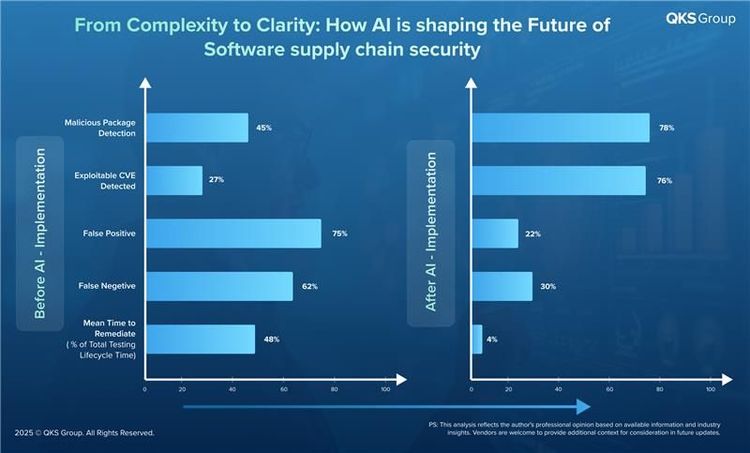
One notable challenge was the incomplete detection of malicious packages as conventional methods, heavily dependent on known signatures and deterministic rule sets, frequently failed to identify sophisticated or novel threats, resulting in significant blind spots exploitable by adversaries. Similarly, accurately determining which Common Vulnerabilities and Exposures (CVEs) are truly exploitable in a real-world environment has long been a significant challenge as traditional security tools often flagged many vulnerabilities without considering the specific operational context, resulting in a diluted focus where security teams spent time addressing issues that did not pose immediate or substantial risk.Another issue was False positive alerts, where security systems mistakenly flag safe activities as threats which have been a significant challenge for security teams as these high volume of incorrect alerts overwhelms developers, making it difficult for them to focus on real security issues and effectively prioritize remediation efforts. Conversely, false negatives alerts, vulnerabilities or threats that go undetected pose serious risks by leaving critical weaknesses unaddressed within the software supply chain, potentially leading to breaches and exploitation.
Furthermore, AI-based automation, remediation took longer because teams had to switch between disconnected tools and manually decide what to fix first. This extra coordination extended exposure to risk, increased audit, and incident workloads, and drove up operating costs, which in turn slowed release schedules. As a result, organizations faced a persistent trade-off between speed and protection, with observable impacts on reliability, risk visibility, and overall competitiveness.
Collectively, these challenges underscored the necessity for more intelligent, context-aware, and adaptive solutions, catalyzing the adoption of AI-driven capabilities as a strategic imperative in advancing the efficacy of Software Supply Chain Security Management.
AI-Driven Transformation: Turning Insights into Actionable Security
Artificial Intelligence has fundamentally transformed the Software Supply Chain Security Management landscape by overcoming the constraints of traditional methods through sophisticated analytics, pattern recognition, and environmental context awareness.
First, AI enhances the detection of malicious software packages by applying behavioral analysis, anomaly detection, and advanced machine learning techniques. Unlike rule-based systems, these AI-driven approaches effectively identify suspicious traits and evolving threats within software components, enabling organizations to proactively block high-risk elements before they can cause harm.
In the realm of vulnerability management, AI introduces intelligent prioritization by evaluating not just the presence of CVEs, but also considering contextual factors such as exploitability and real-time threat intelligence. This nuanced analysis allows security teams to focus remediation efforts on vulnerabilities that present legitimate operational risks, thereby optimizing resource allocation and reducing unnecessary disruptions.
Furthermore, AI significantly reduces false positive alerts by learning from historical security data and correlating multiple signals, this enhances the precision of alerts, enabling developers to concentrate on meaningful threats and streamline workflows.
AI helps reduce the risk of missed threats by detecting complex attack patterns and previously unknown vulnerabilities that traditional scanning tools might overlook. AI models learn and improve continuously, which helps them keep up with new threats and maintain strong protection against advanced attackers.
Finally, AI accelerates remediation processes through context-driven risk scoring and the automation of response workflows, often integrating seamlessly into modern development pipelines such as Continuous Integration/Continuous Delivery (CI/CD). This integration ensures that security keeps pace with development velocity, reducing the time between vulnerability discovery and resolution without introducing bottlenecks.
Business and Operational Impacts of AI Integration in SSCSM
Beyond technical metrics, AI-infused SSCSM realizes significant strategic value:
- Operational Efficiency: Automation and AI-driven insights reduce the burden on security teams by eliminating redundant tasks and focusing attention where it matters most. Security operations become more proactive rather than reactive, optimizing resource use.
- Scalability and Agility: AI supports continuous security across dynamic, ephemeral cloud-native environments by enabling agentless or lightweight scanning methodologies. This adaptability ensures organizations maintain real-time visibility regardless of infrastructure elasticity or complexity.
- Improved Developer Experience: Integrating AI-powered security tools into developers' workflows encourages a culture focused on security without slowing innovation also developers get clear, relevant feedback and prioritized security issues early in the software development process, helping them fix problems quickly and reduce future risks and technical debt.
- Risk and Compliance Alignment: AI supports detailed risk assessments that align with changing regulations and company policies. This helps organizations improve governance and close compliance gaps, especially in complex software supply chains
Conclusion: Harnessing AI for a Resilient Software Supply Chain Future
The progression from traditional, manual Software Supply Chain Security Management (SSCSM) practices to AI‑driven, intelligent security frameworks mark a pivotal shift toward greater clarity amid inherent complexity. In practical terms, this means correlating signals across code, dependencies, build systems, artifacts, and runtime to elevate detection precision, applying contextual exploitability analysis to suppress noise, and using policy‑aware automation to enable faster, evidence‑based remediation. By integrating with CI/CD pipelines, artifact registries, and cloud control planes, AI extends continuous visibility from design and commit through build, deploy, and production, while guardrails such as SBOM enrichment, provenance attestation, and policy‑as‑code maintain consistent standards with auditable traceability.
From a business perspective, these capabilities reduce unplanned work and operational friction, translate technical risk into business terms such as asset criticality, data impact, and regulatory scope, and improve audit readiness through continuous evidence collection. As digital transformation accelerates, embedding AI within SSCSM is not simply a competitive advantage; it becomes foundational to sustaining release velocity, strengthening reliability and resilience, and preserving stakeholder confidence while ensuring governance and human oversight remain integral to decision making.
Author: Shiva Bhardwaj, Analyst at QKS Group