

30.07.2025
QKS Insight
Charting Intelligence in Strategy Execution: Introducing the QKS AI Maturity Matrix for SPM Platforms
Author:
Ashray Gadekar


In an era defined by rapid disruption and continuous reinvention, the ability to translate strategy into execution has become a defining enterprise capability. Strategic Portfolio Management (SPM) is no longer enough to visualize roadmaps or monitor portfolio health through quarterly reviews. Today’s enterprise leaders need platforms that sense change, simulate impact, and steer resources dynamically. This is where AI is changing the rules of the game.
At QKS Group, we’ve observed a growing imperative among CXOs, transformation heads, and enterprise architects to move beyond traditional frameworks and toward systems that support strategic agility in real time. AI is not merely a feature enhancement in this context; it is the structural foundation that enables organizations to navigate volatility with confidence and clarity. From investment scenario modeling and capability alignment to adaptive roadmap recalibration, AI is reshaping how enterprises execute strategy at scale.
However, while AI’s potential is widely acknowledged, its maturity across the SPM landscape remains uneven. Many platforms claim AI integration, yet few deliver intelligence that is deeply embedded into strategic workflows, decision layers, and enterprise operating models. To bring clarity to this fragmented landscape, QKS Group has developed the AI Maturity Matrix for SPM, a comprehensive framework that evaluates not just what AI features a platform offers, but how those features empower better strategic decision-making, portfolio adaptability, and enterprise value realization.
This blog offers a lens into the forces reshaping the SPM market, the strategic value of AI integration, and how the QKS AI Maturity Matrix helps vendors and buyers benchmark progress toward a more intelligent future of portfolio orchestration.
Redefining the Role of SPM: From Planning to Orchestration
At its foundation, SPM helps enterprises define, fund, and execute the right mix of strategic initiatives. Strategic Portfolio Management (SPM) platforms unify inputs from enterprise architecture, corporate strategy, finance, and execution layers, providing leadership teams with the visibility and control needed to align resources with high-impact objectives.
Historically, SPM tools have focused on portfolio visualization, initiative tracking, and governance oversight. They enabled annual planning cadences, ROI modeling, and portfolio rationalization exercises but such static models fall short in an environment shaped by continuous disruption such as economic shifts, M&A activity, regulatory change, and technological innovation.
Enterprises now require systems that can adapt and recalibrate with speed. They need tools that not only reflect what the portfolio looks like today but also simulate what it could look like tomorrow. This is where AI becomes mission critical.
Why Intelligence Is the New Currency in Strategy Execution
Traditional Strategic Portfolio Management (SPM) models are constrained by linearity. Strategic plans often lag execution realities, and decisions made in Q1 are misaligned by Q3. AI flips this paradigm by infusing the SPM layer with dynamic learning, proactive recommendations, and contextual understanding.
AI-enabled SPM platforms are now capable of real-time prioritization, value tracking, and adaptive roadmapping. They help leaders make sense of complex trade-offs across investments, capabilities, and risk exposure, and simulate potential outcomes before committing resources.
This evolution turns SPM into a living model of strategic agility. Intelligence becomes the connective tissue between planning cycles, operating models, and market signals empowering leadership teams to pivot, prioritize, and perform with confidence.
Strategic Intelligence in Action: The Mutual Value of AI for SPM Users and Vendors
The integration of AI into Strategic Portfolio Management is no longer a peripheral enhancement, it is foundational to redefining how strategy is crafted, executed, and continuously optimized. For enterprise users across functions, AI introduces targeted, high-impact capabilities such as a Chief Strategy Officer can simulate trade-offs between digital transformation and ESG initiatives under varying budget constraints; a finance leader can dynamically reprioritize investments based on real-time ROI forecasts and shifting macroeconomic indicators; and an enterprise architect can assess the downstream effects of delaying a capability buildout, factoring in resource interdependencies and milestone impacts. AI enables organizations to move beyond static heatmaps and retrospective analysis, toward scenario-driven planning, anticipatory risk mitigation, and continuous portfolio steering. In this context, AI does not merely improve visibility, it elevates strategic precision, allowing decision-makers to operate with agility, foresight, and measurable value orientation.
For vendors, the implications are equally profound. AI is not just another feature on the roadmap; it is the architectural differentiator that will separate platforms built for tomorrow from those anchored in yesterday. Vendors must transition from offering isolated AI widgets such as basic forecasting or chatbot assistance to delivering deeply integrated intelligence engines that span strategic planning, investment governance, resource modeling, and adaptive execution. Those that succeed in embedding AI across the decision stack will unlock a new tier of platform utility: one defined not by visibility, but by strategic influence.
SPM as a Strategic Decision Engine, Not Just a Planning Tool
The convergence of AI and Strategic Portfolio Management (SPM) marks a fundamental transformation. With AI, a strategy officer can forecast capability gaps before they emerge. A CFO can model investment scenarios under changing macroeconomic conditions. A transformation leader can simulate the enterprise-wide impact of delaying a key initiative. In each case, the platform doesn’t just display information, it guides intelligent action.
Modern SPM platforms are moving from systems of insight to systems of intelligence. This evolution is especially important in decentralized enterprises, where distributed teams require strategic guardrails to avoid fragmentation and value leakage.
Why the QKS AI Maturity Matrix for SPM Matters Now
Despite the surge in AI-driven messaging, many SPM platforms remain in the early stages of true intelligence integration. While chat-based assistants and predictive dashboards are becoming common, these features rarely reflect deep architectural integration or decision automation.
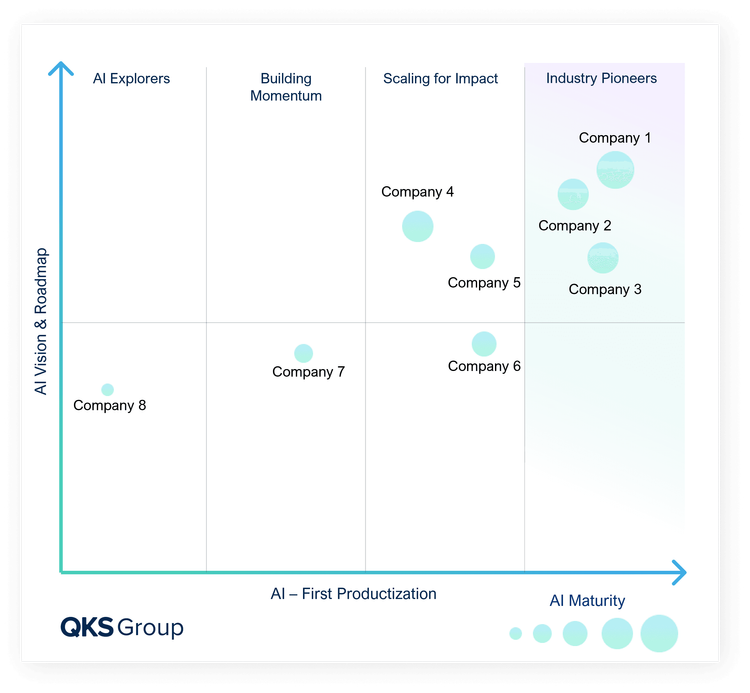
At QKS Group, we believe that evaluating AI maturity requires more than counting features. Our AI Maturity Matrix for SPM is designed to assess how platforms integrate AI across the strategic stack from strategic demand intake and capability mapping to investment governance and roadmap simulation.
The matrix segments platforms into four levels of maturity, assessing areas such as portfolio optimization, contextual prioritization, AI-led scenario planning, and enterprise-level orchestration. Crucially, it connects technical depth with user value, highlighting how AI enables better, faster, and more strategic decisions.
For buyers, the matrix becomes a practical lens to evaluate vendor fit. Whether the organization is embarking on its SPM journey or scaling toward continuous strategic alignment, this tool helps identify the right platform for the right maturity curve.
For vendors, it serves as a product blueprint. It clarifies how AI can move beyond pilots and prototypes to become an embedded, differentiating engine. It also encourages a shift in narrative from capability demonstration to strategic enablement.
Looking Ahead: Intelligence as the Strategic Operating System
As the velocity of change accelerates and strategic planning cycles collapse into continuous navigation, enterprises will increasingly rely on intelligent systems to drive portfolio choices, resource shifts, and capability investments. The next generation of SPM platforms will not differentiate based on visual dashboards or planning workflows, they will compete on how intelligently they help the enterprise respond to change, forecast complexity, and deliver outcomes.
AI is becoming the strategic operating system of modern organizations. Without it, even the most well-integrated Strategic Portfolio Management (SPM) platform risks becoming a static archive of outdated intent. With it, the same platform becomes a living model of strategy, self-aware, responsive, and outcome driven.
The QKS AI Maturity Matrix for SPM is designed to reflect this reality. It enables technology buyers to cut through the noise and make informed decisions about platform fit, readiness, and strategic alignment. It offers vendors a path to move from incremental enhancement to intelligent orchestration. And it empowers the entire ecosystem to shift the conversation from tools that manage strategy to platforms that enable it.
To explore the framework or benchmark your platform’s AI maturity, contact us at nikhileshn@qksgroup.comor ashrayg@qksgroup.comThe future of strategic execution will belong to platforms that think. Let this be your moment to lead with purpose and intelligence.
Author: Ashray Gadekar, Analyst - Strategic Portfolio Management at QKS Group