



The Third and Final Blog of this series highlights the most affected functionalities of the Software Engineering Landscape that hold the possibility of completely diminishing the impact or importance of Human interventions. In the first instalment, we explored the restrained role of AI in domains where judgment, architectural foresight, and business-contextual reasoning dominate. We concluded that despite AI’s rapid advances, its ability to replace human-led strategy and architecture remains minimal, precisely because these areas are bound by interpretive complexity and contextual variability. The second part of the series shifted focus to execution-driven functions, where AI has begun exerting moderate influence, accelerating tasks such as code scaffolding, defect triage, and automated testing. In such environments, repeatability and predictability create opportunities for automation, although human oversight remains crucial for ensuring accuracy and preventing cascading errors.
This third and final piece examines the high-impact frontier, the transition of AI from an assistive co-pilot to a self-governing autopilot. This shift does not imply the wholesale handover of engineering processes to AI. Instead, it signals the selective delegation of repeatable, policy-bound operations where autonomy does not introduce disproportionate risk. In other words, autonomy thrives where guardrails, policies, governance frameworks, and accountability structures provide a safe environment. The question before enterprises is no longer if AI can take over, but where and under what conditions it should be trusted to do so.
The Autonomy Test: Defining the Framework
The Autonomy Test is a practical lens through which enterprises can assess where AI can safely transition from assistive support to independent execution. Not every task is suited for autonomy; some demand judgment, contextual awareness, and strategic foresight. The Autonomy Test helps separate those areas from the ones where automation compounds speed, reliability, and efficiency without introducing disproportionate risk.
The framework rests on four parameters that serve as predictors of AI’s potential impact:
1. Signals: The availability of machine-readable indicators, such as logs, metrics, test results, or anomaly scores, that inform AI-driven decisions.
Importance: In software engineering, signals provide the raw input for action. For example, CI/CD test failures, latency spikes in observability dashboards, or vulnerability scan results all create precise triggers that AI can act on. Without reliable signals, autonomy risks acting on incomplete or misleading data.
2. Repetition: The frequency and consistency with which a task occurs across the engineering lifecycle.
Importance: Tasks that recur daily or weekly, such as applying dependency updates, rotating secrets, or resolving common container failures, are prime candidates for AI autopilot. High repetition builds pattern recognition, allowing AI systems to refine their responses and improve precision over time.
3. Reversibility: The ability to roll back, undo, or degrade gracefully if an AI-driven action has unintended consequences.
Importance: In engineering, reversibility provides a safety net. If an automated deployment introduces an issue, can it be instantly rolled back? If a configuration change fails, can the system revert to a stable state? High reversibility reduces the risk of autonomy, making experimentation safer and adoption faster.
4. Telemetry: The continuous collection of outcome data that validates whether AI actions achieved their intended effect.
Importance: Telemetry closes the loop, enabling AI systems to learn and self-correct. In software engineering, telemetry comes from monitoring pipelines, SLO dashboards, or cost-performance metrics. It ensures that autonomy doesn’t just execute tasks but also adapts based on results, aligning future actions with enterprise goals.
What Disappears vs. What Remains Human (and why it matters)
As AI advances from co‑pilot to autopilot, the distribution of work in software engineering undergoes a structural shift. The tasks that once consumed the majority of engineering time, repetitive fixes, maintenance chores, and predictable operational responses, begin to shrink in importance, while judgment‑driven, integrative, and high‑context responsibilities remain firmly human. This rebalancing does not diminish the role of engineers; instead, it redefines it, pushing human effort upward into areas of strategic influence and creative problem‑solving while automation absorbs the repetitive foundations of execution.
What Disappears (or Shrinks)
Typical tasks such as trivial PRs (lint/format, small refactors), flaky‑test triage, routine rollbacks, low‑risk dependency and patch updates, secret rotation, infrastructure rightsizing and scaling tweaks, known‑signature incident fixes, pipeline restarts or backfills, and performance tuning of common knobs are increasingly being delegated to AI systems. They fade from human responsibility because they meet all four conditions of the Autonomy Test: they are high‑repetition, generate strong signals, are safely reversible, and produce abundant telemetry.
From a strategic perspective, the disappearance of these tasks reduces tactical drag and frees leadership to focus on platform roadmaps and product acceleration, enabling greater optionality and the ability to run more parallel bets. From a business standpoint, eliminating toil leads to faster lead times for changes, higher deployment frequency, and more consistent customer experience, which in turn improves retention and satisfaction. The human resource dimension is equally significant: with toil collapsing, on‑call fatigue diminishes, and roles begin to tilt toward automation engineering, runbook design, and systems thinking. Instead of firefighting, engineers now develop and refine the rules of automation. On the cost side, fewer engineer‑hours are spent on repetitive work, incident costs decrease as MTTR improves, and cloud unit economics benefit from continuous rightsizing, even though new investments in telemetry and tooling are required. Technologically, the result is greater stability of repos and environments, stronger golden paths, and cleaner release hygiene, though organizations must be wary of building automation debt if they expand autonomy faster than they strengthen observability and test depth.
What Remains Decisively Human
In contrast, responsibilities such as domain architecture, cross‑team prioritization, threat modelling, exception handling, structural refactors, schema evolution, and product‑risk trade‑offs remain firmly human. These tasks endure precisely because they require contextual judgment, complex trade‑offs, tacit knowledge, and negotiation. They exist in areas where signals are ambiguous, repetition is low, reversibility is costly, and telemetry is lagging or qualitative.
The impacts here are profound. Strategically, leaders now own the scope and surface area of autonomy itself, defining where autopilot should operate and setting organizational risk appetite. Freed from repetitive oversight, they can focus more clearly on architectural vision and long‑term product alignment. Business impacts are also visible: governance becomes evidence‑based rather than checklist‑driven, delivery predictability improves, and outcomes align more tightly with customer value. From a human resource perspective, roles evolve significantly. Developers become product engineers, SREs transition into reliability strategists, security teams become risk curators, and QA professionals shift toward quality engineers focused on contracts and automation.
Hiring priorities tilt toward systems design, platform thinking, and fluency in risk and controls, while career ladders open new paths for autonomy, stewardship and observability leadership. Costs also rebalance: although organizations invest heavily in telemetry, test coverage, and rollback mechanisms, these are offset by lower overall costs of change and higher reliability of critical releases. Finally, from a technology perspective, the enduring human work ensures that autonomy is governed by guardrails rather than hard gates, with contracts, SLAs, progressive delivery strategies, and chaos testing defining the boundaries of safe automation.
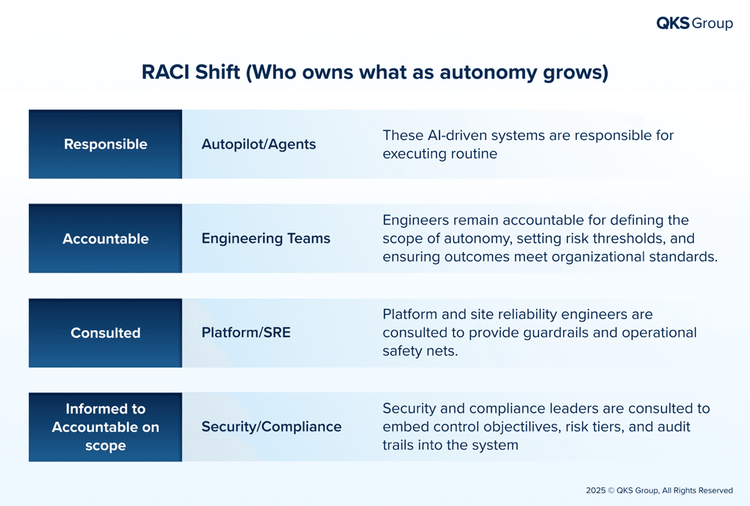
RACI Shift (Who owns what as autonomy grows)
As autonomy scales across engineering functions, accountability and ownership must be redefined. A RACI (Responsible, Accountable, Consulted, Informed) model provides clarity by mapping who drives execution, who carries outcome ownership, who shapes guardrails, and who ensures alignment with business priorities. This avoids confusion as machines take on repeatable work and humans concentrate on governance and judgment-heavy tasks.
Autopilot/Agents (Responsible): These AI-driven systems are responsible for executing routine and well-defined tasks such as known-pattern fixes, automated rollbacks, scaling adjustments, low-risk patches, and test maintenance. They are the first line of action, carrying out decisions at speed and scale, but they do not own the final accountability for success.
Engineering Teams (Accountable): Engineers remain accountable for defining the scope of autonomy, setting risk thresholds, and ensuring outcomes meet organizational standards. They determine which tasks are eligible for automation, validate AI actions, and own the quality and reliability of the systems overall.
Platform/SRE (Consulted): Platform and site reliability engineers are consulted to provide guardrails and operational safety nets. They design golden paths, create rollback primitives, and define the economic trade-offs of reliability, ensuring that autonomy aligns with platform-level resilience and cost efficiency.
Security/Compliance (Consulted): Security and compliance leaders are consulted to embed control objectives, risk tiers, and audit trails into the system. Their guidance ensures that automated actions comply with regulatory standards and organizational policies.
Product/Leadership (Informed to Accountable on scope): Product leaders and executives are informed of the surface area of autonomy and, in cases involving customer impact or business-critical flows, become accountable for approving the scope of automation. They align AI autonomy with broader business objectives and customer expectations.
Leading Indicators to Track the Shift
The transition from human-driven operations to AI autonomy is not a binary flip but a gradual journey, and enterprises need evidence that the shift is delivering measurable value. Leading indicators serve as early signals that autonomy is scaling effectively, reducing risk, and creating business impact. Each indicator ties directly to software engineering performance, organizational health, and cost efficiency.
- Percentage of Auto-Merged Low-Risk PRs and 24-Hour Revert Rate: A rising share of pull requests merged autonomously without manual intervention, coupled with a low revert rate within the first 24 hours, demonstrates that AI is handling routine code changes safely and effectively.
- Percentage of Incidents Auto-Resolved and MTTR Delta vs. Manual Path: Tracking how many recurring incidents are resolved without human intervention, alongside the reduction in mean time to resolution compared to manual resolution, shows how much autonomy is relieving on-call teams and strengthening service reliability.
- Change Failure Rate (CFR) and Deployment Frequency Uplift: A lower CFR with a higher cadence of deployments indicates that AI-driven release orchestration is not only accelerating delivery pipelines but also reducing the number of failed releases, proving that speed and stability can coexist.
- Cost per 1,000 Requests (or per Transaction) with SLO Adherence: Monitoring the unit economics of serving workloads, factoring in both performance and error budgets, demonstrates how AI-based rightsizing and scaling impact cloud spend while maintaining service quality.
- Flaky-Test Rate and Coverage Growth vs. Regression Rate: A declining percentage of flaky tests and steadily improving coverage show that AI is effectively managing the testing layer, reducing wasted engineering cycles, and strengthening quality assurance.
- Percentage of Workloads Right-Sized Automatically and Spend Variance Stability: Measuring how many workloads are tuned automatically by AI agents, along with the stability of cost variance, provides insight into how effectively autonomy is governing infrastructure and FinOps decisions.
Together, these indicators help organizations move beyond anecdotes to tangible proof points. They provide executives with confidence that autonomy is not just a technical experiment but a measurable transformation delivering speed, resilience, and cost discipline.
High-Impact Domains of Autonomy (What Engineers Should Do Now)
AI is beginning to cross the threshold from supportive assistance into autonomous execution across specific domains of software engineering. These domains are impacted the most because they exhibit all four factors of the Autonomy Test: they generate strong, machine-readable signals, involve highly repetitive tasks, allow safe reversibility through rollbacks or mitigations, and produce rich telemetry for continuous learning. As a result, these areas are natural candidates where autonomy compounds both efficiency and reliability at scale.
Trivial code reshaping and hygiene, tasks such as linting, formatting, removing dead code, or renaming variables, are low-value but high-frequency. They rely on machine-readable signals like static analysis and unit tests, are trivially reversible through a commit rollback, and success is instantly verifiable through CI pipelines. These are precisely the conditions where AI thrives. Instead of engineers spending hours on repetitive cleanups, AI agents can enforce consistency continuously and automatically. For Engineers, the role shifts from execution to stewardship: defining what qualifies as a “safe edit,” refining code-mod libraries, and curating exceptions when context demands a deviation.
Low-risk dependency and base-image patching are other areas where AI’s dominance is inevitable. Dependency updates, container base refreshes, and patch upgrades are frequent, rule-driven, and easily verified against SBOMs, vulnerability budgets, and build pipelines. Rollbacks are safe, and telemetry is precise. Here, AI is not just a productivity tool; it is a compliance and security accelerator. Engineering role evolves toward handling major version jumps, managing breaking changes, and designing sustainable upgrade cadences that balance innovation against stability.
Secrets and certificate lifecycle management, rotating API keys, renewing TLS certificates, and revoking tokens are inherently deterministic. Expiry windows and policy-driven renewals are well-defined signals; the tasks are repetitive, and failures are easily caught through authentication error spikes. AI can handle these cycles hands-free, reducing toil and removing a common source of outages. Engineers no longer waste time firefighting expired credentials; instead, they design tiered rotation policies, align practices with zero-trust models, and manage exceptional scenarios where automation cannot act alone.
Provenance, signing, and SBOM generation are already fully mechanistic. Building an SBOM, signing artifacts, and enforcing release gating policies require no human judgment once the rules are defined. These processes fail closed, are repeatable per build, and telemetry is binary: either attestations are present and valid, or they are not. Humans move into oversight roles, deciding which frameworks or standards to adopt (e.g., SLSA levels), negotiating supplier compliance, and auditing the organization’s supply chain posture.
GitOps drift reconciliation provides another natural candidate for AI autonomy. Detecting configuration drift and reconciling infrastructure back to the declared state is a precise, repetitive, and reversible task. Tools already execute most of this deterministically; AI can close the loop with pre-flight checks and adaptive scheduling. Human engineers will focus less on resolving drift and more on designing complex multi-environment topologies, managing “break-glass” exceptions, and evolving golden paths that balance speed with safety.
Progressive delivery orchestration, including canary rollouts, blue-green deployments, and feature-flag promotions, is governed by formulaic promotion criteria and bounded by reversible strategies like rollbacks. AI can manage these safely using telemetry from SLOs, error budgets, and cost metrics. Engineers, in turn, will spend their energy on higher-order design: setting risk thresholds, shaping promotion policies, and making ethical or strategic decisions about dark launches, high-risk features, or user cohort selection.
Known-pattern incident autoremediation is another domain where AI already acts as an autopilot. Restarting pods, clearing caches, rerouting traffic, or resetting circuit breakers are well-documented and highly repeatable runbooks. When signatures match and remediation is validated by telemetry, AI can close incidents without human intervention. Engineers step into a new role as runbook architects and chaos testers, curating the automation library, validating that it behaves as expected under stress, and focusing their own time on novel or complex incidents where context is ambiguous.
Rightsizing and autoscaling are already data-driven. AI can adjust CPU, memory, or scaling thresholds dynamically based on utilization and SLO adherence. These actions are reversible and bounded by budgetary and performance constraints. Engineers will no longer spend time tweaking resource knobs; instead, they will architect capacity models, negotiate trade-offs between cost and performance, and design policies that optimize for multi-tenant fairness or business-critical workloads.
Pipeline and image hardening, such as refreshing base images, blocking builds with leaked secrets, or quarantining vulnerable containers, fits neatly into automation. Policies are codified, violations are deterministic, and remediation is scripted. AI ensures these are enforced without fatigue. Engineers’ role shifts toward expanding policy-as-code frameworks, evaluating ambiguous cases (e.g., temporary CVE exceptions), and improving the developer experience so that security is not seen as a blocker but as an enabler.
PR, ticket, and communications automation leverages AI’s natural language processing capabilities to classify pull requests, detect duplicates, generate changelogs, or draft templated incident updates. These are high-volume, low-value tasks where accuracy can be quantified and reversibility is trivial. Engineers will remain responsible for higher-stakes communication, shaping taxonomies, training classifiers in organizational vocabulary, and handling stakeholder messaging where nuance and strategy are essential.
Backup integrity and restore drills are predictable, repeatable, and testable. AI can schedule restores into sandboxed environments, validate outcomes against golden checks, and surface only deviations. This relieves teams from repetitive validation chores. Engineers’ responsibility remains in scenario planning for regional outages, handling legal data residency requirements, and balancing redundancy costs against performance.
Data and MLOps “known error” handling is another fit. Retries, quarantines, checkpointed backfills, and retrains are highly patterned and reversible. AI can execute these automatically, freeing teams from the endless toil of chasing stale partitions or bad batches. Engineers will continue to own schema evolution, model redesign, and ambiguous edge cases where automation cannot interpret intent.
FinOps guardrails like terminating idle resources, enforcing TTLs on preview environments, or activating anomaly kill-switches are straightforward and data-driven. AI can enforce these rules hands-free with continuous telemetry on spend and utilization. Engineers step up into strategic finance–engineering negotiations, architecting budget trade-offs against reliability and aligning cost governance with business priorities.
Configuration and compliance autofix, from blocking public buckets to enforcing encryption and IAM minima, is a clear policy-as-code problem. AI can remediate violations instantly, log actions for audit, and escalate only when exceptions arise. Engineers take ownership of the evolving policy libraries, adjudicate exception requests, and align practices with regulatory changes.
Near Term (6–24 Months to Full Autonomy)
Database index management and plan tuning are on the horizon of automation. With workload telemetry and plan statistics providing detailed signals, AI will soon be able to add or drop indexes and tweak query plans safely in bounded contexts. These actions are narrow, reversible, and measurable, making them ideal candidates for AI. Engineers will focus instead on logical data design, partitioning strategies, and cross-service optimization, areas where context and judgment remain essential.
Performance regression mitigation will also move toward autonomy. AI can detect regressions in latency or throughput, tune caches, and adjust pool sizes or timeouts dynamically. These adjustments are bounded and reversible, and telemetry confirms impact. Engineers will redirect their effort to systemic re-architecture, designing caching strategies, and optimizing business workflows rather than adjusting runtime knobs.
Contract-driven SDK and client regeneration are already highly automatable. Given a source-of-truth API contract, AI can regenerate clients, run compatibility tests, publish artifacts, and even draft release notes. Engineers will remain responsible for evolving the contracts themselves, negotiating breaking changes, and managing deprecation policies with customers and partners.
Ephemeral environments on demand, spinning up golden-path previews for each pull request, seeding masked data, running checks, and tearing down are template-driven and highly repetitive. With infrastructure as code providing reversibility and health telemetry validating correctness, AI can manage this lifecycle autonomously. Engineers will design the golden paths, curate representative seed datasets, and troubleshoot anomalies across multi-service previews.
License compliance and third-party notice generation will soon be fully automated. SBOMs combined with license databases can detect conflicts and generate required notices at build time. The process is rule-driven and deterministic, making human intervention unnecessary except in exotic licensing scenarios. Engineers and legal stakeholders will focus on policy evolution, vendor negotiations, and exception handling.
Runbook-templated stakeholder communications is another near-term candidate. Incident narratives, RCA drafts, and customer updates can be auto-generated from telemetry when templates and sign-off rules are pre-delegated. These tasks are repetitive and constrained, and reversibility is as simple as issuing an update. Engineers and leaders will continue to own sensitive or high-stakes communications, refine templates, and ensure that the “voice of the organization” remains authentic in complex situations.
Advisory
For Organizational Decision Makers
Executives, CIOs, and CTOs must approach AI autonomy as a governance transformation rather than a technology rollout. The priority is to create a clear policy framework that defines which domains are safe for autonomy and which demand human oversight. Leaders should establish tiered policies that classify tasks into high-risk and low-risk categories, begin with compliance-friendly areas such as patching, scaling, and identity enforcement, and mandate explainability and auditability for every autonomous action. To sustain trust, it is essential to form cross-functional councils that include IT, security, compliance, and business stakeholders. These groups continuously validate boundaries, ensuring that autonomy aligns with enterprise risk appetite and strategic objectives. The strategic payoff is operational excellence and innovation capacity, but only if governance maturity keeps pace with technological adoption.
For Software Engineering Teams
For developers and engineering teams, the shift to autonomy is less about ceding control and more about redefining their roles. Engineers must focus on designing robust policy-as-code frameworks that set clear boundaries for AI operation. Observability pipelines should be prioritized so that every AI-driven action leaves behind a transparent audit trail. Rather than performing repetitive fixes, developers evolve into supervisors and policy architects who ensure that automation behaves safely and predictably. Teams should treat AI agents like junior engineers whose work must be validated, monitored, and corrected until full trust is established. This transition requires new skills in automation design, reliability engineering, and data-driven validation, elevating the profession from task execution to system-level governance.
For Vendors
Vendors must resist the temptation to oversell unbounded AI autonomy as end-to-end automation. Enterprises do not seek blind delegation; they seek safe delegation. To meet this demand, vendors should embed governance and compliance frameworks directly into their platforms, provide configurable guardrails, and supply pre-built policy templates aligned to regulations such as GDPR, HIPAA, and PCI DSS. Transparency features such as explainability dashboards, real-time logs, and traceability chains should be considered table stakes, not premium add-ons. Vendors that balance autonomy with accountability will position themselves as trusted partners, while those who market autonomy without guardrails risk undermining enterprise trust and credibility.
Conclusion
The shift from co-pilot to autopilot marks a redefining moment in software engineering. Autonomy thrives where repeatability and telemetry converge, unlocking speed, reliability, and scale. But AI is not replacing humans; it is reshaping their role. Engineers become supervisors, policy setters, and exception handlers, while AI handles execution at machine scale.
Looking ahead, the future roadmap for AI autonomy will extend beyond code, testing, and infrastructure. Segments such as security operations, MLOps reliability, data engineering pipelines, and performance optimization will see the deepest levels of automation as telemetry matures and rollback mechanisms become seamless. In the enterprise technology stack, DevOps, SecOps, and FinOps domains are poised to experience the most visible transformation because they combine clear signals, high repetition, and measurable economic outcomes. Meanwhile, strategic domains such as architecture, cross-team governance, and product alignment will remain human-centred, enriched by AI insights but not supplanted by AI execution.
The technology landscape of the coming years will be characterized by hybrid operating models in which AI autopilots handle the operational heavy lifting, while human engineers focus on systems design, ethical boundaries, and innovation. Toolchains will converge into platforms that embed autonomy by default, with observability, compliance, and explainability built in as first-class capabilities. Vendors that successfully combine autonomy with trust will shape the new normal, while enterprises that delay adoption may find themselves locked in slower, costlier, and less resilient operating models.
The broader arc of this transition signals a future where autonomy is not an experiment but an operational baseline. Software engineering will be defined less by manual toil and more by how effectively organizations design, monitor, and evolve the boundaries of AI-driven execution. In this sense, the journey from co-pilot to autopilot is not about surrendering control, but about scaling trust, and in doing so, reshaping the very fabric of how digital systems are built, operated, and evolved.
Author: Nikhilesh Naik, Associate Director at QKS Group