


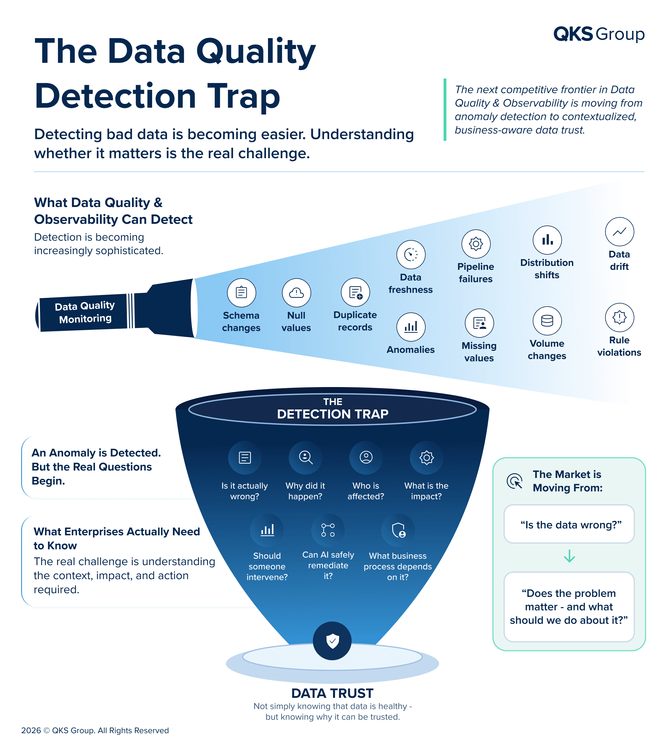

About six months into our evaluation of the Data Quality & Observability Tools market, the anomaly-detection demos in our notes had started to blur together. A pipeline is connected, the platform learns what "normal" looks like, something drifts, an alert fires, and a lineage graph lights up the downstream tables. Across the 22 vendors we assessed, the differences at this stage were mostly about polish, not capability.
The conversations only became distinctive when we asked the next question. Is that anomaly actually a problem? Who owns the data? What breaks if nobody acts? Would you let the platform fix it on its own? That is where this market separates, and where most market overviews stop.
The question behind the Matrix
Six months of briefings, product demonstrations, RFI responses, a 143-criterion capability assessment, and practitioner conversations pushed us from a conventional research question toward a less comfortable one:
If detecting bad data has become easy, why do so many enterprises still not trust their data?
We began with a working hypothesis: that the real shift in data quality is from fixing bad data to continuously proving it can be trusted. The research supported that, but only halfway. You cannot prove data is trustworthy until you have defined what it is trustworthy for, and most enterprises have not. What sits between fixing and proving turned out to be the most interesting part of the Data Quality and Observability market.
The conventional story, that data quality is moving from batch to continuous, from rules to machine learning, and from IT-owned cleansing to always-on observability, is broadly accurate. What it misses is where the bottleneck has moved.
What the research actually revealed
AI-powered data quality commoditized faster than the market admits
Almost every vendor positioned machine learning as central to its proposition. Yet ML-based monitoring of freshness, volume, schema, and distribution drift appeared across heritage data quality vendors, observability-native vendors, and platform suites alike. Of the 22 vendors evaluated, 18 offered native ML-based anomaly detection across freshness, volume, schema, and distribution, and 14 of those offered it out of the box without custom model configuration. AI was supposed to be the differentiator; at the detection layer, it has become the entry ticket. The vendors that stood apart did so on less fashionable ground: metadata depth, mature rules and business-term libraries, granular lineage, and the ability to tie a quality signal to a business definition rather than a column name.
Proactive in the demo, reactive in production
Observability promises to catch problems before the business notices. In our end-user conversations, however, data problems were still often discovered first by a business user questioning a dashboard, report, or model output. The gap is not technical. Monitoring coverage tends to follow what engineering can instrument, not what the business depends on, and broader coverage without prioritization simply produces alert fatigue. Trust does not scale with signal volume; it scales with the share of alerts that actually matter.
Autonomy stops at the production boundary
"Autonomous" and "agentic" featured heavily in vendor roadmaps. Buyers were more measured: let AI propose a rule, suggest a root cause, or draft a fix, but keep a human approval step before anything touches production data. In the near term, the capability that matters is not autonomy but accountability: remediation that is explainable, approved, logged, and reversible.
The tools are continuous; the programs are still projects
Platforms are built for continuous operation, but the initiatives described to us were often tied to a migration, an MDM rollout, a regulatory deadline, or an AI pilot. When the event ended, so did the funding and sometimes the ownership. A continuous tool inside an episodic operating model decays quietly, which is why a standing owner and budget predict long-term value better than any feature list.
Real-time is a property of a domain, not a platform
Real-time monitoring sat on many buyer wish lists, but genuine latency sensitivity concentrated in specific domains such as payments, fraud, customer-facing operations, and some operational AI workloads. Much analytical and reporting data was well served by scheduled or event-triggered checks. The more mature buyers had begun tiering monitoring by business criticality, which again depends on business context.
The uncomfortable truth
The industry has solved the detection problem faster than the decision problem, and that gap has become a leading source of distrust in enterprise data.
Detection is a statistical question, and machines answer it well. Deciding what to do is different. It requires knowing whether a change is an error or a legitimate business event, where it originated, which processes and models consume the data, what it costs if the data is wrong, who has authority to act, and whether an automated fix is safe. None of those answers lives inside the data. They live in business definitions, ownership, lineage, and risk classifications scattered across catalogs, MDM hubs, spreadsheets, and people's heads.
So better detection without better context can make trust worse. Each unexplained alert teaches the organization that the system cries wolf. The enterprise ends up knowing more about what might be wrong and less about what it can rely on.
The AI paradox
AI removes the informal human checkpoint that absorbed bad data for decades. An analyst who spots an odd number asks a colleague; an AI agent or RAG pipeline uses what it retrieves, at machine speed, and answers confidently. Quality also expands to questions traditional rules never asked, such as whether a document is current, superseded, or appropriate for this user, and it now applies to AI-generated data that no person ever entered.
The paradox is that AI has made data quality urgent to executives, yet the underlying problems of inconsistent definitions, unclear ownership, and undocumented transformations are unchanged. AI did not create new data problems; it removed the tolerance for old ones. When an AI system acts on bad data, the executive question is not "which monitor failed?" but "who was accountable for knowing?" That moves data quality into the territory of business risk and AI governance.
Convergence is really a race for context
Heritage data quality vendors are extending into observability and ML detection. Observability-native vendors are extending into business rules, data contracts, catalog, and lineage. Catalog and governance platforms are absorbing quality signals into their own trust indicators. This is less a feature consolidation than a race to own business context, because context is where the decision problem gets solved.
For buyers, the architecture question becomes where the system of record for data context will live. Ownership disputes between the CDO's office, engineering, and business domains become unavoidable. Side-by-side detection scoring stops separating vendors. And because context is sticky, whichever platform holds it will be hard to displace, so that choice should be deliberate.
Who is moving in the right direction
Several vendors in our evaluation illustrate the shift toward context particularly well, each from a different starting point. Ataccama has rebuilt Ataccama ONE around a single architecture spanning data quality, observability, lineage, catalog, and MDM, with an AI agent positioned as a digital data steward; its bet is that trust is easiest to establish when quality and context share one metadata model, and the real test will be how much agentic remediation enterprises actually permit in production. Informatica, now part of Salesforce following the acquisition that closed in November 2025, brings breadth across quality, catalog, governance, and MDM under its CLAIRE AI engine; the open question for buyers is how its roadmap balances Salesforce-centric priorities with heterogeneous data estates. Collibra approaches from the governance side, embedding Data Quality & Observability into its platform so quality signals connect to data products, policies, and AI models, a clear expression of the race for context that works best where the catalog is already the system of record. Experian pairs quality and governance in Aperture Data Studio with curated reference and enrichment data, and its native Snowflake integration reflects a wider move to run quality checks where the data lives. Redpoint Global is the most domain-specific of the group, anchoring quality in customer identity resolution and golden-record accuracy, a reminder that context can come from deep domain knowledge as much as from a horizontal metadata layer. What unites them is not superior detection, which is now common across the field, but a deliberate effort to connect quality signals to business meaning.
Analyst verdict
Detection, once the hard problem, is now the price of entry. The next generation of data quality and observability platforms will be distinguished not by how many problems they find, but by how much business context they bring to each one, how quickly they turn a signal into an accountable decision, and how safely they act. Vendors will compete on context. Buyers will succeed or fail on whether they have defined it and are prepared to own it.
The enterprises that trust their data in the AI era will not be the ones that have found every flaw in it. They will be the ones that know which flaws matter.
Author: Arun U, Principal Analyst - Data Management at QKS Group
Devendra Pagnis, Associate Vice President & Principal Advisor - AI Transformation at QKS Group