



The year 2024 has been a pivotal year for the identity verification market. With a significant rise in the frequency and sophistication of identity fraud, vendors have upgraded their solutions to address these advanced fraud techniques effectively. The type of identity fraud that garnered the most attention was AI-powered fraud including deepfakes and synthetic identities. The number of deepfake attacks has increased over 10-fold in the past one year. Deepfakes are highly realistic but fake videos, images, or audio recordings generated by AI. Traditional verification techniques are unable to detect or protect these types of fraud. As these sophisticated fraud techniques become more prevalent, the need for advanced identity verification solutions has never been more critical.
AI to Tackle AI:
To combat deepfakes, vendors need sophisticated AI-backed identity verification solutions that use advanced behavioral biometric capabilities, liveness detection, and advanced analytics. These solutions integrate technologies such as AI, ML, biometrics, and data analytics. They provide robust and adaptive defenses to effectively combat fraud. Enhanced biometric verification analyzes facial features, voice patterns, and behavioral traits to detect subtle inconsistencies, while liveness detection ensures the presence of a real person.
Behavioral analysis monitors user patterns for deviations, and advanced data analytics identifies fraudulent activity. While all of these capabilities are powered by AI for efficiency, the solution requires a reliable supply of data to effectively train the models. Continuous learning from traditional as well as new data sources helps AI models stay ahead of the evolving deepfake threats and maintain robust fraud prevention.
To summarize, an effective identity verification solution needs two key elements–
- A robust technology backed by best-in-class AI/ML
- Comprehensive datasets to train the ML models effectively
Most of the solutions that are present in the market are backed by these technologies but differ significantly in terms of the maturity of their AI/ML and analytics capabilities.
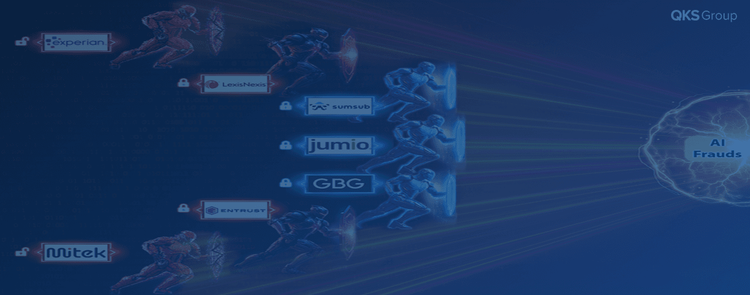
Let us see how different vendors such as Jumio, GBG, Sumsub, LexisNexis, Entrust, Experian, and Mitek Systems are placed to fight the deepfakes race.
Market Dynamics:
The identity verification market dynamics can be understood as a powerplay between vendors who have varying propensities to innovation and change. On one end there are innovative and best-of-breed solution providers, who are leading the market by always upgrading their solutions in response to the evolving fraud landscape. On the other hand, both established vendors and specialized niche vendors have been relatively slow to adapt to market changes.

Leading the Pack Through Innovation:
Jumio, GBG and Sumsub are at the forefront of developing AI-backed identity solutions to tackle deepfake fraud.
Jumio: Jumio is undeniably one of the leaders when it comes to innovativeness and adaptation to evolving fraud attack types, like deepfakes. Jumio’s AI-powered Identity Verification solution supports risk-based decisioning and performs real-time identity verification across channels to detect manipulation of ID images, content, and face photo replacement. The solution uses multi-modal biometrics, and certified 3D liveness detection backed by sophisticated AI to keep deepfake attacks at bay.
GBG: GBG, an old player in the identity verification market, upped its game by acquiring Acuant back in 2021, and since then it has continuously enriched its identity verification capabilities. GBG’s IDscan is an advanced AI-powered identity verification solution that utilizes FaceMatch technology, liveness detection (including both active and passive checks), behavioral analysis, and advanced data analytics. To detect and defend against deepfakes, IDscan uses AI-powered video analysis of lip movement and mouth shapes to identify synchronization discrepancies and simultaneously runs facial recognition alongside certified passive liveness detection.
Sumsub: A relatively newbie in the market, Sumsub introduced an industry-first Deepfake Detection feature as a part of its video verification solution early this year. This feature is embedded in Sumsub's Liveness product and operates in real-time during video interviews to identify and prevent fraudsters from manipulating real-time video interviews, further securing the identification process.
Acquisition to Drive Growth:
The identity verification market is set for significant disruptions with two major acquisition announcements in 2024.
Entrust, a leading digital identities and security company, stirred up the identity verification market by making an entry with the acquisition of Onfido in April 2024. Onfido’s identity verification solution, powered by Atlas AI™ -their in-house, anti-bias AI- promises high accuracy and adaptability. The integration of Onfido's AI-driven biometrics and document verification capabilities, with Entrust's extensive security expertise, is likely to provide a strong defense against deepfake frauds. This integrated approach is likely to enhance liveness detection, improve biometric analysis, and strengthen data analytics, thereby increasing the probability of comprehensive protection for digital interactions against potential AI fraud.
LexisNexis is a leading player in the risk and fraud domain, with itssolutions benefiting from its strong global data networks and advanced analytics capabilities. But its identity verification solution capabilities have never been amongst the best in the industry. However, with their recent announcement to acquire IDverse in December 2024, the dynamics for the company could change in the coming years.
IDverse offers proprietary Deepfake Defender technology that uses GenAI, deep neural network, and federated learning to train its identity-proofing systems. IDVerse's AI-driven technology, which includes biometric algorithms and liveness detection, can significantly bolster LexisNexis' ability to detect and prevent sophisticated fraud attempts, including deepfakes.
Vendors who are Lagging in the Race to Defend against AI Fraud
Experian- While Experian definitely has a strong data field, it falls short in its identity verification capabilities. Firstly, the company relies heavily on partnerships for its identity verification capabilities and has multiple partnerships for various technology features. This dependence on external ecosystem often creates unnecessary friction and result in poor user experience. Additionally, where players in this market need to be very agile and innovative due to emerging fraud trends, Experian has been quite laid back in developing sophisticated AI-driven capabilities, especially compared to other leading vendors. To remain competitive in this highly dynamic market, Experian needs to reassess its strategy.
Mitek Systems- Although Mitek offers all the capabilities required for a good ID verification solution,its AI and ML capabilities are not as advanced or adaptive as some competitors, affecting the accuracy and effectiveness of fraud detection. Additionally, the effectiveness of Mitek's biometric verification technology is not at par with the latest advancements in the industry, impacting its ability to detect and prevent AI-backed identity frauds especially deepfakes. Furthermore, Mitek's systems also face challenges in processing identity verification requests in real-time, especially during high-volume periods, leading to delays and a less seamless user experience.
In conclusion, the identity verification landscape has transformed significantly in 2024, driven by the increasing sophistication of AI-powered frauds like deepfakes and synthetic identities. Vendors have had to adapt quickly, enhancing their solutions with advanced AI, ML, and biometric technologies to stay ahead of these threats. As we move forward, the ability to innovate and leverage cutting-edge technologies will define the leaders in this space. Companies that invest in robust AI-backed identity verification solutions and rich data sets for continuous learning will be well-positioned to combat emerging fraud tactics effectively.
Food for Thought:
Will Jumio, GBG, and Sumsub continue their dominance in the market?
Will Entrust and LexisNexis be able to foster the synergies brought through acquisition?
Will Experian and Mitek Systems make any significant technological enhancements to catch up?
Disclaimer & Invitation:
This blog is based on independent research and publicly available information. The insights presented reflect the views of QKS Group and are for informational purposes only. While we strive for accuracy, we do not guarantee completeness or absolute correctness. Vendors are welcome to provide clarifications or updates. If any vendor listed in this analysis wishes to provide additional context or clarification, we welcome a briefing call and will consider incorporating relevant updates. This analysis is not intended to disparage any vendor but to provide an informed, balanced perspective. We encourage open and constructive dialogue to foster transparency and a deeper understanding of the industry.
Author: Divya Baranawal, Vice President & Principal Analyst, at QKS Group