

17.06.2025
QKS Review
QKS Review: Why Vertical Fit Is the New Competitive Edge in Business Intelligence
Author:
Madhu Kittur


Executive Summary:
As the Data Analytics and Artificial Intelligence market faces rising pressure from data science integration, edge device integration, continuous intelligence, BI-as-a-Service, inbuilt data management, verticalization, and other disruptive trends, organizations are moving beyond traditional visualization tools such as Excel, Tableau, and Power BI.
This review blog by QKS Group assesses whether Business Intelligence and Visualization vendors are truly innovating to meet these demands—or merely making incremental updates.
What Modern Business Intelligence and Visualization Platforms Should Deliver:
Today’s platforms must offer more than core features. Critical next-gen capabilities include:
• Self-Service Analytics
• Embedded Analytics
• Copilots for Dashboarding and Storytelling
Key Findings: Organizations are now seeking platforms that can enable true self-service analytics, integrate seamlessly into operational workflows, and support secure, scalable, and embedded deployments. There's a growing demand for BI tools that offer pre-built industry-specific templates, strong data governance features like role-based access and audit trails, and real-time analytics suited for high-volume environments. The ability to align analytics with regulatory standards, support vertical use cases (like risk scoring in BFSI or HIPAA compliance in healthcare), and deliver insights directly within user-facing applications is becoming non-negotiable.
• Leading vendors (Qlik, Domo, Google) stand out with comprehensive, enterprise-grade solutions.
• Capable vendors (Sisense, Strategy, Pyramid Analytics) show promise in niche areas but lack breadth or global scale.
• Lagging vendors (Tableau, Power BI) remain focused on outdated features and risk losing relevance.
When we talk about business intelligence and analytics market and its vendors, most enterprise users prefer to use default tools, either Tableau or Power BI. These tools are accessible, polished, and widely adopted specifically for those looking for basic analysis through freemium versions. But as the data grows, complexity grows bringing in regulations and integrations with elaborated environments freemium versions fall short and buying Power BI or Tableau licenses at scale becomes expensive.
In our conversation with learners, analysts, and domain experts from multiple industries, a pattern has emerged - while many users think PowerBI and Tableau has a common entry points, teams turn to alternative BI vendors who cost, usability, and business relevance come to play. These alternatives not only offer affordable pricing models, but they also come with pre-built dashboards, industry specific metrics, and embedded analytics templates tailored for vertical and horizontal use cases.
Users prefer plug-and-play functionality over building everything from scratch and aligning them with the data models and compliance needs. For such users, niche BI vendors are gaining importance to solve problems PowerBI and Tableau were not designed for.
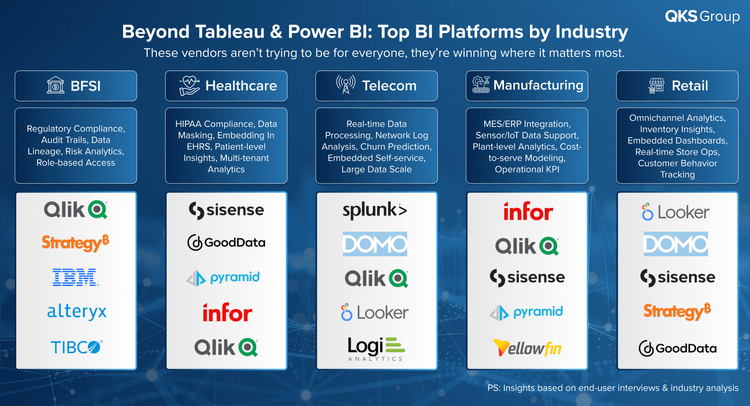
For Business Intelligence and Analytics users from the BFSI sector, compliance is a core requirement. Vendors who go beyond surface-level dashboards by offering audit trails, detailed data lineage, and secure role-based access are preferred. This is why banking institutes and insurance companies trust vendors like Qlik and MicroStrategy. Qlik’s associative engine supports complex risk analysis while Strategy’s governance and mobile capabilities are often praised. The traditional financial reporting, especially in the heavily regulated setting IBM Cognos remains relevant. Alteryx brings strong data preparation and statistical modelling by metricing risk scoring and fraud analytics. For fintech players looking to embed reporting into their applications, TIBCO Jaspersoft is a lightweight yet capable option.
The healthcare and life sciences industry priorities data security, HIPAA compliance, and the ability to embed insights directly into operational systems like EHRs or clinical research platforms. Sisense’s robust embedding capabilities enables users to embed patient dashboards within provider apps. GoodData works well with SaaS as it offers multi-tenant delivery serving multiple healthcare clients. Pyramid Analytics’ feature that supports FDA-complaint analytics workflows caters to life sciences firms. Meanwhile, the healthcare ERP systems’ native integration with Infor Brist adds value on the operational side. Qlik’s flexible architecture allows it to adapt well to hospital resource tracking and clinical workflows in real time.
Telecommunications companies’ challenge is speed at scale. Telcos operate in an environment where managing network logs and tracking user behaviour and churn is important and latency here is not tolerated. Splunk emerged as a leading platform here offering real-time log analysis for network team. Followed by Domo, whose live dashboards appeal to telco executives to control visibility across regions. Qlik’s ability to handle large datasets with user defined logic further favours its ability in this industry sector. Looker, now part of Google Cloud, comes with customizable self-service dashboards which can seamlessly embedded into telecom customer service portals. Logi Analytics provides a developer friendly framework to build telecom SaaS products and embed BI within customer portals.
Integration and visibility is the top priority of operational landscape in the manufacturing industry that analyses and ties together shop-floor data, MES & ERP systems, sensor inputs, and quality control metrics. Infor offers ERP suite to which the Infor Brist is tightly coupled making it the go-to choice for manufacturing vendors. Factories distributed across different locations use Qlik for their unified performance dashboards. Sisense’s capability to bring together the IoT data and business KPIs stand out. Pyramid Analytics is used extensively for predictive modeling and defect analysis, particularly in high-precision manufacturing. Yellowfin’s appeal lies in its ability to combine visual analytics with automated storytelling, making it easier for operations managers to communicate findings across plants.
Retail companies operating in the digital and physical channel needs platforms that adapt fast while scaling effortlessly to tell compelling data stories. We found Google Looker being widely used among retailers for real-time inventory, marketing attribution, and customer behaviour dashboards in the e-commerce specifically. Domo again has been noted here for its strong mobile experience making it choice for the CXOs and store managers. The embedding of SKU-level analytics into digital storefronts is offered by Sisense, while Strategy supports omnichannel performance tracking and loyalty program insights. GoodData is gaining traction among retail SaaS vendors who deliver analytics directly to partner brands or franchises.
Conclusion:
The rise in the number of industry-specific BI vendors is not accidental; it is a response to what many end users need but rarely find in generic platforms. Teams do not want to spend weeks creating basic dashboards from scratch when there are tools that already understand their domain, provide templated metrics, and easily embed into existing systems. In BFSI, healthcare, or telecom, it is more than mere convenience-it is a necessity born of regulations, operational complexity, and overlaying data security.
Power BI and Tableau-splendid though they might be-were not created with greater vertical depth in mind. Their prowess lies in their general application-exactly what is limiting them. As solutions become embedded deeper into operational systems and regulatory environments, the concept of “one-size-fits-all” begins to fray. A user during our interviews shared something to the effect of: “We didn’t move away from Tableau because it was bad-we moved away because it couldn’t keep up with the language of our business.”
It is time for Tableau and Power BI to move beyond visual capabilities, perhaps even beyond Copilot-style AI, if they want to maintain a central position in enterprise analytics strategy. Serious verticalization must go underway-industry-specific data models, governed metrics layers, embedded analytics kits, and regulatory-ready templates that speak the language of banks, hospitals, factories, and retail floors.
Till then, the ones that start niche might be the very ones that remain.
Author: Madhu Kittur, Senior Analyst - Data Analytics at QKS Group
Co-Author: Amandeep Singh, Associate Director & Principal Analyst at QKS Group
Vendors: