

24.06.2025
QKS Review
QKS Review: Who's Actually Building Threat Intel for SMBs?
Author:
Arpita Dash


Executive Summary:
As the SMB (Small and Medium Business) cybersecurity market faces rising pressure from targeted ransomware attacks, phishing campaigns, and resource constraints, organizations are moving beyond basic firewalls and antivirus tools.
This review blog by QKS Group assesses whether leading Threat Intelligence Platform (TIP) vendors are truly innovating to meet the needs of SMBs—or merely repackaging enterprise-grade tools that exceed operational capacity.
What Modern Threat Intelligence Platforms for SMBs Should Deliver:
Today’s platforms must offer more than raw threat feeds or manual IOC correlation. Critical next-gen capabilities include:
• Low-friction, integrated intelligence delivery with minimal analyst overhead
• Automated alert enrichment and response workflows for lean teams
• Scalable models with pricing and functionality aligned to SMB realities
Key Findings:
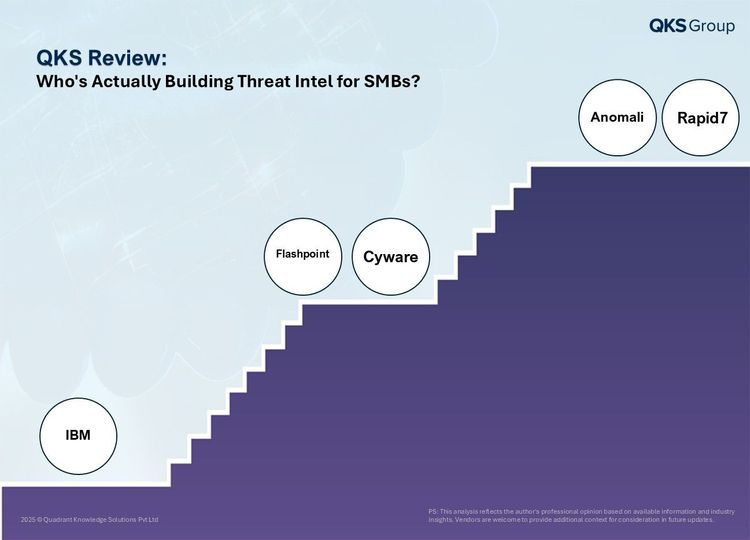
• Leading vendors (Rapid7 Threat Command, Anomali) stand out with accessible, integrated solutions suited for lean security teams and SMB operational models.
• Capable vendors (Cyware, Flashpoint) offer advanced capabilities like SOAR and dark web intelligence but require internal maturity that many SMBs lack.
• Enterprise-focused vendors (IBM X-Force) remain too resource-intensive and complex, offering diminishing returns for smaller organizations.
Intro:
In today’s evolving threat landscape, threat intelligence platforms (TIPs) and advanced threat intelligence solutions have become vital components of cybersecurity strategies. These platforms aggregate, analyze, and operationalize threat data from a myriad of sources, helping organizations detect, respond to, and mitigate cyber threats proactively. While large enterprises have the budgets, teams, and infrastructure to benefit from these sophisticated tools, small and medium businesses (SMBs) often struggle with complexity, cost, and operational requirements. This begs the question: are leading threat intelligence vendors like Cyware, Anomali, Rapid7, Flashpoint, and IBM X-Force overkill for SMBs?
Let's take a deep dive into each of these platforms to evaluate their strengths, their fit for SMB environments, and what trade-offs SMBs must consider if they plan to adopt them.
IBM X-Force Threat Intelligence: The Enterprise Powerhouse
IBM X-Force Threat Intelligence is an industry stalwart known for its vast intelligence repository and integration within IBM’s extensive security portfolio. It delivers comprehensive threat feeds, real-time attack indicators, vulnerability intelligence, and incident response insights derived from IBM’s global network of sensors, research teams, and partnerships. This breadth and depth make it a go-to for large enterprises and governments that require highly contextualized, actionable intelligence within their existing IBM ecosystem, such as QRadar SIEM or IBM Cloud Pak for Security.
The strength of IBM X-Force lies in its seamless integration with enterprise-grade security tools, combined with the pedigree and scale of IBM’s research capabilities. Organizations with mature Security Operations Centers (SOCs), skilled analysts, and extensive infrastructure benefit enormously from its granular insights and predictive analytics. However, this level of sophistication also makes it unwieldy for small and medium businesses. The platform assumes a security maturity level and resource availability that most SMBs lack. Deploying and extracting value from IBM X-Force demands significant analyst expertise, continuous tuning, and infrastructure investment, making it prohibitively expensive and complex for smaller organizations.
The trade-off for SMBs is clear: while IBM X-Force offers some of the most advanced and rich intelligence available, the operational overhead and cost make it an overkill. The investment required to adopt it often outweighs the incremental security gains for SMBs, especially when simpler, more focused solutions may cover their threat landscape adequately.
IBM X-Force stands out as a best-in-class solution, but its enterprise orientation means it’s generally unsuitable for SMBs seeking more streamlined, affordable, and manageable threat intelligence options.
Flashpoint: Niche Deep/Dark Web Intelligence with Complexity
Flashpoint has carved out a unique niche in the threat intelligence ecosystem by specializing in deep and dark web intelligence, focusing heavily on fraud detection, geopolitical risk, and insider threats. By harvesting closed-source, hard-to-access underground forums, marketplaces, and encrypted communities, Flashpoint delivers intelligence that is rarely available through traditional channels. This capability makes it invaluable for sectors such as finance, retail, defense, and law enforcement, where the stakes of fraud or espionage are extremely high.
Flashpoint’s greatest strength is the granularity and exclusivity of its intelligence. It exposes threat actors, criminal infrastructure, and emerging campaigns early, providing a strategic advantage in threat mitigation. However, this sophistication comes at a cost. The platform requires dedicated analysts capable of interpreting and contextualizing nuanced and often ambiguous intelligence. The operational complexity and financial investment place Flashpoint well beyond the reach of typical SMBs. Most small and medium businesses lack the security resources and use cases to justify this level of intelligence depth.
The trade-off here is between exclusivity and usability. While Flashpoint provides high-value insights for specialized threat scenarios, SMBs will likely find the platform overwhelming, with a steep learning curve and costs that exceed practical benefits. Instead, SMBs may benefit more from generalized threat intelligence platforms that integrate easily with existing security tools and require less manual interpretation.
Flashpoint is an exceptional platform for organizations with mature security teams focused on targeted intelligence, but it is an overkill for SMBs whose priorities lean towards operational simplicity and cost-efficiency.
Cyware: Modular and Powerful, But Still Complex
Cyware has gained recognition for its modular and automation-driven approach to threat intelligence sharing and security orchestration, automation, and response (SOAR). Unlike some monolithic TIPs, Cyware enables organizations to customize threat data ingestion, enrichment, and dissemination workflows. Its emphasis on collaboration across communities such as ISACs and ISAOs allows companies to participate in shared defense initiatives effectively.
The platform’s strength lies in its flexibility and the ability to automate tedious threat intelligence workflows, reducing time to action and improving coordination between security teams and external partners. Cyware’s modular design lets organizations scale functionality as needed, an attractive feature for growing SMBs with ambitions to mature their security operations.
However, Cyware assumes a baseline level of security process maturity and integration capability that many SMBs do not yet possess. The platform’s complexity and customization options can be daunting without experienced analysts and sufficient operational processes in place. The cost and effort required to implement and maintain Cyware’s automation and sharing ecosystem may outweigh the benefits for smaller teams.
The trade-off for small and medium businesses is between scalability and complexity. While Cyware can grow with a company and deliver substantial efficiencies at scale, it can initially represent an operational challenge and resource drain. SMBs without existing SOC frameworks or analyst expertise may find it difficult to justify Cyware over simpler, more out-of-the-box solutions.
Cyware straddles a middle ground. It is more accessible than some enterprise-focused platforms but still leans toward organizations that have invested in threat intelligence workflows and seek to automate and scale collaboration.
Anomali: Usability Meets Threat Intelligence Management
Anomali is often positioned as a more approachable threat intelligence platform, providing threat feed aggregation, indicator management, and threat detection capabilities with a focus on user-friendly interfaces. Its design helps security teams operationalize threat intelligence by simplifying the ingestion and contextualization of multiple feeds, enabling faster detection and response.
One of Anomali’s strengths is its relatively easier onboarding and interface compared to many high-end TIPs. It supports SMBs and mid-market companies by balancing robust threat intelligence functionality with usability. However, it is not a fully turnkey solution; some analyst maturity and security process discipline remain necessary to extract maximum value. The platform’s extensive capabilities can still overwhelm very small or under-resourced teams.
The trade-off here is between capability and simplicity. Anomali offers a good middle ground, powerful enough to handle complex threat intelligence needs while being more accessible than legacy enterprise TIPs. SMBs that have started formalizing security operations or partnering with MSSPs may find Anomali a fitting platform to grow into.
In final consideration, Anomali represents a relatively SMB-friendly platform, especially for organizations with some security infrastructure and an appetite to advance threat intelligence usage without committing to heavyweight enterprise solutions.
Rapid7 Threat Command: The SMB Ally
Rapid7 Threat Command, part of the broader Insight platform, is arguably the most SMB-friendly solution among the five vendors considered. It benefits from Rapid7’s philosophy of usability, integration, and automation, designed to fit well within SMBs’ often constrained budgets and lean security teams.
Rapid7 offers a cloud-native, integrated approach where threat intelligence, vulnerability management, and incident detection coexist in a unified interface. This convergence reduces operational friction, allowing SMBs to benefit from threat intelligence without managing separate complex tools. InsightIDR and InsightVM integration means organizations can automate alerting, reduce false positives, and accelerate response actions more easily than with standalone TIPs.
The platform’s strength is in its balance of capability and accessibility. While it may not deliver the same depth of niche intelligence as Flashpoint or IBM X-Force, it delivers practical, operationally focused threat intelligence suited to SMB realities. It also supports growing organizations that want to mature security operations without large upfront investments.
The trade-off for SMBs is a relative limitation in raw intelligence depth and specialized feeds compared to enterprise-focused solutions. However, this is a strategic compromise that often pays off with reduced complexity, lower total cost of ownership, and faster time to value.
Rapid7 Threat Command represents the best fit for SMBs looking to integrate threat intelligence pragmatically into their security programs without the overhead associated with heavyweight enterprise platforms.
Conclusion:
For small and medium businesses, embracing threat intelligence is no longer optional but essential in a world where cyber threats increasingly target organizations of all sizes. However, the key to successful adoption lies in aligning threat intelligence capabilities with the realities of limited budgets, smaller teams, and less mature security operations.
SMBs should begin by clearly defining their risk profile and understanding the specific threat vectors most relevant to their industry and size. This targeted approach ensures that investment in threat intelligence is purposeful rather than aspirational. Rather than pursuing broad, enterprise-grade platforms out of the gate, SMBs should consider solutions that offer ease of deployment, integration with existing security tools, and automated workflows to reduce manual overhead.
Building internal security expertise, even at a foundational level, is critical. SMBs can leverage managed security service providers (MSSPs) or threat intelligence sharing communities to augment their capabilities without bearing the full operational burden. Starting small with focused use cases such as phishing detection, vulnerability prioritization, or automated alert enrichment enables SMBs to gain measurable value and build confidence.
Scalability and flexibility should also guide platform selection. SMBs benefit from platforms that can grow alongside their security maturity, offering modular capabilities and tiered pricing rather than one-size-fits-all enterprise solutions. This pragmatic progression allows them to adopt more advanced intelligence capabilities as their needs evolve, without getting overwhelmed or overspending upfront.
Disclaimer:
This blog is based on independent research and publicly available information. The insights presented reflect the views of QKS Group and are for informational purposes only. While we strive for accuracy, we do not guarantee completeness or absolute correctness. Vendors are welcome to provide clarifications or updates. If any vendor listed in this analysis wishes to provide additional context or clarification, we welcome a briefing call and will consider incorporating relevant updates. This analysis is not intended to disparage any vendor but to provide an informed, balanced perspective. We encourage open and constructive dialogue to foster transparency and a deeper understanding of the industry.
Author: Arpita Dash, Analyst - Security Analytics and Automation at QKS Group
Vendors: