

24.06.2025
QKS Review
QKS Review: Who Really Secures BFSI? The Battle for the Best Digital Threat Intelligence
Author:
Arpita Dash


Executive Summary:
As the Banking, Financial Services, and Insurance (BFSI) industry faces rising pressure from targeted cyberattacks, regulatory scrutiny, and digital transformation, organizations are moving beyond traditional threat feeds and ad-hoc cyber monitoring tools.
This review blog by QKS Group assesses whether Digital Threat Intelligence Management (DTIM) vendors are truly innovating to meet these evolving challenges or merely offering incremental extensions of legacy threat detection.
What Modern Digital Threat Intelligence Platforms Should Deliver:
Today’s platforms must offer more than basic indicators of compromise. Critical next-gen capabilities include:
• Predictive analytics and real-time threat scoring for early risk mitigation
• Integration with incident response, fraud, and compliance workflows
• Context-rich intelligence from surface, deep, and dark web sources
Key Findings:
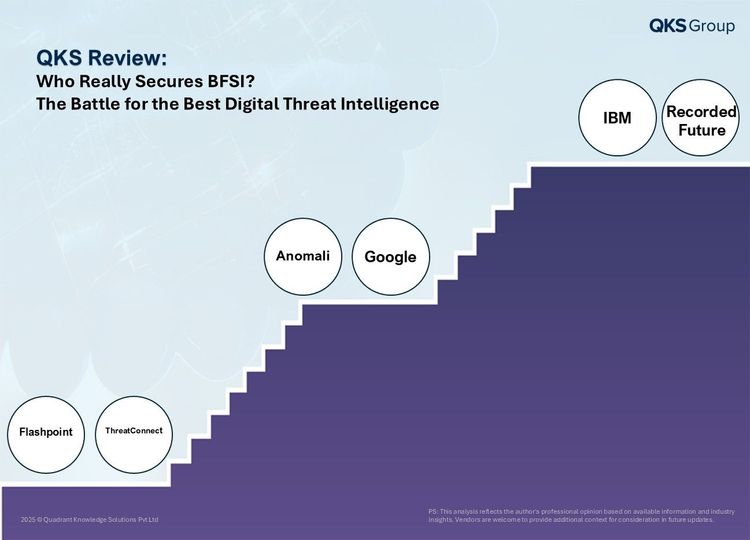
• Leading vendors (Recorded Future, Google Mandiant) stand out with enterprise-grade intelligence, predictive capabilities, and strong relevance for financial threat landscapes.
• Capable vendors (IBM X-Force, Anomali, ThreatConnect) demonstrate strength in specific BFSI use cases like ecosystem integration, workflow automation, or custom threat modelling but may lack depth in open-source visibility or proactive scoring.
• Niche vendors (Flashpoint) offer essential intelligence from illicit ecosystems, but require complementary solutions to deliver full-spectrum protection.
For BFSI institutions, threat intelligence is no longer optional—it is foundational to maintaining trust, compliance, and operational resilience in an era of constant cyber disruption. This evaluation helps security leaders align DTIM investments with both current risk priorities and long-term strategic imperatives.
Intro:
In today’s digital-first financial world, the Banking, Financial Services, and Insurance (BFSI) sector faces relentless threats from cybercriminals and nation-state actors. The stakes are high: the theft of sensitive customer data, breaches of regulatory compliance, and the erosion of trust can bring even the most established institutions to their knees. In this volatile threat landscape, Digital Threat Intelligence has become indispensable not just as a reactive shield, but as a strategic, proactive weapon.
Among the top DTIM providers competing to secure BFSI environments, six vendors stand out: Recorded Future, IBM (X-Force), Google (Mandiant), Anomali, ThreatConnect, and Flashpoint. Each offers a distinct value proposition, targeting various maturity levels and pain points within the BFSI industry. This article provides a detailed, comparative evaluation of these six providers in terms of their strengths, fit for BFSI, trade-offs, and a final verdict on who leads the pack.
Recorded Future has established itself as a frontrunner in threat intelligence by offering real-time, machine learning-enhanced threat insights across a vast data set that includes open sources, technical telemetry, and deep and dark web feeds. Its core advantage lies in its ability to deliver contextualized, high-fidelity intelligence enriched with predictive analytics. This allows security teams to prioritize threats, mitigate risks before incidents occur, and respond quickly to emerging vulnerabilities. In 2024, Mastercard acquired Recorded Future to bolster its fraud prevention and cybersecurity services, highlighting the platform's strategic value in the financial sector.
However, the sophistication and breadth of Recorded Future’s platform come at a price. It is positioned in the premium segment of the market, which might deter smaller banks or credit unions with limited budgets. Additionally, while the platform offers powerful automation features, security teams may face a learning curve when attempting to unlock the full potential of its capabilities.
Still, the strategic benefits far outweigh the challenges. For global banks, insurance giants, and financial exchanges that require real-time risk scoring, wide threat visibility, and automated intelligence workflows, Recorded Future is the clear choice.
IBM’s X-Force threat intelligence service is a comprehensive offering that combines research, malware analysis, incident response, and threat hunting. Backed by decades of experience and the robust infrastructure of IBM Security, X-Force is an authoritative and widely trusted source of intelligence for many enterprises. Its strength lies in its integration across IBM’s security ecosystem, including QRadar, Resilient, and Guardium. BFSI institutions that already rely on IBM for their SIEM or data protection needs find X-Force to be a natural extension that enhances visibility and control across their security stack. IBM's AI-driven analytics enhance threat detection capabilities, supporting advanced use cases in BFSI environments.
On the flip side, the platform can be less agile than some of its more narrowly focused competitors. The integration and deployment process may be slower, and organizations outside the IBM ecosystem might find it challenging to realize the full value of the solution. Additionally, while its threat feed is robust, it doesn’t always match the real-time, predictive capabilities of more specialized vendors.
Despite these trade-offs, IBM X-Force is an excellent choice for BFSI enterprises already aligned with IBM’s infrastructure and looking for an integrated, reliable, and enterprise-grade intelligence partner.
Mandiant, now part of Google Cloud, brings unmatched credibility in adversary profiling and incident response. Known for its front-line experience with state-sponsored threats and advanced persistent threat (APT) groups, Mandiant offers deep insights into attacker tactics, techniques, and procedures (TTPs). The Mandiant platform excels in high-pressure environments where real-world attack evidence is necessary to guide security strategy. For BFSI firms navigating advanced threats, ransomware, and nation-state-sponsored attacks, Mandiant provides the kind of forensic intelligence and context-rich reporting that no other vendor can easily match. Its close integration with Google Chronicle also makes it appealing for BFSI organizations adopting a cloud-first or hybrid strategy. The ability to correlate intelligence with telemetry data from modern cloud environments helps streamline detection and response.
While Mandiant has a strong foundation in incident response, its integration with Google Cloud has enhanced its proactive threat intelligence offerings. However, it focuses more on high-touch services, including incident response and advisory engagements, than on turnkey, continuously updated threat intelligence feeds.
Overall, Mandiant is the best fit for BFSI institutions facing serious threat actors or undergoing IR transformation. It delivers unparalleled intelligence depth for organizations that prioritize forensic-level clarity in threat attribution.
Anomali positions itself as a highly customizable and integration-friendly threat intelligence platform. It specializes in aggregating and normalizing threat feeds from multiple sources, allowing BFSI organizations to consolidate their intelligence data and apply it to existing detection and response tools. Anomali's AI-powered analytics and seamless integration with ITSM tools like ServiceNow and Jira make it a versatile choice for BFSI institutions seeking customizable threat intelligence solutions. This flexibility allows financial institutions to tailor the platform to their specific needs and easily integrate both commercial and open-source feeds.
The platform’s cost-effectiveness and interoperability have won it a place in several mid-sized banks and financial service providers. However, it doesn’t offer the same depth of vertical-specific modeling or predictive threat analytics as some of its more advanced competitors. It requires internal resources to maintain and tune the intelligence environment, which can be a barrier for resource-constrained teams.
Anomali is a practical choice for BFSI players that want to build and manage their own Threat Intelligence operations and have the expertise to do so.
ThreatConnect brings a unique value proposition by combining threat intelligence with security orchestration and automation (SOAR). Its platform enables financial institutions to not just collect and analyze threat data but also to act on it in a structured, automated manner. This integration of intelligence with workflow automation is a boon for mature BFSI SOC teams. ThreatConnect allows analysts to build playbooks, automate threat detection and response workflows, and tailor their environment to their specific use cases, including phishing response, credential abuse, and insider threat detection. ThreatConnect not only integrates threat intelligence with SOAR but also aligns it with business risk management, enabling BFSI organizations to make informed security decisions.
However, this strength also brings complexity. Organizations new to SOAR may find it challenging to implement without significant ramp-up time. Additionally, while it does offer threat intelligence feeds, its core strength lies more in orchestration than in real-time intelligence gathering or predictive analysis.
ThreatConnect is an ideal match for BFSI institutions with high internal security maturity, looking to translate intelligence into automated action across the incident response lifecycle.
Flashpoint is distinct from the rest in that it focuses heavily on threat intelligence from the deep and dark web. It delivers insights into illicit activities such as carding, fraud, insider threats, and the sale of stolen credentials making it especially relevant for BFSI institutions’ fraud teams. Flashpoint combines AI-powered analysis with expert human insight to deliver actionable intelligence from the deep and dark web, aiding BFSI fraud teams in pre-empting illicit activities. Banks and insurance firms can monitor dark web forums, uncover potential breaches, and identify brand abuse or impersonation schemes long before they impact customers.
That said, Flashpoint is not a comprehensive TIP or threat detection platform. It excels in external, actor-focused intelligence but may need to be supplemented with additional tools for full-spectrum Threat Intelligence. Also, it doesn’t offer predictive analytics or real-time automated scoring like Recorded Future.
Nonetheless, Flashpoint is highly valuable as a complementary solution for BFSI organizations focused on fraud mitigation and threat actor monitoring.
Conclusion
Cyber threats facing the BFSI industry are not just frequent, but they are targeted, persistent, and increasingly sophisticated. From advanced persistent threats (APTs) and insider risks to fraud campaigns and data breaches originating from the deep and dark web, financial institutions must stay ahead by adopting proactive threat intelligence capabilities.
However, the responsibility does not solely lie with IT or security teams. As end users of threat intelligence CISOs, compliance heads, fraud investigators, and even business risk managers stakeholders in the BFSI space must evaluate DTIM vendors not just by feature sets but by strategic fit. Factors such as regulatory mandates, digital transformation roadmaps, internal skill sets, existing tech stacks, and risk appetite should all influence the final choice.
In an age where one breach can erode years of brand equity and consumer trust, BFSI organizations must treat threat intelligence not as an optional enhancement but as a core pillar of cyber resilience. Choosing the right DTIM partner is no longer about filling a tactical gap, it is a strategic imperative for long-term operational security and reputational integrity.
This blog is based on independent research and publicly available information. The insights presented reflect the views of QKS Group and are for informational purposes only. While we strive for accuracy, we do not guarantee completeness or absolute correctness. Vendors are welcome to provide clarifications or updates. If any vendor listed in this analysis wishes to provide additional context or clarification, we welcome a briefing call and will consider incorporating relevant updates. This analysis is not intended to disparage any vendor but to provide an informed, balanced perspective. We encourage open and constructive dialogue to foster transparency and a deeper understanding of the industry.
Author: Arpita Dash, Analyst - Security Analytics and Automation at QKS Group
Vendors: