

24.06.2025
QKS Review
QKS Review: When Every Second Counts: Comparing Threat Feed Sharing Among Threat Intelligence Vendors
Author:
Arpita Dash


Executive Summary:
As the Digital Threat Intelligence Management market faces rising pressure from faster attack cycles, commoditized adversary infrastructure, and the growing demand for real-time, actionable insights, organizations are moving beyond traditional IOC aggregation tools.
This review blog by QKS Group assesses whether threat intelligence vendors are truly innovating to meet these demands—or merely making incremental updates.
What Modern Threat Intelligence Platforms Should Deliver:
Today’s platforms must offer more than static indicator feeds. Critical next-gen capabilities include:
• Automated ingestion and normalization of threat data at scale
• Contextual enrichment with actor attribution, exploitability, and risk scoring
• Operational integration with SIEM, SOAR, EDR, and firewall systems
Key Findings:
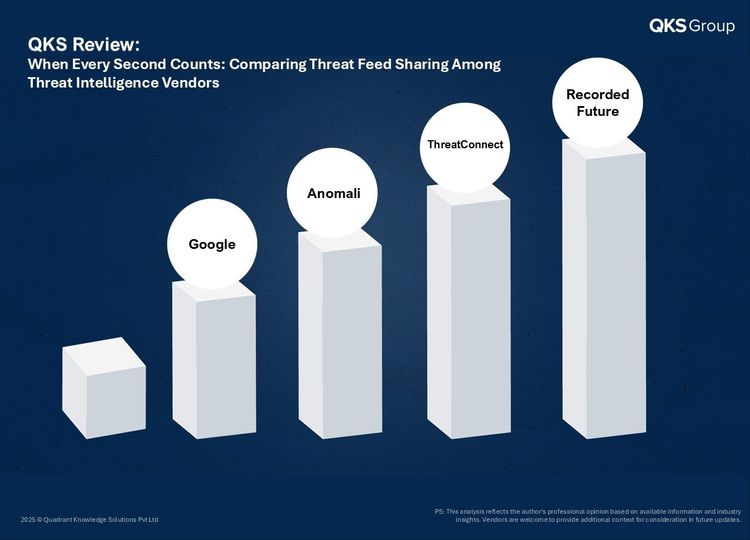
• Leading vendors (Recorded Future, ThreatConnect) stand out with real-time delivery, advanced context, and automation readiness.
• Capable vendors (Anomali) offer strong aggregation and sharing models but require tuning to manage volume and relevance.
• Lagging vendors (Google Threat Intelligence) focus on curated, high-fidelity data but lack feed streaming flexibility and automation depth needed for broader SOC integration.
Introduction
In today’s dynamic threat landscape, actionable intelligence is no longer a luxury, it is a strategic necessity. Cyberattacks have become fast, global, and highly commoditized. Malware kits, phishing infrastructure, and zero-day exploits are traded on dark web forums in minutes, not days. Security teams are expected to operate in this reality, where detection and response must outpace adversaries who thrive on automation and scale.
Threat intelligence feeds serve as the connective tissue between detection systems and the real-world threat landscape. For SOC analysts, incident responders, and threat hunters, these feeds are the lens through which emerging risks can be seen, understood, and acted upon. Integrated into SIEMs, SOARs, firewalls, and EDRs, they allow automated enrichment, correlation, and prioritization of alerts helping defenders focus on what is truly malicious and relevant. The value lies not in raw data, but in operational context: feeds that are timely, accurate, and integrated make the difference between proactive defense and reactive chaos.
But not all feeds are created equal. Some are enriched with behavioral context, attribution data, and real-time updates. Others offer only static indicators, or worse, outdated and noisy data that adds confusion. The method of sharing - how feeds are ingested, how they are updated, how much context accompanies them, and whether others in the ecosystem can benefit - becomes critical to an organization’s ability to respond at speed. In an age where one organization’s compromise can inform the next one’s defense, the adage “If one is attacked, all can learn” reflects more than sentiment. It defines the potential of intelligence feed sharing as a mechanism of collective defense.
Recorded Future takes a real-time, context-rich approach to intelligence feed sharing. Built around its proprietary Intelligence Graph, the platform aggregates vast amounts of data from open web sources, dark web monitoring, technical sensors, and internal telemetry. The platform offers real-time indicators of compromise, threat actor infrastructure, vulnerability exploitation trends, and risk scoring. These feeds are formatted in STIX/TAXII and JSON, making integration into SIEMs, SOAR platforms, and EDRs straightforward. Its ability to correlate current threats with historical behavior adds a powerful layer of foresight for defenders.
The platform's depth can overwhelm smaller teams or those without rigorous operational processes. Its intelligence graph is proprietary, which can limit transparency and two-way information sharing.
Organizations with mature security operations that prioritize context-driven automation will benefit most from Recorded Future’s model, although tuning is necessary to maintain signal clarity.
Anomali focuses on aggregation and normalization of threat data from diverse sources like open-source, commercial, and industry-specific. Through ThreatStream, users can centralize incoming data, tag and score it, and share intelligence across trusted communities or internal groups. The platform supports both ingestion and distribution via STIX/TAXII and integrates with major SIEMs and SOARs. Anomali also promotes user-generated contributions and facilitates community-based defense, making it flexible and adaptable for different verticals.
Because the platform pulls from many sources, quality and consistency may vary. Without initial tuning and strong relevance filters, security teams risk being flooded with low-priority data and duplicates.
Anomali is ideal for organizations seeking to consolidate multiple data streams and build a shared intelligence ecosystem, provided they invest in refining the flow of data.
ThreatConnect merges its threat intelligence platform with built-in SOAR functionality to streamline the path from detection to response. It supports STIX/TAXII feed ingestion, user tagging, enrichment, and scoring, along with dynamic context layering through its CAL™ engine. The platform enables sharing of intelligence both internally and with external partners and supports workflows that operate across tactical and operational threat levels. Its playbooks allow for automated detection and mitigation based on feed inputs, reducing manual intervention.
This depth and integration introduce operational overhead. Organizations with existing SOAR solutions may experience tool redundancy or integration friction.
ThreatConnect fits teams looking to automate not just intelligence consumption but also the response process, particularly where collaboration and precision are priorities.
Google Threat Intelligence leverages the threat research capabilities of Mandiant, delivering curated threat data through integrations with Chronicle and VirusTotal. Rather than providing continuous IOC streams, Google focuses on curated intelligence: campaign tracking, adversary behavior, and detailed profiling. This intelligence is high-confidence and analyst-validated, often aligned with nation-state and APT activity. Chronicle’s ATI Fusion feed enhances the Chronicle SIEM with context-rich intelligence, while VirusTotal helps analysts pivot across artifacts and signatures using shared metadata.
The curated, report-driven nature of the intelligence means less applicability for high-volume, automated environments. Customization options and user contribution mechanisms are also limited.
Organizations that prioritize adversary understanding over IOC volume will find strong value in Google’s approach, especially in incident response and threat profiling use cases.
Conclusion
The way these vendors approach threat feed sharing highlights deep contrasts in design philosophy. Recorded Future prioritizes automated, high-context real-time data; Anomali aims for breadth and flexibility through aggregation and community sharing; ThreatConnect blends intelligence with response automation; and Google focuses on high-fidelity, incident-driven insight.
For the end user, be it a SOC analyst, a responder, or a security engineer, these differences have significant implications. Choosing the right threat intelligence feed is about more than what data it contains. It's about how that data is shared, prioritized, and operationalized. Done right, threat feed sharing is not just an ingestion exercise, it’s a strategic advantage, allowing defenders to act faster, collaborate across industries, and prevent the same attack from succeeding twice.
Disclaimer:
This blog is based on independent research and publicly available information. The insights presented reflect the views of QKS Group and are for informational purposes only. While we strive for accuracy, we do not guarantee completeness or absolute correctness. Vendors are welcome to provide clarifications or updates. If any vendor listed in this analysis wishes to provide additional context or clarification, we welcome a briefing call and will consider incorporating relevant updates. This analysis is not intended to disparage any vendor but to provide an informed, balanced perspective. We encourage open and constructive dialogue to foster transparency and a deeper understanding of the industry.
Author: Arpita Dash, Analyst - Security Analytics and Automation at QKS Group
Vendors: