

31.07.2025
QKS Review
QKS Review: From Smart to Autonomous: Who’s Truly Driving AI in Pharma MES?
Author:
Nithin A K


Executive Summary:
As the Pharmaceutical Manufacturing market faces rising pressure from complex regulatory demands, skilled labor shortages, and the push toward real-time batch release, organizations are moving beyond traditional Manufacturing Execution System (MES) tools.
This review blog by QKS Group assesses whether Pharma MES vendors are truly innovating to meet these demands-or merely making incremental updates.
What Modern Pharma MES Should Deliver:
Today’s platforms must offer more than compliance and basic batch tracking. Critical next-gen capabilities include:
- Agentic AI to autonomously execute Manufacturing Execution Systems (MES) workflows within validated boundaries
- Predictive & Prescriptive Analytics for anomaly detection, yield optimization, and process simulation
- Modular Intelligence Layers that adapt across traditional, cell & gene, and personalized manufacturing models
Key Findings:
- Leading vendor:
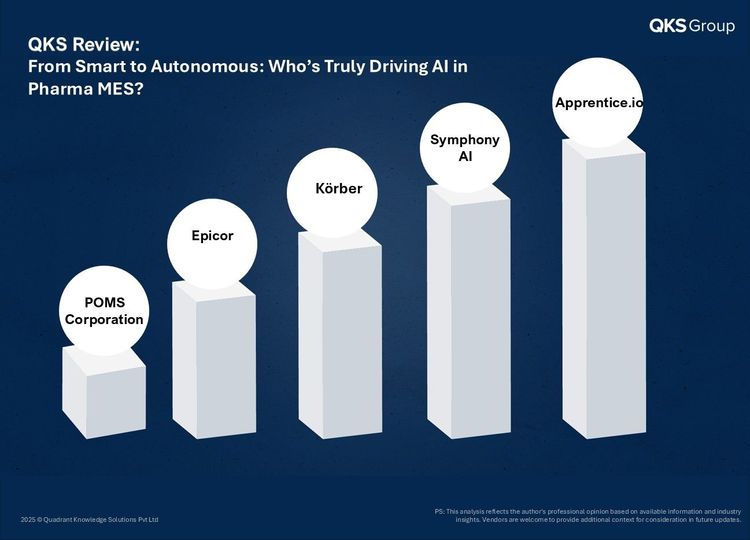
Apprentice.io stands out with a fully agentic AI architecture, enabling autonomous execution, native data science integration, and digital co-workers built for real-time Pharma operations. - Capable vendors:
Körber (PAS-X) and SymphonyAI offer strong predictive analytics and roadmap alignment-but remain manual or semi-autonomous, with no embedded AI agents currently active in core execution.
Epicor shows AI promise through Prism and Grow AI, which deliver agentic features like conversational assistants and predictive models when deployed alongside its Industry ERP Cloud. However, the Pharma MES itself remains a data capture + SPC tool without embedded autonomy. - Lagging vendor:
POMS Corporation continues to operate with a traditional MES architecture that prioritizes compliance and process control. However, it currently lacks native AI or agentic capabilities, and its analytics features remain limited-posing constraints for manufacturers aiming to modernize execution intelligence.
As pharmaceutical manufacturers race toward smarter production lines, the conversation is shifting from analytics dashboards to autonomous decision-making. Embedded artificial intelligence (AI) is no longer a futuristic add-on-it’s becoming a core capability of modern Manufacturing Execution Systems (MES). But among the top vendors, who’s truly walking the talk when it comes to AI maturity?
After a close review of five major MES Process and Batch players-Apprentice.io, Körber (PAS-X), SymphonyAI, Epicor, and POMS corporation one vendor clearly stands apart.
Apprentice.io: The New Standard for Agentic AI in Pharma MES
Apprentice.io isn’t just another MES with AI features-it’s redefining how execution systems behave. Their Tempo Manufacturing Cloud introduces a fully agentic architecture, where AI-powered digital co-workers carry out batch execution, real-time quality checks, scheduling, and even SOP updates-all with minimal human intervention.
Key capabilities include:
- Autonomous Agents: Specialized AI agents handle everything from procedure authoring to continuous improvement.
- Ask Apprentice AI: A conversational layer that taps into systems like SAP and Veeva during live batch runs.
- Digital Peer Review: Co-workers (AI agents )validate each other’s actions, embedding compliance directly into AI workflows.
- Native AI Training: Structured and unstructured data ingestion supports continuous AI learning and evolution.
What makes Apprentice.io remarkable is its agentic execution-AI doesn't just analyze data; it acts on it. This makes them the clear maturity leader in AI-driven Pharma MES.
Körber PAS-X: AI Overlays, But Execution Still Manual
Körber’s PAS-X has added analytics and AI overlays to its Manufacturing Execution Systems (MES) through modules like PAS-X Intelligence Suite and K.AI. These bring capabilities such as anomaly detection, predictive maintenance, and process optimization based on historical batch data. The Savvy Suite also supports data integration from ERP, LIMS, and automation systems.
However, AI in Körber is limited to prescriptive recommendations. There are no autonomous agents. All workflows still depend on human operators. Even advanced features like real-time setpoint adjustments via K.AI remain guided, not self-executing. Biometric login via K.ME-IN adds convenience, but doesn't impact core execution intelligence.
The roadmap suggests movement toward closed-loop control, but as of now, Körber is not delivering agentic AI. It remains a traditional MES platform with some analytics enhancements-not a system built for autonomous decision-making.
SymphonyAI MOM 360: Advanced Analytics, Early Steps Toward Autonomy
SymphonyAI’s MOM 360 is built on the robust EurekaAI platform, offering predictive modeling, prescriptive insights, and Golden Batch optimization. With over 100 native connectors through IIoT 360, it enables deep visibility and multivariate analysis.
However, its AI is suggestive, not agentic. It recommends actions (like material verification alerts), but execution still needs operator intervention. Think of it as a powerful assistant-highly intelligent, but still needing a supervisor.
Where it shines:
- Strong digital twin capabilities
- Composable AI models
- Integration with LIMS, CMMS, and Proceedix for rich data context
SymphonyAI is AI-advanced, but still maturing toward full autonomy.
Epicor Advanced MES: SPC-Driven, But No Native AI Autonomy
Epicor’s Pharma-focused MES-based on the same Kinetic-powered Advanced Manufacturing Execution Systems (MES) used across its life sciences deployments-does not include any native agentic AI or autonomous workflow capabilities. Its MES modules focus on SPC/SQC dashboards, control-chart alerts, anomaly detection, and root-cause traceability, but lack embedded machine learning models or AI-driven decision-making.
Any desire for agentic AI-such as conversational assistants, scheduling agents, supplier communication tools, or visual analytics-requires deploying separate layers like Epicor Prism or Epicor Grow AI on top of the Industry ERP Cloud. These AI layers do not reside inside the MES itself.
In effect, Epicor’s Pharma MES remains a data capture + SPC solution, delivering lean manufacturing insights without autonomous intelligence or embedded learning.
POMSnet Aquila: Trusted GMP Backbone, AI Yet to Arrive
POMS offers a configurable, compliance-first MES-but AI is not yet part of its DNA. The system leans on templates and business rules rather than machine learning or predictive engines.
What’s currently missing:
- No visible AI roadmap
- No agentic execution layer
- Data science integration is minimal
While it's a reliable option for companies prioritizing validation and GMP robustness, those aiming for intelligent execution will find it lacking.
Final Takeaway: Choose Your AI Maturity Level

Pharma manufacturers should align vendor selection with their desired level of AI autonomy. Whether you're optimizing SPC charts or deploying digital co-workers on the shop floor, the question is no longer “if” AI will shape MES-but how intelligently it can act.
Disclaimer:
This blog is based on independent research and publicly available information. The insights presented reflect the views of QKS Group and are for informational purposes only. While we strive for accuracy, we do not guarantee completeness or absolute correctness. Vendors are welcome to provide clarifications or updates. If any vendor listed in this analysis wishes to provide additional context or clarification, we welcome a briefing call and will consider incorporating relevant updates. This analysis is not intended to disparage any vendor but to provide an informed, balanced perspective. We encourage open and constructive dialogue to foster transparency and a deeper understanding of the industry.
Author: Nithin A K, Analyst at QKS Group
Vendors: