

25.07.2025
QKS Review
QKS Review: Automated, Intelligent, Scalable: Which LOS Vendors Fit the Future of Lending?
Author:
vvvd akhilesh


Executive Summary:
As the lending landscape shifts toward instant credit, embedded finance, and AI-powered decisioning, banks are under pressure to move beyond traditional, rules-based Loan Origination Systems (LOS). Platforms must now support real-time intelligence, dynamic risk assessment, and composable workflows to remain competitive in a rapidly evolving credit ecosystem.
This review blog by QKS Group evaluates whether today’s LOS vendors are truly enabling intelligent lending or simply modernizing legacy workflows with a digital façade.
What Modern Loan Origination Systems Should Deliver:
Today’s LOS platforms must go beyond basic automation and document workflows. Critical next-gen capabilities include:
- AI-powered credit scoring, borrower profiling, and risk modeling
- Dynamic workflow orchestration and low-code configurability
- Real-time decisioning, covenant monitoring, and predictive analytics
- Seamless integration with core banking, CRM, and fintech ecosystems
Key Findings:
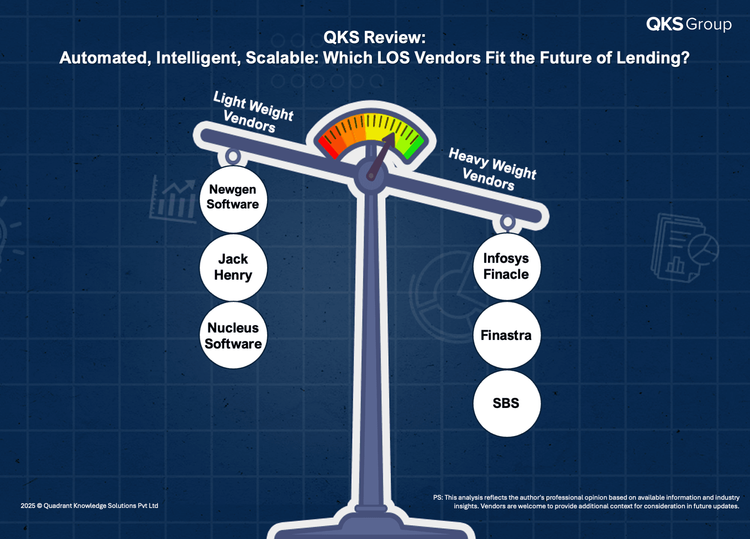
Leading vendors (Infosys Finacle, Finastra, and SBS) deliver intelligent, scalable platforms with embedded AI, deep credit workflow coverage, and high configurability positioning them well for the future of adaptive, insight-driven lending.
Capable vendors (like Newgen Software, Jack Henry, and Nucleus Software) offer solid automation and retail lending functionality but lack depth in AI orchestration, commercial lending agility, and dynamic risk analytics.
While all platforms have embraced digital, only a few are truly engineered for autonomous, intelligent, and scalable lending will define the next decade of credit innovation.
Digital lending has hit an inflection point. The days of workflow automation and digitized forms being called “transformation” are over. Today’s lending environment demands more intelligence, more adaptability, and more strategic orchestration across the entire credit lifecycle. From instant credit approvals and AI-based underwriting to risk-adjusted pricing and post-disbursal analytics, the Loan Origination System (LOS) is no longer a back-office tool.
Yet, while nearly every vendor claims to offer “digital” lending, not all platforms are built to handle the new realities of lending at scale. The platforms that will lead tomorrow’s market aren’t just digitized, they’re automated, intelligent, and composable by design. They embed AI at the core, support low-code configurability, and deliver real-time credit insights that evolve with customer behavior and regulatory complexity.
In this blog, we categorize key LOS vendors into two tiers, those who are architecting the future of lending, and those still modernizing the past. So, who’s truly ready to power intelligent credit in a high-velocity, high-risk world?
Category 1: Intelligent Lending Platforms
Infosys Finacle: The AI-Native Credit Architect
Infosys Finacle isn’t just modernizing loan origination rather it’s infusing intelligence into every step of the credit lifecycle. At its core is the Finacle Origination Suite, a modular, multi-segment Loan Origination Systems that digitizes onboarding, processing, credit evaluation, and post-booking review in one unified platform. What truly differentiates it is the Finacle Data & AI Suite, built on a BIAN-aligned data lakehouse and automated data pipelines. The accompanying AI Platform offers no-code model building, pre-trained ML models, synthetic data generation, model comparison, bias detection, drift monitoring, and explainability enabling banks to operationalize AI responsibly and at scale. Additionally, Finacle embeds AI across lending workflows, automating financial-spread analysis, deploying dynamic credit scoring, monitoring covenant compliance, and enabling real-time credit pipeline insights. On top of that, Finacle provides Generative AI Assistants like the Knowledge AI Assistant for document search and the Support AI Assistant for ticketing which streamline credit operations with intelligent NLP-driven support. Infosys Finacle isn’t just digitizing origination. It’s re-architecting it for intelligence, adaptability, and scale making it one of the few platforms truly aligned with the future of commercial lending.
Finastra: The Configurable Powerhouse in Origination
Finastra’s loan origination portfolio spanning Fusion Originate, Fusion Credit Connect, and Fusion Loan IQ delivers a highly configurable and API-driven architecture that supports both retail and complex commercial lending use cases. What makes Finastra stand out is its FusionFabric.cloud ecosystem, which allows banks to seamlessly integrate third-party fintechs, AI models, and analytics accelerators without rewriting core systems. On the AI front, Finastra leverages AI and machine learning in borrower profiling, document classification (via Lucia), credit risk modeling, and RM decision support. Its Fusion Credit Connect features offers AI-driven “Next Best Action” recommendations that aid RMs in offering tailored products at opportune times. Additionally, its Lucia AI engine automates contract and agreement extraction via ML/OCR, feeding structured data into the system and reducing manual reviews. Further, it also embeds AI modules such as advanced underwriting engines, language models, and proprietary scoring tools enabling banks to implement cognitive tools at their own pace across the lending lifecycle.
SBS: Scalable, Configurable, and Intelligence-Ready
SBS has leapfrogged into the top tier of lending platforms with its SBP Lending Platform, a fully SaaS, real-time, cloud-native LOS infrastructure that integrates AI deeply across lending workflows. The platform allows financial institutions to configure product-specific rule sets and design borrower personas all through a low-code environment. What makes SBS stand out is its composable, API-first architecture, enabling seamless integration with digital channels, analytics engines, and document management systems. Embedded AI models assist in decision support, portfolio-level credit risk analysis, and dynamic borrower profiling. The platform also supports real-time data capture and decisioning across the credit lifecycle, enhancing both speed and accuracy. Overall, SBS combines functional richness with technology agility, offering banks a high-performance LOS that’s both intelligent and adaptable.
Category 2: Limited Intelligence, Stretched for Scale
Newgen Software: Digitally Efficient, But Intelligence-Lite
Newgen’s Loan Origination System delivers a clean, digital-first lending workflow designed for fast deployment and front-end efficiency. The platform offers strong capabilities in workflow automation, document capture, and rule-based processing, with a configurable UI that simplifies application intake, verification, and routing. Its integration-ready architecture allows institutions to connect with credit bureaus, KYC services, and core banking systems with minimal friction. However, Newgen’s intelligence layer is still underdeveloped. AI is primarily applied in OCR-based document classification and form recognition, with limited application in predictive credit scoring, borrower behavior analysis, or dynamic risk profiling. Additionally, post-booking features like covenant tracking, early warning indicators, or portfolio risk analytics are also minimal making the solution more suitable for transactional automation than cognitive lending transformation. For banks seeking a digitized but not deeply intelligent LOS, Newgen serves the purpose but scaling it for high-value, insight-driven lending may require significant custom effort or external augmentation.
Jack Henry: Streamlined for Simplicity, but Limited for Complex Credit
Jack Henry’s loan origination capabilities, primarily delivered through its LendingXpress and LoanVantage platforms, cater effectively to small banks, credit unions, and community lenders focused on retail and small business lending. The solution offers dependable workflow automation, digital document management, and core banking integration, with strong support for compliance, audit trails, and template-driven loan processing. However, the platform’s flexibility and intelligence begin to taper off when moving into complex commercial lending. Advanced features like financial spreading, automated covenant tracking, risk-adjusted pricing, and AI-based underwriting are either limited or require manual configuration. The system lacks robust tools for borrower behavioral analysis, predictive insights, or intelligent credit orchestration making it more suitable for institutions with standardized lending models rather than those seeking dynamic, portfolio-level insights.
Nucleus Software: Stable for Retail, But Lags in Intelligence and Flexibility
Nucleus Software’s FinnOne Neo platform has long been a reliable choice for retail loan origination, especially across emerging markets. It provides a solid foundation of capabilities such as rule-based workflows, product configuration, document handling, and compliance automation delivering operational efficiency for banks with standardized lending processes. However, the platform’s evolution toward AI-led, insight-driven lending has been slow. While Nucleus has added support for basic digital onboarding and rule-driven decisioning, it lacks embedded machine learning models, behavioral analytics, or predictive scoring engines. For institutions seeking dynamic borrower profiling, portfolio risk analytics, or AI-powered pricing, FinnOne Neo may require significant customization or third-party augmentation.
Conclusion: The Lending Race Isn’t About Going Digital. It’s About Getting Smart
In today’s lending landscape, digitization is table stakes. The real differentiator is how intelligently, autonomously, and contextually a platform can operate. Vendors like Infosys Finacle, Finastra, and SBS are leading the charge by not just automating forms and workflows, but embedding AI, real-time decisioning, and behavioral insights deep into the fabric of credit orchestration. These platforms aren’t just managing loans; they’re strategically engineering smarter credit ecosystems.
Meanwhile, Newgen, Jack Henry, and Nucleus Software offer reliable automation and usability, but they’re still catching up on intelligence, scalability, and AI maturity. Their solutions may work for straightforward, volume-driven retail lending, but they lack the cognitive depth, predictive agility, and modular intelligence required to support high-value, dynamic, and risk-sensitive lending operations.
The future of loan origination isn’t about faster processing. It’s about adaptive lending intelligence where platforms not only respond to borrower needs, but anticipate them, mitigate risk in real time, and orchestrate credit as a competitive asset.
So, the question for lenders is no longer: “Is your Loan Origination System digital?”
It’s: “Is your LOS smart enough to keep you in the game five years from now?”
Disclaimer:
This blog is based on independent research and publicly available information. The insights presented reflect the views of QKS Group and are for informational purposes only. While we strive for accuracy, we do not guarantee completeness or absolute correctness. Vendors are welcome to provide clarifications or updates. If any vendor listed in this analysis wishes to provide additional context or clarification, we welcome a briefing call and will consider incorporating relevant updates. This analysis is not intended to disparage any vendor but to provide an informed, balanced perspective. We encourage open and constructive dialogue to foster transparency and a deeper understanding of the industry.
Author: VVVD Akhilesh, Senior Analyst - Banking Solutions at QKS Group
Vendors: