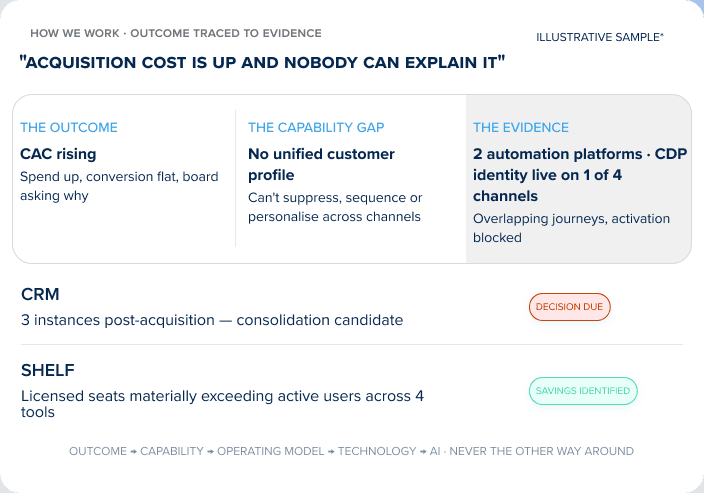
Customer Data · CRM & SalesTech · Marketing · Service & CCaaS · Conversational AI — we trace the number the board is asking about down to the capability that's missing, the ownership that isn't settled, and the technology decision behind both. Then we design the fix, validate the choice, and prove the value landed.
450+
SPARK Matrix reports behind the calls
50+
Years of practitioner experience on this page
6x
Microsoft Dynamics CRM MVP — recognised by the ecosystem, paid by no one in it
0
Resale margin, alliance fees or build revenue

Where It Starts
Nobody calls an analyst firm because their stack is untidy. They call because a number moved the wrong way — and every explanation they've been given came from someone with something to sell.
"Acquisition costs keep climbing."
More spend, same conversion — and no way to tell which channel is actually earning it.
Capability Gap: UNIFIED PROFILE · ATTRIBUTION
"We're losing customers we should keep."
Churn signals sit in three systems and reach nobody in time to act.
Capability Gap: CUSTOMER DATA · ORCHESTRATION
"Cost-to-serve won't come down."
Volume grows, deflection doesn't, and the contact centre absorbs the difference.
Capability Gap: UNIFIED PROFILE · ATTRIBUTION
"We can't personalise at any real scale."
Segments built by hand; the single customer view was bought years ago and never arrived.
Capability Gap: IDENTITY · CONSENT · ACTIVATION
"Pipeline quality keeps slipping."
Forecast accuracy argued in every review; reps working leads nobody scored; RevOps firefighting the data.
Capability Gap: UNIFIED PROFILE · ATTRIBUTION
Every stalled customer program we've seen traces back to a question nobody answered before the platform was bought. Operating model isn't a workstream at the end — it's the layer between the capability and the technology.
Who owns Customer 360?
DATA · CX · IT — USUALLY UNRESOLVED
Who owns the journey?
MARKETING · SERVICE · BU
Who owns consent?
LEGAL · DATA · MARKETING
Who owns AI governance?
RISK · CX · AI FUNCTION
Platforms change names every few years. These don't — which is why we scope, benchmark and design against capabilities, not product categories.
Customer Intelligence
Customer Data & Identity
Journey Orchestration
Sales Effectiveness
Revenue Operations
Service Operations
AI-Enabled Engagement
Measurement & Attribution
What We Actually Do
The same operating model runs across every QKS transformation practice — intelligence, design, validation and assurance. Advisory firms stop after the first. Integrators skip to the build. The two in the middle are where decisions become artifacts and artifacts become defensible.
Layer 01
Transformation Intelligence
Market, vendor, capability and benchmark intelligence applied to your decision — from the research we publish.
Layer 02
Transformation Design
Target architecture, customer data model, operating model, roadmap and business case — the artifacts your team builds from.
Layer 03
Transformation Validation
An independent second opinion on a decision you've already made — vendor, architecture, blueprint, AI readiness, go-live.
Standalone or Embedded
Layer 04
Value Realization
Benefits, KPIs and quarterly optimisation until the business case is evidenced — not reported, evidenced.
What We Don't
Configuration, integration, development, migration execution, campaign operations or run. Your SI, agency or team builds — we hold no resale margin, no alliance fees and no build revenue. An advisor who profits from the build cannot be trusted to size it.
Transformation Validation
It's the most expensive question in enterprise technology, and there's nowhere honest to ask it. Every party you could ask has a stake in the answer — so most enterprises never ask it at all, and find out during implementation.
We rank these categories for a living and take no revenue from any build. That makes us the only party at the table who can answer without an interest in the outcome.
Vendor decision
Target architecture
Implementation blueprint
Acceptance criteria
Implementation readiness
Design reviews
Stage gates
AI readiness
The Vendor
"Yes — And Here's The Roadmap Slide."
Your SI
"Yes — And We'd Love To Build It."
Rival SIs
"No — Pick Ours Instead."
QKS
"Here's The Evidence, The Risks, And The Conditions Under Which Your Decision Holds."
Transformation Packages
Each package is defined by what you receive and who signs it — assessment, target design, reference architecture, shortlist, KPIs, AI-readiness score and the business case, as one deliverable set. Not "we'll advise on your CDP." Durations computed at scoping, never promised flat.
Why Packages, Not Day Rates
A fixed deliverable set is the only honest form of outcome pricing — you know what arrives, we carry the delivery risk, and scope creep is a change request rather than an argument. Fees can sit partly at risk against outcomes we control: savings identified, decision signed, package accepted — never against a go-live date somebody else owns.
Selection Intelligence
It's the defining architectural decision in this market, it comes back at every renewal, and everyone who offers you an answer sells one of the options. We research every sub-category on both sides of it. Follow one through:
Domain
Customer Data & Identity
Single View, Activation, Consent
→
SPARK Matrix Categories
CDP · Identity Resolution · Consent & Preference
Markets We Actively Research
→
Vendor Landscape
Suite Modules Vs Specialists — Leaders & Challengers
Resolved In-Platform · Refreshed Every Matrix Cycle
We rank these vendors for a living. We just don't sell them.
Implementation-partner selection runs the same way — delivery evidence, not alliance economics.
Validate The Case First - CDP ROI Benchmark Coming Soon
The AI Layer
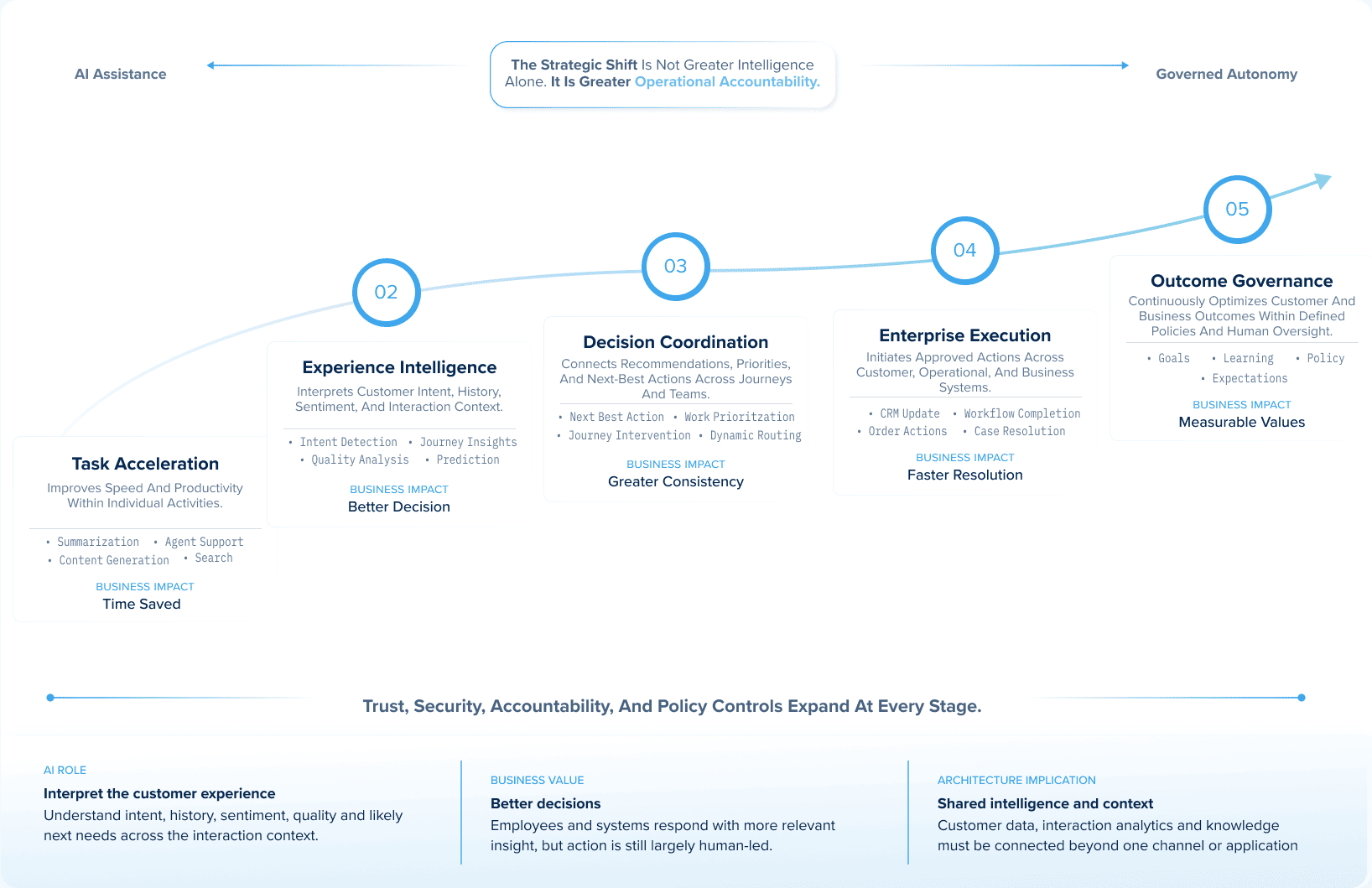
Most customer AI programs stall in the same place: an assistant bought per channel, each with its own knowledge and its own answer, automation that halts at the first approval, governance retrofitted afterwards, and ROI argued on deflection rate. The fix is not a better agent — it is where AI sits in the architecture. The shift is not simply from weaker models to stronger models. It is a transfer of operational accountability: from improving an individual task, to interpreting experience, coordinating decisions, executing approved actions and optimizing measurable customer outcomes within enterprise policy.

Design For The Destination, Not Only The Pilot
Adding copilots can create immediate productivity, but durable customer value requires an AI-native engagement model built around shared context, decision coordination, governed action and a continuous outcome loop.
Starter AI
Add Assistance To Existing Work
Summaries, Drafting, Search And Guidance Improve Tasks But Leave Processes, Ownership And Handoffs Untouched.
→
Connected AI
Coordinate Decisions Across Journeys
Shared Context, Next-Best Action And Dynamic Routing Improve Consistency Across Channels And Teams.
→
AI-Native Engagement
Execute Within Governed Boundaries
AI Carries Work Across Systems, Completes Approved Actions And Learns From Outcome Evidence Under Human Oversight.
The buying question changes: not "Which AI features are included?" but "How much responsibility can this architecture assume without losing context, control or accountability?"
AI-native engagement connects every interaction to a persistent customer context, a governed decision layer and the enterprise systems required to complete the work.
Start Here · Fixed Fee · 4–6 Weeks
Feature counts reveal very little about whether a platform can progress from assistance to accountable execution. Evaluation should test the architecture, control model and evidence of production outcomes.
01 · Context Continuity
Does context persist?
Customer identity, intent, history, consent and journey state should move across channels, teams and AI agents without being reconstructed.
02 · Decision Depth
Can AI coordinate decisions?
Assess reasoning, prioritization, next-best action, dynamic routing and multi-step planning across the full journey.
03 · System Actionability
Can it complete work?
Secure read/write connectivity to CRM, case, order, billing and workflow systems matters more than conversational fluency alone.
04 · Governance By Design
Are controls native?
Policy enforcement, approval gates, explainability, audit, exception handling and rollback should be embedded in execution.
05 · Architecture Openness
Can the stack evolve?
Model choice, data portability, orchestration interoperability and reusable services reduce dependence on one application or channel.
06 · Outcome Evidence
Can value be proven?
Measure resolution quality, cycle time, customer effort, cost-to-serve, retention and conversion—not only adoption or deflection.
How this changes transformation design: platform selection, customer data, workflow access, governance and outcome measurement must be decided together. Otherwise the enterprise may launch AI quickly, but it will remain an assistant because the architecture never gave it the context, authority or controls required to become agentic.
What We Do
Stack Rationalization, Consolidation Decisions And Vendor Selection
Target Architectures, Customer Data Models, Identity And Consent Design
Migration And Consolidation Designs, Requirements And Governance
Design Authority Through Your Partner's Build; Benefits Tracked To Realization
What We Don't
Campaign Execution, Creative, Content Production Or Media Buying — That's Your Agency's Craft
Platform Implementation, Configuration Or Custom Development
Managed Services Or Marketing Operations As A Body-Shop
Software Resale Or Vendor Alliances With Referral Economics
When you need the disciplines we leave out, we'll say so — and point you to people who do them well.
Who You'd Work With

Umang Thakur
Vice President & Principal Advisor
Know more

Devendra Pagnis
Associate Vice President & Principal Advisor
Know more

Aaron Andrews
Practice Director & Principal Advisor
Know more

Amandeep Khanuja
Practice Director & Principal Analyst
Know more

Richa Choubey
Principal Analyst
Know more

Vaishnavi
Principal Analyst
Know more
A stack rationalization is fixed-fee and ends in artifacts: what's overlapping, what's shelfware, what to consolidate, and what it's worth. Everything after that is a decision with evidence behind it.