

10.12.2025
QKS Insight
Understanding the Engagement–Enablement–Intelligence Value Loop in Modern SalesTech
Author:
Vaishnavi
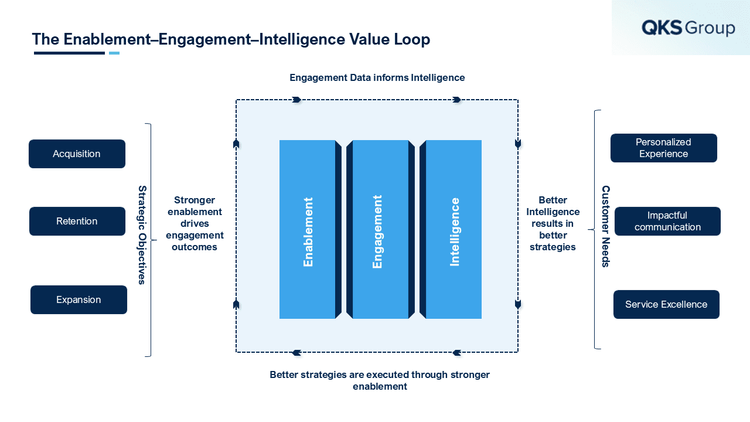


The SalesTech landscape has reached a new phase defined by closer convergence between engagement data, enablement workflows, and intelligence tools. The emergence of a more unified architecture combining engagement and intelligence capabilities has resulted in the category of Revenue Orchestration Platform (ROP). This evolution represents the practical reality of how revenue teams currently carry out, assess, and enhance go-to-market activities.
The Engagement–Enablement–Intelligence Value Loop, a continuous cycle that connects customer-facing actions to strategic goals, is at the center of this change. The loop illustrates how contemporary revenue teams combine data, content, coaching, and execution into a single system to produce compounding benefits.
1. Intelligence Is Informed by Engagement Data
Engagement data is produced by every customer interaction, including calls, emails, demos, and digital experiences. This information is loud on its own. However, it becomes a strategic asset when combined and analyzed using AI-driven revenue intelligence. Buyer behavior patterns show deal risks, competitive pressure, new wants, and the efficacy of content. This intelligence layer has been increasingly integrated directly into interaction suites during the last two years, so combining the two categories. Platforms are no more passive tools; instead, they actively provide representatives with workflow information.
2.Increased Intelligence Results in Improved Strategies
The ultimate goal is not intelligence alone. Its usefulness is in turning unprocessed signals into practical strategy. These insights are used by leaders to optimize training priorities, modify playbooks, improve message frameworks, and more precisely categorize purchasers. Real-time market sensing makes strategy dynamic and constantly updated. This serves as a strategic link between business objectives like acquisition, retention, and growth and customer needs like individualized experiences, effective communication, and superior service.
3. Stronger Enablement Leads to Better Strategies
The operationalization of strategy occurs through enablement. Targeted onboarding, adaptive coaching, content standardization, and scenario-based training are all products of refined frameworks. Enablement becomes more of an execution engine and less of a static knowledge function when intelligence sharpens these components. Based on what the most recent research shows buyers react to, teams are prepared not only to communicate but also to communicate precisely.
4. Better Engagement Outcomes Are Driven by Stronger Enablement
The field benefits immediately from effective enablement. Representatives show a deeper comprehension of client problem points, build tailored experiences at scale, and deliver more relevant interactions. Higher quality engagement follows, deals move forward, meetings advance, and customer confidence rises. In the end, this leads to better results in terms of expansion, retention, and acquisition.
Revenue Enablement Platforms now have access to an unprecedented amount of behavioral, content-consumption, and interaction-level data thanks to the integration of DSRs and deeper engagement analytics. This broadens their responsibilities from mainly assisting with content supply and preparation to actively influencing the strategic decision-making of the sales and content teams. The path toward AI-enabled automation becomes much more obvious as these datasets get richer and more organized.
AI-driven analytics will soon improve how teams prioritize accounts, create plays, and customize messages. However, a more revolutionary option is beginning to emerge: in the same way that platforms already produce Next Best Action (NBA) recommendations for seller-buyer engagement, the next development may introduce NBAs for larger GTM motions and account-level strategy. Systems might start recommending which accounts to target, which plays to deploy, which content assets need to be updated, and where revenue risks are building along the pipeline, rather than just telling representatives what to do within a sale.
Author: Vaishnavi, Senior Analyst - MarTech & SalesTech