

10.09.2026
QKS Insight
The next CX advantage will come from AI that can act, not just assist
Author:
Amandeep Singh Khanuja
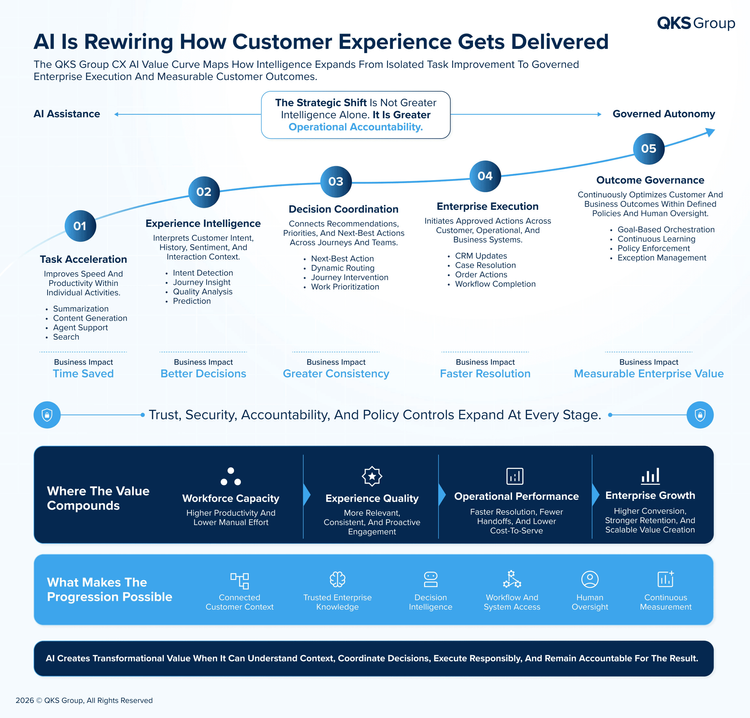


Artificial intelligence has already changed many of the individual activities that sit inside customer engagement. Agents can retrieve knowledge faster, conversations can be summarized automatically, content can be generated in seconds, customer intent can be identified earlier, and routine interactions can increasingly be handled without human intervention. Yet much of this progress still sits within the boundaries of the existing customer engagement operating model. AI may improve how work is performed, but the underlying sequence remains familiar: a customer expresses a need, an employee or application interprets it, a decision is made, and separate systems and teams complete the actions required to resolve it.
The next phase of customer engagement transformation is beginning to alter that sequence itself. AI is gradually moving from supporting individual activities to participating in the coordination of decisions and execution across the customer journey. The distinction matters because the economic value of AI changes considerably once intelligence becomes connected to operational action. An AI system that summarizes a service interaction creates productivity value. A system that understands the customer's broader context, determines an appropriate course of action, coordinates the required processes across enterprise applications, executes within approved boundaries, and measures the resulting outcome has a fundamentally different role in the organization.
This evolution can be understood as a progression from AI Assistance to Governed Autonomy. It begins with task acceleration, develops through richer experience intelligence and coordinated decisioning, extends into enterprise execution, and ultimately reaches a model in which AI can act with increasing independence while remaining constrained by policy, permissions, accountability, and human oversight. The technology becomes more capable at each stage, but the more important change is organizational: enterprises are gradually assigning intelligence a greater degree of operational responsibility.
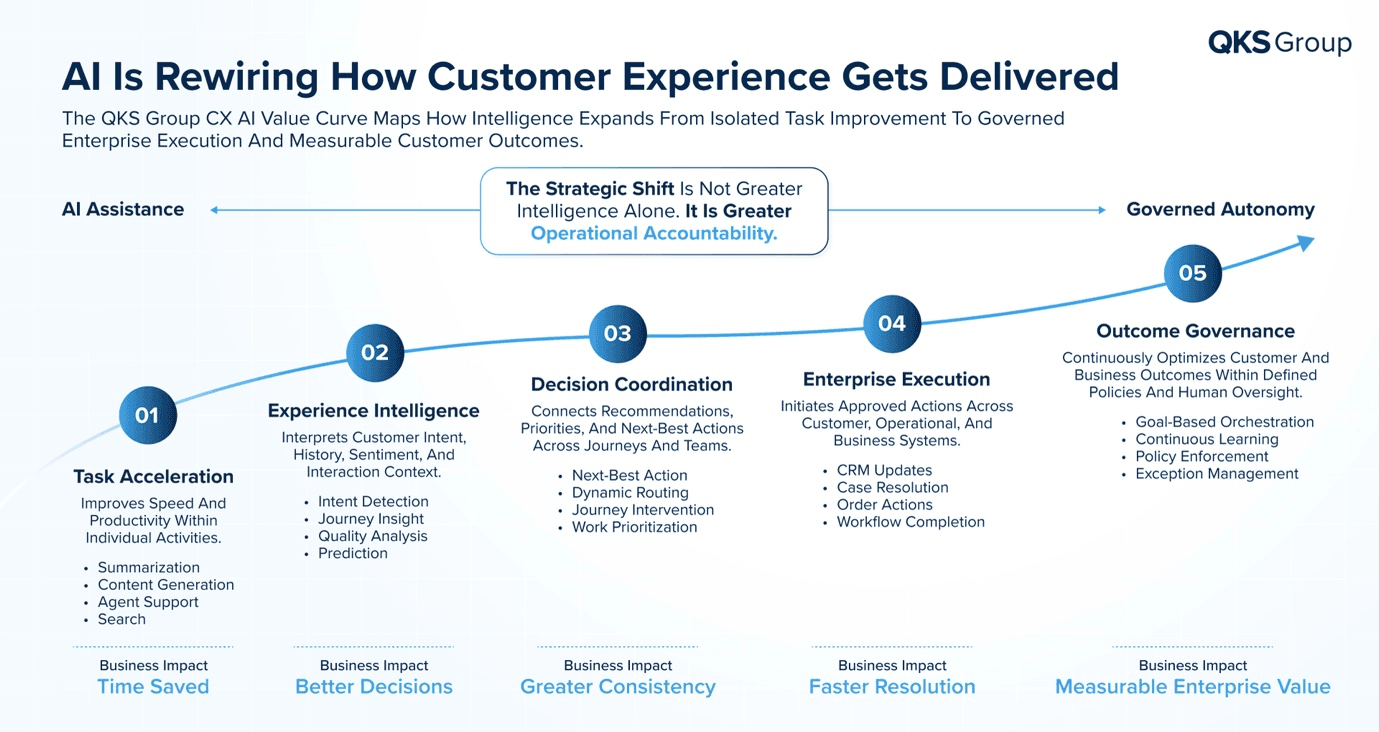
Figure 1. The CX AI Value Curve: How customer engagement progresses from task-level assistance toward governed execution and measurable enterprise outcomes.
The image should sit after the opening three paragraphs, not at the top of the article. By this point, the reader understands the market thesis, and the visual then becomes the analytical framework for the rest of the discussion.
The first phase of AI improved the work without changing the operating model
Most of the first meaningful wave of AI adoption in customer engagement concentrated on clearly defined activities where the relationship between capability and business value was easy to understand. Agent-assist technologies surfaced relevant information during conversations, generative AI reduced the effort associated with case notes and communication creation, automated quality management increased the proportion of interactions that could be assessed, and conversational AI absorbed a growing share of repetitive customer enquiries. These capabilities have helped organizations improve productivity and, in many cases, enhance service consistency. They have also provided enterprises with a relatively controlled environment in which to introduce AI because employees remained responsible for most material decisions and actions.
This model can deliver significant value, but its limitations become visible as organizations attempt to translate productivity gains into broader customer outcomes. Reducing after-call work does not necessarily reduce the time required to resolve an issue. Improving knowledge retrieval does not remove the operational steps that an employee may still need to complete across CRM, billing, order management, workflow, and other systems. Generating a more relevant response does not address situations in which different functions within the enterprise are working from different versions of customer context. The organization may therefore become faster at individual tasks without materially simplifying the journey experienced by the customer.
That distinction is becoming increasingly important as enterprises evaluate the next generation of AI investments. The value ceiling of assistive AI is reached when intelligence can recommend what should happen but remains disconnected from the mechanisms required to make it happen. The next source of differentiation therefore comes from moving AI closer to the decision itself and giving it access to a broader understanding of the customer situation in which that decision is being made.
Experience intelligence changes the unit of decision-making
Customer engagement has historically been optimized around individual interactions, channels, and functional systems. A contact center understands the service conversation, a marketing platform interprets campaign behavior, a CRM application stores account context, and a digital analytics platform observes online activity. Although enterprises have invested heavily in connecting these environments, important parts of the customer relationship remain fragmented across technology and organizational boundaries.
AI has the potential to make that fragmentation less visible at the point of decision. By combining conversational signals with transactional history, digital behavior, service activity, sentiment, journey state, product usage, previous commitments, and other contextual information, AI can help an organization interpret not only what the customer is asking for, but also why the interaction matters within the broader relationship. This represents a shift from interaction intelligence toward experience intelligence.
The difference can be significant. Two customers may contact an organization with the same apparent service request, yet the appropriate response may differ substantially when broader context is considered. One may be experiencing an isolated problem; another may have already contacted the organization multiple times, have an unresolved complaint, be approaching a renewal, or be showing signals associated with attrition. A system focused solely on the current interaction may treat both cases similarly. A system with richer experience intelligence can recognize that the required business response should be different.
This is where the value of AI begins to move beyond efficiency. The system is no longer simply making an employee faster; it is beginning to improve the quality and relevance of the decision itself. However, better decisions at an individual interaction level still do not solve one of the most persistent problems in customer experience: different parts of the enterprise frequently optimize for different outcomes.
Decision coordination becomes the missing layer in customer experience
One of the structural weaknesses of many customer engagement environments is that decisioning remains distributed across functions. Marketing may determine the next-best offer, service may prioritize issue resolution, sales may pursue expansion opportunities, retention teams may apply a different customer value model, and operations may be working within constraints that are invisible to all of them. Each decision can be rational within its own system while still producing an incoherent experience when viewed from the perspective of the customer.
This problem becomes more pronounced as organizations introduce additional AI models and agents. Without a mechanism for coordinating objectives, enterprises risk replacing fragmented human decision-making with fragmented machine decision-making. More intelligence does not automatically create a more consistent customer experience if every application continues to optimize independently.
The emerging requirement is therefore not simply better prediction, but stronger decision coordination. AI needs to evaluate customer context alongside commercial priorities, service commitments, operational constraints, policy rules, eligibility conditions, previous actions, and the likely downstream consequences of different choices. In practical terms, this means determining not only the best action within one application, but which action should take precedence across the broader journey.
This is an important point for enterprises assessing customer engagement transformation. The long-term value of AI will depend less on the number of individual models or recommendations an organization can deploy and more on its ability to create coherence between them. The customer ultimately experiences the collective behavior of the enterprise, not the internal boundaries between marketing, service, sales, operations, and technology systems. Decision coordination therefore becomes the bridge between better intelligence and better experience.
The move into enterprise execution changes the architecture of CX
The most consequential transition occurs when AI moves beyond interpreting and recommending to initiating operational action. This is the point at which the discussion around agentic AI becomes materially relevant to customer engagement.
Consider a customer contacting an organization because an order has not arrived. In an assistive environment, AI may identify the reason for contact, retrieve the order details, summarize previous interactions, recommend an appropriate response, and guide an employee through the resolution process. The experience may be faster, but the employee is still responsible for navigating the underlying operational workflow.
In a more mature execution model, AI can take responsibility for a larger portion of that workflow. It can determine whether the customer qualifies for remediation, select the appropriate resolution based on policy and context, initiate a replacement or refund, update the customer record, trigger the required logistics process, communicate the outcome, and escalate the case only when the situation falls outside defined boundaries. The interaction layer has effectively become connected to the systems capable of delivering the outcome.
This changes the architecture required to support customer experience. Historically, many CX platforms have been evaluated according to their ability to manage channels, interactions, routing, employee productivity, analytics, and customer data. As AI moves into execution, the relevant architecture expands toward CRM, ERP, payments, order management, workflow automation, service management, identity, policy engines, commerce platforms, and industry-specific systems of record.
The competitive distinction between an AI system that can converse and one that can execute will therefore become increasingly important. A highly capable conversational interface may improve customer perception during the interaction, but the customer ultimately evaluates the organization based on whether the underlying problem was resolved. The strategic objective moves from conversational automation toward closed-loop execution, where customer intent can be translated into a completed enterprise action with minimal unnecessary handoffs.
Governed autonomy is an operating model, not an automation target
As AI acquires greater execution authority, the challenge shifts from determining what the technology can do to defining what the organization is prepared to allow it to do. This is why governed autonomy should be understood as an operating model rather than as a destination in which human involvement simply disappears.
Enterprise autonomy is unlikely to be uniform. Different actions carry different levels of financial, regulatory, reputational, and customer risk. An AI system may be allowed to reschedule a delivery without approval, issue a service credit within a prescribed threshold, or update a routine customer preference independently. The same organization may require human authorization before the system changes a contractual term, processes a high-value refund, alters a regulated product, or takes action affecting a vulnerable customer.
Autonomy therefore becomes graduated. The appropriate level of authority depends on the nature of the action, the confidence of the system, the reversibility of the decision, the potential customer impact, and the policies governing the underlying process. This requires enterprises to define execution boundaries with far greater precision than was necessary when AI was used primarily for recommendations.
Governance must consequently move into the execution path itself. Identity, permissions, policy enforcement, approval logic, audit trails, exception handling, observability, and human escalation can no longer sit outside the AI system as independent control mechanisms. They need to determine, at runtime, which actions the AI is allowed to take and under what conditions. The shift toward agentic customer engagement therefore expands the scope of AI governance from model behavior toward operational behavior.
This distinction will become increasingly significant. An inaccurate recommendation can often be corrected before it affects the customer. An autonomous action can update a system of record, trigger a financial transaction, modify an entitlement, change an order, or initiate another automated process. As the consequence of AI decisions increases, the maturity of the surrounding control environment becomes as important as the sophistication of the intelligence itself.
The value model must shift from automation metrics to outcome economics
The movement toward greater AI authority also requires a different approach to measuring value. Much of the current CX AI market remains focused on metrics such as containment, deflection, handle-time reduction, automation rate, agent productivity, and response accuracy. These indicators are useful for evaluating specific operational improvements, but they become insufficient when AI begins coordinating and executing more of the customer journey.
A higher containment rate, for example, has limited strategic value if customers subsequently recontact the organization because their issue was not fully resolved. A shorter interaction may improve an operational metric while leaving the underlying journey unchanged. An automated retention intervention may prevent immediate churn but create a commercially poor outcome if the cost of the intervention outweighs the long-term customer value.
As AI moves further along the value curve, enterprises therefore need to broaden measurement from activity efficiency toward outcome economics. Resolution quality, repeat-contact reduction, customer effort, cost-to-resolve, retention quality, lifetime value, revenue protection, journey completion, and the financial consequences of autonomous decisions become increasingly relevant.
This transition is important because it creates the feedback mechanism required for more sophisticated autonomy. If AI is expected to optimize outcomes rather than simply execute predefined tasks, the organization needs to define which outcomes matter, how they should be balanced, and how the consequences of different actions will be measured. Outcome governance therefore becomes both a control mechanism and a learning mechanism. It allows the enterprise to understand not merely whether an autonomous process completed successfully, but whether the action produced the business and customer result it was intended to create.
Customer engagement technology is becoming part of a broader enterprise execution layer
These developments also challenge the traditional boundaries of the customer engagement technology market. CCaaS, CRM, conversational AI, customer data platforms, journey orchestration, workflow automation, analytics, and enterprise applications have historically been evaluated as relatively distinct categories. Agentic engagement increasingly depends on capabilities that span several of these layers at once.
An AI system that is expected to deliver an end-to-end customer outcome requires contextual data to understand the situation, reasoning and decisioning to identify an appropriate course of action, orchestration to coordinate processes, integrations and APIs to reach enterprise applications, identity and governance to constrain authority, and observability to determine whether the action produced the desired result. The strategic value of the customer engagement platform therefore begins to depend on how effectively it can participate in this broader execution architecture.
This has a direct implication for technology evaluation. The presence of an AI agent, copilot, or generative interface tells an enterprise relatively little about the actual maturity of a platform. The more relevant assessment concerns the depth of context available to the AI, the decisions it can coordinate, the enterprise systems it can safely invoke, the controls governing its actions, and the ability to measure the resulting customer and business outcomes.
The market is therefore likely to differentiate increasingly around the depth of execution rather than the visibility of the AI interface. Vendors able to connect intelligence with operational processes will have the opportunity to address a broader share of the customer journey, while platforms concentrated predominantly on conversational capability may remain dependent on other systems to complete the work that creates the actual customer outcome.
The constraint is shifting from AI capability to enterprise readiness
The final implication is perhaps the most important. As AI technology improves rapidly, the limiting factor in customer engagement transformation is likely to move away from what the model is technically capable of doing and toward what the enterprise is operationally prepared to delegate.
Organizations may discover that an AI system is capable of executing a workflow before internal teams have agreed who owns the resulting decision. The required data may exist but remain constrained by organizational boundaries. The integration may be technically possible while the policy determining when the action should occur remains poorly defined. Different functions may support automation individually while disagreeing on the objective the AI should optimize across the journey.
This means the transition toward governed autonomy is not primarily a technology deployment exercise. It requires enterprises to establish decision rights, clarify ownership, redesign processes, connect data and systems, define authority thresholds, and create governance structures capable of operating at the speed of automated execution.
Organizations that address these issues early will be better positioned to capture the value of agentic customer engagement. They will be able to increase autonomy selectively, beginning with processes where outcomes are measurable and risk can be controlled, while retaining human authority where judgement or accountability remains essential. Over time, evidence from these deployments can support a gradual expansion of AI authority rather than a binary movement from human execution to automation.
Analyst perspective
The evolution from AI assistance to governed autonomy should not be viewed as another stage in the feature cycle of customer engagement technology. It represents a gradual redistribution of operational responsibility between employees, software platforms, and intelligent systems.
The first generation of CX AI primarily improved the economics of existing work. The next generation will increasingly influence how decisions are coordinated and how work is executed across the enterprise. This creates the potential for considerably greater value because AI can begin to reduce not only the effort associated with an interaction, but also the organizational friction between customer intent and completed resolution.
The organizations that create a durable advantage are unlikely to be those that automate the highest percentage of interactions or deploy the largest number of AI agents. More important will be their ability to determine where autonomous execution genuinely improves an outcome, provide AI with the enterprise context and system access required to deliver that outcome, and maintain sufficient governance to ensure that increased authority does not result in reduced accountability.
This is the deeper significance of the CX AI value curve. The progression from task acceleration to experience intelligence, decision coordination, enterprise execution, and outcome governance is also a progression from productivity value toward operational value. As enterprises move along that curve, customer engagement becomes less about how effectively AI supports a conversation and more about how reliably intelligence can convert customer intent into a governed, measurable business outcome.
Author: Amandeep Singh Khanuja, Associate Director & Principal Analyst QKS Group