

23.06.2025
QKS Insight
Revenue Lifecycle Management: Who’s Really Ready for the Full Quote-to-Cash Journey?
Author:
Abhishek Dubey
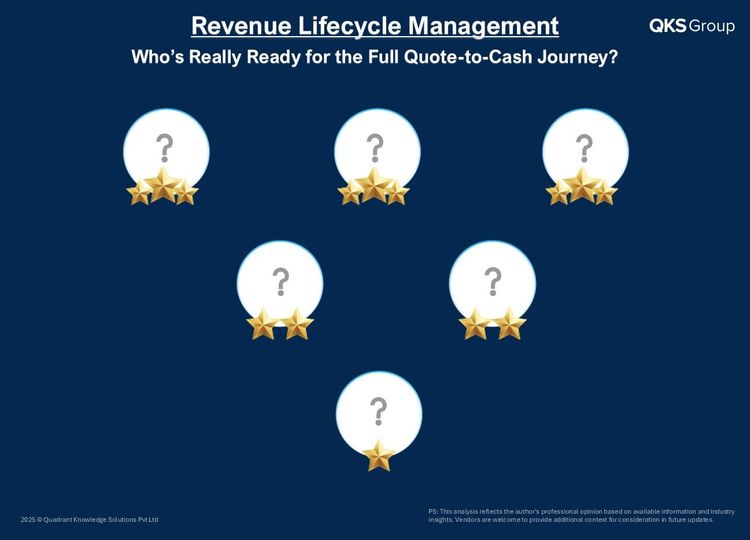


Revenue is not a department, It’s a system!
Behind every confirmed deal, renewed contract, or sales lies an interconnected process stretching across sales, legal, finance, and customer operations. For years, journey from quoting and contracting to invoicing and revenue recognition has been fragmented across multiple systems. But as enterprise expectations shift from speed to intelligence, the quote to cash market is now responding with a new unifying concept, that is Revenue Lifecycle Management (RLM).
At QKS Group, we are launching an exclusive research study SPARK Matrix: Revenue Lifecycle Management Suites, 2025, to evaluate vendors across the RLM spectrum, from those who are enabling the deal creation to those who are managing execution, compliance, and revenue realization. This analysis is not just about platform breadth, but it’s about architectural integration, automation readiness, and functional consistency across every stage of the Quote-to-Cash (Q2C) process.
Some vendors are evolving into this space from CPQ market. Others are expanding outward from CLM platform, eSignature software, or Billing platforms. But regardless of the entry point, the core question remains the same: Can your platform orchestrate revenue, or does it merely support it in isolation?
RLM: The Architecture Behind Revenue
Let’s define the terrain first.
According to QKS Group, "A Revenue Lifecycle Management (RLM) Suite is an integrated software solution that enables organizations to manage the entire revenue generation process, from product configuration and quoting to contract execution, billing, and revenue recognition. It provides the ability to streamline CPQ, CLM, document automation, and subscription billing workflows within a unified framework. By connecting sales, legal, and finance operations, an RLM platform ensures process continuity, compliance, and operational efficiency across the customer lifecycle. It also supports real-time visibility into commercial performance, enabling intelligent decision-making and faster revenue realization.”
This includes:
- Configure-Price-Quote (CPQ): For product configuration, pricing logic, approvals, and quote generation.
- Contract Lifecycle Management (CLM): For legal agreement creation, negotiation, compliance tracking, and obligation management.
- eSignature: For digital execution and auditability of agreements.
- Subscription & Billing: For recurring revenue management, usage billing, invoicing, collections, and revenue recognition.
- Analytics & Forecasting: For visibility across performance metrics, churn, renewal readiness, and financial risk.
Individually, these systems have matured. But most still operate in silos. The true challenge and opportunity, lies in creating a unified Quote-to-cash backbone that eliminates redundancy, manual effort, and information loss within organization.
Why some software providers are approaching to Revenue Lifecycle Management even though having different starting Points
Not every platform in the market claims to be a full-suite RLM provider and that’s expected. In fact, most are still in transition. Here’s how the market is shaping up:
- From CPQ to RLM: Software providers vendors that began with CPQ are now adding CLM, Billing, and even document automation layers. Their strength lies in sales process alignment, but contractual and financial execution often lags unless backed by tight integrations among different Q2C modules.
- From CLM to RLM: These platforms have strong governance and legal compliance foundations. Some are layering CPQ capabilities or embedding pricing intelligence to support pre-signature workflows. Others are aligning with billing platforms to extend downstream.
- From eSignature to RLM: These vendors are building upward and outward expanding from signature capture into contract repository management, form generation, and even workflow automation. However, many still rely on partners or APIs for CPQ or revenue functions.
- From Billing to RLM: Billing-first platforms often lead in subscription flexibility and financial operations, but their ability to handle pre-sales configuration, quote logic, or legal negotiation is still developing.
Each entry point brings strengths but also blind spots. As an analyst, my role is not to rank vendors by size or marketing claims, but to evaluate actual readiness for unified revenue execution.
What I’ll Be Analyzing in this Research Study
This research will evaluate vendors across a set of carefully defined Technology Excellence criteria, focusing on real product capabilities and architectural robustness. Each vendor will be assessed not just on the features they offer, but on how those features interconnect, scale, and support revenue agility.
1. Quote-to-Cash Process Orchestration
Can the platform truly orchestrate an end-to-end journey, from configuration to signature to invoice? I will look at how workflows are triggered across modules, how data integrity is preserved, and whether process bottlenecks are visible and remediable in real time.
2. Pricing, Quoting & Commercial Configuration
How flexible is the pricing engine? Does it support usage-based, tiered, bundled, and negotiated pricing? Can sales teams configure complex deals while maintaining governance? Platforms entering from CLM or Billing often struggle here, this analysis will reveal where gaps exist.
3. Contract Lifecycle Management
Does the platform support clause-level intelligence, negotiation workflows, version control, redlining, and obligation tracking? Is AI used to assist clause selection or detect risk? For vendors evolving from CPQ or eSignature, this is often the weakest link.
4. Subscription, Billing & Revenue Recognition
How well does the system manage recurring billing, usage tracking, credit notes, and ASC 606/IFRS 15 compliances? Are billing rules contract-aware? Can revenue be recognized based on actual delivery terms?
5. Document Management & Workflow Automation
Are documents auto generated from quote and contract inputs? Can workflows be dynamically triggered based on deal context, role, and geography? This becomes a key differentiator in high-volume environments.
6. AI-Driven Process Automation & Predictive Intelligence
Does the platform offer AI that actively reduces manual work such as recommending prices, predicting delays, identifying risky clauses, or suggesting renewal terms? Or is it limited to surface-level analytics?
7. Analytics, Forecasting & Revenue Performance Tracking
Can revenue leaders see the full picture, quotes in play, contracts signed, revenue earned, risks flagged, and renewals approaching? Or is data scattered across systems?
8. Integration & Interoperability
How seamlessly does the platform connect with CRM, ERP, accounting, and other enterprise systems? Are integrations real-time, bi-directional, and API-friendly?
9. Modularity & Scalability
Can customers adopt just CPQ or CLM and grow into full Revenue Lifecycle Management later? Does the platform scale across regions, business models, and product portfolios?
10. Competitive Differentiation Strategy
Is the vendor innovating in user experience, process intelligence, or vertical specialization or just rebranding existing capabilities as “RLM”?
11. Application Diversity & Use Case Coverage
How adaptable is the platform across industries such as SaaS, manufacturing, telecom, life sciences? Does it address direct, channel, and self-service models?
Why This Research Matters- For Enterprises and End Users
The buying centre for revenue-related platforms is shifting. What was once a sales ops or legal ops decision is now increasingly owned by CROs, CFOs, and even Chief Transformation Officers. Why? Because disjointed revenue systems are no longer just operational inefficiencies, they’re customer experience liabilities and growth inhibitors.
Delayed quotes. Contracts stuck in legal. Disconnected billing. Poor visibility into renewals. These aren't just internal workflow problems; they directly impact the end user.
This research is designed to serve two equally critical audiences:
1. Enterprise Decision Makers
This study will help revenue, finance, and IT leaders:
- Identify which platforms are truly orchestrating the full revenue lifecycle
- Understand where point tools may still provide value depending on business model
- Detect integration gaps and automation limits before they cause downstream delays
- Choose systems that align with their growth, compliance, and renewal objectives
2. End Users Across Teams
Whether you're in sales, legal, finance, customer success, or billing operations, your day-to-day is shaped by how well these systems talk to each other. Here’s what’s at stake for end users:
- Sales Teams: Faster, more accurate quotes; real-time visibility into contract terms and billing timelines
- Legal Teams: Clause libraries with pre-approved fallback positions; automated redlining; reduced manual review load
- Finance Teams: Early visibility into deal structures and obligations; automated revenue recognition tied to contract triggers
- Customer Success: Access to signed contracts and renewal clauses without needing to dig through emails
- Operations: Streamlined workflows from deal close to provisioning, reducing friction and duplication of effort
Ultimately, a well-integrated Revenue Lifecycle Management platform enables faster time-to-value for customers, cleaner revenue forecasts for leadership, and fewer handoffs and surprises for internal teams. That’s the real promise of RLM and the lens through which this research will be conducted.
To Vendors: Now is the Time to Show Your RLM Capabilities
This framework is also an open invitation to platform providers across CPQ, CLM, eSignature, and Billing. If your product vision includes RLM or you’ve made strategic moves in that direction, this is the time to bring your story forward.
The analysis will be objective, structured, and visually represented with vendor names and performance ratings shared across our network. Participation ensures your position is based on your actual strengths, not inferred from public information.
Some platforms may lead in CPQ and CLM but lack billing functionality. Others may combine contract execution with document automation but depend on third-party quoting tools. That’s okay. The value of this research lies in surfacing those distinctions, so buyers make informed, aligned decisions.
Closing Thought: RLM Is Not a Product Category, It’s an Execution Strategy
As the lines blur between pre-sale and post-sale, between configuration and compliance, Revenue Lifecycle Management is no longer optional for growth-oriented enterprises. It’s a strategic priority.
This market is at an inflection point. Some vendors will evolve and consolidate. Others will form ecosystems of interconnected best-of-breed tools. Either way, the winners will be those that operationalize revenue as a connected process, not just a checklist of siloed functions.
At QKS Group, our upcoming research will separate the claims from the capabilities. And as always, the door is open for those who want to be evaluated, not overlooked.
Reach out to me for booking a briefing slot or share your product story directly.
Connect me at: abhishekd@qksgroup.com
Author: Abhishek Dubey, Analyst - Revenue Lifecycle Management at QKS Group