

12.06.2025
QKS Review
QKS Reviews: The Legacy Reset in Discrete Product Lifecycle Management (PLM) - Who's Leading, Who's Lagging in 2025?
Author:
Anoch Mane


Executive Summary:
As the Discrete PLM market faces rising pressure from accelerated product complexity, global variants, and platform usability, organizations are demanding more than traditional CAD vaulting or slow ERP-connected PLM workflows.
This review blog by QKS Group investigates whether legacy PLM vendors are ready to support fast, connected, and configurable enterprise operations or if they risk being left behind.
What Modern Discrete PLM Should Deliver:
- Real-time configuration and multi-domain BOM orchestration
- Low-code extensibility for cross-lifecycle governance
- Hybrid cloud and SaaS-native delivery options
Key Findings:
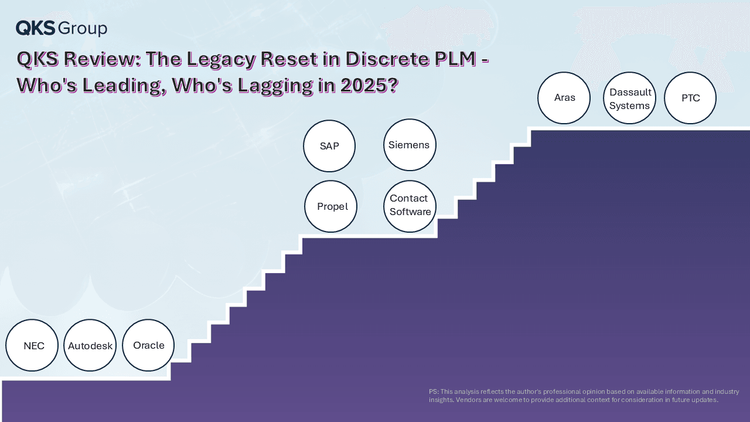
- PTC, Aras, and Dassault lead with scalable, engineering-complete, and configurable PLM platforms.
- Siemens shows breadth and commitment to modernization but is slowed by legacy UI and deployment models.
- Oracle, NEC, and Autodesk lag in engineering-specific workflows, offering limited flexibility for enterprise-wide PLM innovation.
2025 is not a normal year for the PLM market. It’s a line in the sand.
As product complexity skyrockets, manufacturing lifecycles shorten, and cloud-first mandates accelerate, the once-unshakable dominance of legacy PLM vendors is being tested. Platforms built for CAD vaulting, mechanical BOM control, and slow-moving engineering workflows are being challenged by rising demands for cross-functional collaboration, real-time data orchestration, and enterprise-wide configurability.
The shift is unmistakable. Engineering-centric PLM is giving way to enterprise-scale orchestration platforms. But are the legacy players ready?
Why Discrete PLM is Facing a Reboot
Traditional Product Lifecycle Management systems were engineered for controlled environments, complex assemblies, structured BOMs, and CAD-driven engineering cycles. But today’s manufacturers operate in a new reality:
- Accelerated design-to-release timelines
- Global product variants and configurations
- Integration with supply chain, service, and customer systems
- Pressure for faster implementation, easier scaling, and UI modernity
The new PLM mandate is simple: connect teams, products, and data across the digital thread without anchoring in monolithic, CAD-first infrastructure. Platforms that fail to make this leap risk fading relevance.
Vendor Landscape: Who’s Pushing, Who’s Falling Behind
Enterprise-Ready PLM Leaders
PTC: Integrated Portfolio with Execution Consistency
PTC offers one of the most comprehensive Product Lifecycle Management portfolios in the market with Windchill, Windchill+, and Arena PLM. Windchill continues to be the core enterprise solution for complex engineering, with robust configuration and variant BOM management, multi-domain lifecycle control, and native support for digital thread extensions via ThingWorx (IoT) and Vuforia (AR). The Windchill+ SaaS architecture represents PTC’s transition toward cloud-native scale and flexibility, while Arena PLM enables SMB and electronics-centric deployments with lightweight, intuitive PLM workflows.
PTC’s product strategy aligns with the need for hybrid cloud flexibility, deep CAD-PLM-ALM integration, and platform extensibility. Its steady pace of innovation and focused execution position it as one of the most prepared vendors to address the next decade of discrete PLM.
Dassault Systems: Simulation-Centric and Engineering Deep
Dassault’s ENOVIA, underpinned by the 3DEXPERIENCE platform, stands out for its tight coupling with CATIA, SIMULIA, and DELMIA, enabling a model-based engineering and simulation-driven approach to product lifecycle management. Its strength lies in industries like aerospace and high-tech, where end-to-end product modelling and simulation are critical.
ENOVIA’s USP lies in delivering a collaborative platform that unifies mechanical design, embedded systems, simulation, and manufacturing planning. However, its tightly integrated ecosystem demands dedicated engineering teams and lock-in to Dassault’s toolchain. Still, for design-intensive industries, it remains one of the most engineering-complete PLM stacks.
Aras: Extensible and Resilient, With Platform-First DNA
Aras Innovator offers unmatched flexibility through low-code development, composable PLM apps, and open architecture enabling seamless connectivity and traceability through a robust Digital Thread. It supports both discrete and process industries, enabling advanced lifecycle controls and regulatory safeguards, such as Halal, Kosher, and food safety enforcement.
With AI solutions targeting automation in digital thread analysis and compliance workflows, Aras is making headway into decision-augmented PLM. Its InnovatorEdge platform supports scalable API orchestration, and leading manufacturers across diverse sectors use Aras to unify systems and drive cross-lifecycle collaboration.
However, configuration depth comes with complexity. Successful deployment requires committed planning, and while Aras is in a dynamic growth phase, it is intentionally scaling its partner and integration ecosystem through focused investments.
PLM Vendors in Transition
SAP: PLM Tied to ERP DNA
SAP PLM remains deeply embedded within the S/4HANA ecosystem, with strengths in enterprise data continuity, costing integration, and compliance alignment. However, its core PLM functionality, especially in engineering BOM control, 3D visualization, and configuration simulation is secondary to its ERP workflows.
SAP’s focus on back-office integration rather than front-end engineering collaboration limits its adoption as a true PLM platform. Until SAP delivers a CAD-agnostic, engineering-friendly experience, it will remain more of a compliance facilitator than an innovation driver.
Siemens: Robust Platform with Enterprise Breadth, invests in usability and speed
Siemens offers one of the most comprehensive Product Lifecycle Management portfolios in the industry through Teamcenter (on-premises) and Teamcenter X (cloud-native). These platforms are rich in capabilities including multi-CAD interoperability, BOM configuration and change management, digital twin continuity, and deep integration with manufacturing planning and service lifecycle applications. Siemens stands out for supporting full-scale, multi-site global rollouts and remains a go-to for highly engineered products in sectors like automotive, aerospace, and industrial equipment.
However, Teamcenter's legacy complexity, UI sprawl, and extended implementation timelines can inhibit business agility, especially when compared to newer, cloud-native competitors. To address this, Siemens has made significant investment in deployment acceleration, combining pre-built PLM solutions with tools like Deployment Centre as well as scripted customizations.
The company is actively investing in low code through Mendix and is pushing SaaS momentum via Teamcenter X, but faster delivery of simplified user experiences and lower deployment overhead will be key to engaging a wider range of business stakeholders.
Propel: Cloud-Native Simplicity with Enterprise Aspirations
Propel is built natively on Salesforce, allowing direct integration with CRM, CPQ, and support workflows. It excels in bringing product and commercial teams together and enables fast deployments for mid-sized manufacturers.
However, Propel still lacks depth in enterprise-grade change control, product structure modelling, and CAD integration. For product-oriented business users, Propel is a modern PLM-lite option, but it will need stronger engineering Product Lifecycle Management capabilities to compete in high-regulation, global manufacturing scenarios.
Contact Software - Architecturally Agile, Functionally Focused
Contact Elements offers high modularity, built-in workflow engines, and open data structures, making it attractive for highly customized use cases. Its strength lies in mechanical CAD integration, change control, and cross-discipline documentation.
However, Contact Software has not yet demonstrated broad adoption outside of German-speaking markets or scaled large multi-site rollouts. Its UI and partner ecosystem remain limited compared to the global leaders.
Vendors at Risk of Relevance Loss
Autodesk: PLM Ambitions Constrained by SMB Focus
Autodesk’s Fusion 360 Manage is aimed at design-centric teams needing lightweight Product Lifecycle Management functionality. While the user experience and integration with Inventor and Fusion 360 are polished, its enterprise reach is weak. It lacks built-in depth in change impact analysis, configuration rules, and global collaboration.
Autodesk has not evolved its PLM vision beyond design-led use cases. For discrete manufacturers scaling digital thread or compliance programs, it is currently insufficient.
Oracle: Infrastructure First, PLM Peripheral
Oracle Fusion Cloud PLM sits within a larger ERP and supply chain suite, providing standardized workflows for NPD, change control, and supplier collaboration. However, engineering-specific capabilities, like product structure versioning, advanced search across CAD metadata, and visual BOM authoring remain underdeveloped.
Oracle’s PLM lacks differentiation in core design-to-release workflows and is primarily adopted as an extension of ERP modernization projects.
NEC - Strong Domestically, Lacks Global Engineering Reach
NEC’s Obbligato is a respected Product Lifecycle Management platform in Japan, focused on process standardization, BOM and parts management, and manufacturing documentation. However, its UI, deployment flexibility, and non-Japanese market presence are minimal.
It lacks native support for collaborative modelling, multi-CAD environments, and agile project structures. Without major investment in internationalization and integration extensibility, NEC will remain a regional contender.
Strategic Questions for 2025
- Can SAP decouple PLM from ERP and lead with usability?
- Will Siemens modernize Teamcenter’s delivery model?
- Is Autodesk content with SMB design tools, or will it build out for the enterprise?
- Can Oracle build true PLM depth, not just ERP adjacency?
- Will NEC scale its domestic strengths into global relevance?
2025 marks a clear shift. Discrete PLM is no longer judged by CAD compatibility or document control rather it’s judged by configurability, deployment speed, and user-centric execution.
PTC, Dassault, and Aras are aligned with where the market is going. SAP and Siemens must break free from their old operating assumptions. Propel and Contact need more enterprise-grade functionality. Oracle, Autodesk, and NEC must redefine what they offer or risk becoming background players in a fast-moving race.
Disclaimer:
This blog is based on independent research and publicly available information. The insights presented reflect the views of QKS Group and are for informational purposes only. While we strive for accuracy, we do not guarantee completeness or absolute correctness. Vendors are welcome to provide clarifications or updates. If any vendor listed in this analysis wishes to provide additional context or clarification, we welcome a briefing call and will consider incorporating relevant updates. This analysis is not intended to disparage any vendor but to provide an informed, balanced perspective. We encourage open and constructive dialogue to foster transparency and a deeper understanding of the industry.
Author: Anoch Mane, Analyst - Operational Technology Software at QKS Group
Vendors: