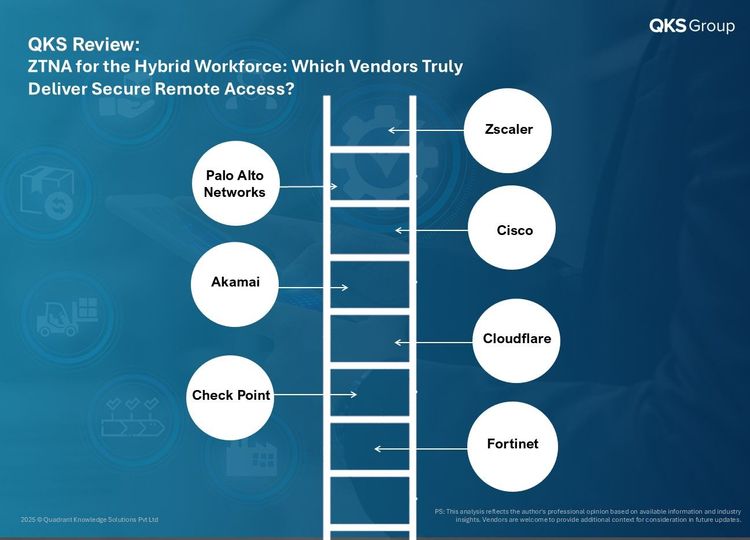
This blog provides a comparative analysis of seven leading ZTNA vendors, Zscaler, Akamai, Palo Alto Networks, Cloudflare, Cisco, Check Point, and Fortinet, based on their secure remote access capabilities. Secure remote access in Zero Trust Network Access (ZTNA) enables users to connect to specific applications without broad network access, based on verified identity, device posture, and granular policies. It provides application-level segmentation, real-time threat inspection, and seamless cloud integration. This capability is used to enhance security, reduce attack surface, and improve user experience in remote and hybrid work environments.
Leaders
Zscaler
Zscaler is a cloud-native platform offering robust Zero Trust Network Access, ensuring secure internet and private application access by connecting users directly to applications and bypassing the network. Its architecture minimizes the attack surface and prevents lateral movement by isolating application access from network access and utilizing outbound-only connections with TLS micro-tunnels. Zscaler Private Access (ZPA) inspects all private application traffic inline to prevent web attacks and supports clientless access options. Zscaler's cloud-first architecture and comprehensive feature set make it a strong contender for organizations prioritizing a pure-play ZTNA solution.
Palo Alto Networks
Palo Alto Networks provides Prisma Access, a comprehensive SASE solution with strong ZTNA capabilities, extending consistent security to users accessing applications from anywhere. Leveraging its next-generation firewall technology, it offers granular access control based on Layer 7 App-IDs and continuous threat inspection even after initial authorization through secure, encrypted tunnels. Prisma Access operates on a "deny all" principle by default. Palo Alto Networks' integration of its established firewall technology into Prisma Access provides a robust and scalable security platform for modern remote access.
Steady Pacers
Akamai
Akamai offers a Zero Trust security model with Enterprise Application Access, providing secure access to private applications by verifying user and device identity before granting access. Their platform utilizes a cloud-hosted Identity-Aware Proxy (IAP) to facilitate granular application access based on real-time signals and integrates microsegmentation and ZTNA capabilities. Akamai supports multi-factor authentication (MFA) and offers clientless access options. However, the solution requires maintaining multiple agents and separate supporting services. Akamai's converged platform integrating microsegmentation and ZTNA offers a highly granular security posture with the added benefit of ease of deployment.
Cloudflare
Cloudflare Access delivers simple and secure user access to internal resources without the complexity of a traditional VPN, by verifying the context of every access request, including user identity and device posture. It offers clientless access for web applications and supports browser-based access to SSH and VNC, utilizing its expansive and globally distributed edge network. While Cloudflare Access enforces context-based, least-privilege access policies, it currently lacks comprehensive device security support, particularly in terms of compatibility with mobile endpoints. Cloudflare's strength in its ease of use, rapid deployment, and global network, making it a compelling option.
Cisco
Cisco Secure Access is a cloud-based SSE solution built on zero trust principles, delivering seamless and secure access to private applications across any port or protocol. It leverages a single, unified agent (Cisco Secure Client) and provides clientless remote access for web-based applications. The platform enforces granular access policies based on user identity and device characteristics, supporting both TCP and UDP-based private applications. However, Cisco Secure Access lacks a truly centralized management experience due to its fragmented control plane. Despite this, Cisco’s established reputation and its comprehensive suite of integrated security services add significant value to the offering.
Laggards
Checkpoint
Check Point's Harmony Connect SASE incorporates Zero Trust Network Access (ZTNA) to deliver secure remote access with application-specific permissions. Access is granted on a case-by-case basis, considering factors such as user role, location, device posture, and time restrictions, and includes clientless access capabilities. The solution features a full-mesh network architecture for improved performance and resilience. However, it can be associated with higher costs and may require a certain level of technical expertise for effective implementation and management. Additionally, technical support often encourages the use of professional services for complex issues, which can leave some users feeling under-supported. Check Point delivers secure, policy-driven ZTNA, but cost and reliance on professional services can challenge broader adoption.
Fortinet
Fortinet Universal ZTNA provides secure access to applications for users regardless of location, tightly integrated within its Security Fabric and FortiGate Next-Generation Firewalls (NGFWs). It verifies user and device identity and posture prior to granting access and uses a unified FortiClient agent to streamline deployment. The solution automatically establishes encrypted TLS tunnels for secure communication. However, Fortinet’s remote access offering still relies on VPN, albeit with enhanced control and performance compared to traditional VPN solutions. Fortinet's integrated ZTNA approach benefits from New Generation Firewall synergy, but continued VPN reliance may not align with strict zero-trust standards.
Conclusion
In conclusion, Zscaler and Palo Alto Networks stand out for their comprehensive Zero Trust Network Access (ZTNA) capabilities and strong analyst recognition, positioning them as leaders in secure remote access. Akamai, Cloudflare, and Cisco offer robust solutions with specific strengths in integration, ease of use, and established ecosystems, respectively. However, Akamai's reliance on multiple components, Cloudflare's limited device security support, and Cisco's fragmented management warrant consideration. Fortinet's continued use of VPN technology and Check Point's potential higher costs and implementation complexity present limitations in a modern zero-trust landscape.
Disclaimer:
This blog is based on independent research and publicly available information. The insights presented reflect the views of QKS Group and are for informational purposes only. While we strive for accuracy, we do not guarantee completeness or absolute correctness. Vendors are welcome to provide clarifications or updates. If any vendor listed in this analysis wishes to provide additional context or clarification, we welcome a briefing call and will consider incorporating relevant updates. This analysis is not intended to disparage any vendor but to provide an informed, balanced perspective. We encourage open and constructive dialogue to foster transparency and a deeper understanding of the industry.
Author: Mohnish Rathore, Analyst at QKS Group