

27.06.2025
QKS Review
QKS Review: Who’s Really Open? A Strategic Breakdown of Open XDR Vendors
Author:
Ayush Patidar


Executive Summary:
Executive Summary:
As organizations shift toward hybrid, tool-diverse environments, Open Extended Detection and Response has become a strategic priority—enabling vendor-agnostic integration, unified detection, and automated response across the SOC. This QKS Review categorizes key vendors by their true Open XDR maturity:
- Born Open Platforms: Architected for interoperability, offering deep third-party integrations and unified analytics. Best for best-of-breed SOC strategies.
- Enterprise-Grade Providers: Modular, scalable platforms suited for regulated, multi-cloud environments. Strong on integration and governance, though ecosystem-aligned.
- Hybrid/Natively Tilted Vendors: Evolving toward openness but primarily optimized for their own ecosystems. Best for SMBs or organizations already embedded in those stacks.
Open XDR is a strategic architecture, not a feature. The most effective platforms enhance, not replace existing tools by delivering scalable, cross-domain correlation and response without vendor lock-in.
Introduction: The XDR Evolution from Native to Open
Extended Detection and Response (XDR) has evolved from a buzzword into a strategic cornerstone for modern security operations. Originally introduced to unify threat detection across endpoint, network, cloud, and identity layers, early XDR solutions were tightly coupled to their vendors' native tools. While they delivered some degree of correlation and automated response, they often did so at the cost of interoperability to lock organizations into a single vendor’s ecosystem.
But the nature of cybersecurity has changed, enterprises today are built on complex, hybrid infrastructures. Their security stacks are already populated with best-of-breed tools from niche EDR platforms and cloud firewalls to standalone SIEMs and identity protection solutions. What these organizations need isn’t a rip-and-replace platform, it’s a detection and response fabric that can stitch these disparate signals together. That’s where Open XDR enters the conversation.
Open XDR platforms promise to unify and orchestrate detection and response across any telemetry source regardless of vendor and by embracing an open, integration-first design. They aim to reduce alert fatigue, improve visibility, and empower security teams to respond faster across fragmented environments.
While vendors are claiming “Open XDR” some maintains a tight control over integrations. Others only ingest telemetry through proprietary APIs or require expensive connectors which may cause confusion and uncertainty among the buyers.
In this blog we will try to cover Open XDR providers and group them into distinct categories to provide which platform may be the best fit for security operations but first let's analyse what truly is Open XDR.
What is Open XDR (And Why It Matters More Than Ever)
Open Extended Detection and Response is an evolution of Extended Detection and Response that emphasizes vendor-neutral integration, centralized analytics, and automated response across diverse security tools and not just a single vendor’s stack. Unlike native XDR, which limits visibility to proprietary components, Open XDR enables full telemetry ingestion from any source such as EDR, NDR, SIEM, identity, and cloud platforms. This allows security teams to reduce alert noise, speed up triage, and build a unified detection layer without vendor lock-in.
In today’s hybrid, tool-saturated environments, Open XDR is essential because it’s not about replacing what works but connecting it all.
To cut through vendor marketing and clarify what “Open XDR” truly delivers, we evaluated each platform using a structured, multi-dimensional framework. Our assessment focused on three core criteria:
- Openness – Does the platform support broad, third-party integrations without bias? Is data ingestion tool-agnostic and API-driven?
- Scalability & Enterprise Fit – Can it support large-scale, multi-cloud, and regulated environments with high availability and performance?
- SOC Modernization – Does it reduce alert fatigue, unify telemetry, and improve detection, investigation, and response workflows?
Based on this analysis, we grouped certain vendors into four strategic categories that reflect their true Open XDR maturity and operational fit.
Born Open XDR Platforms
Vendors purpose-built for Open XDR from inception, emphasizing native interoperability, open architecture, and seamless third-party integrations.
Stellar Cyber is a true Open XDR platform built from the ground up to unify tools across the SOC integrating SIEM, NDR, SOAR, UEBA, and TIP into a single analytics layer. It supports broad third-party integrations via an open architecture and uses Multi-Layer AI™ for advanced threat detection across the attack surface. Stellar Cyber is ideal for greenfield SOCs or organizations ready to shift away from siloed solutions.
Born from the merger of McAfee Enterprise and FireEye, Trellix delivers an adaptive XDR platform designed for interoperability. With over 1,000 supported integrations, Trellix enables deep data ingestion and response orchestration across hybrid environments. Its open API-driven architecture allows security teams to tailor detection and response workflows across EDR, NDR, cloud, and identity layers without vendor lock-in.
These Born-Open XDR Platforms are particularly suited for organizations seeking to enhance their security operations without being constrained by vendor-specific limitations. They offer the flexibility to integrate with a wide array of existing tools, providing a unified and comprehensive approach to threat detection and response.
Enterprise Grade Open XDR Providers
Established industry leaders offering modular XDR solutions that integrate with a broad ecosystem of security tools, catering to large-scale, complex environments.
IBM delivers XDR through its modular QRadar Suite, combining SIEM, EDR, SOAR capabilities into a cohesive detection and response framework. Rather than offering a single bundled product, IBM enables organizations to build a tailored XDR architecture that integrates both native and third-party tools through its Cloud Pak for Security. This makes it particularly well-suited for large enterprises and regulated environments seeking scalable, open, and AI-driven security operations.
Microsoft Defender XDR offers a unified pre- and post-breach enterprise defense suite that protects endpoints, identities, emails, and applications. It integrates seamlessly with Microsoft Sentinel, allowing for centralized incident visibility and management. This integration enables organizations to correlate data across their entire digital estate, enhancing detection and response capabilities. The platform supports multi cloud environments and integrates with third-party applications, providing flexibility for diverse security architectures.
These Enterprise-Grade Open XDR Providers are well-suited for organizations seeking scalable, integrated security solutions from established vendors, offering comprehensive protection across complex and regulated environments.
Hybrid/Natively tilted Vendors Embracing Open XDR
Vendors primarily known for their native security solutions that are progressively incorporating open integration capabilities to enhance interoperability with third-party tools.
Fortinet's FortiXDR is an AI-powered, multi-data-lake solution that unifies security incident detections across endpoints and integrates telemetry from various Fortinet and third-party security tools, including email security, IAM, NDR, NGFW, and cloud security. While FortiXDR offers extensive integration within the Fortinet Security Fabric, its openness to third-party tools is growing, though some organizations may find deeper integration within the Fortinet ecosystem more seamless.
Cynet 360 AutoXDR™ is an autonomous breach protection platform that integrates endpoint, network, and user attack prevention and detection with automated investigation and remediation capabilities. Designed as an all-in-one solution, it offers native automation and comprehensive security coverage. While Cynet emphasizes ease of deployment and management, its integration with third-party security tools is developing, and organizations should evaluate its compatibility with their existing security stack.
These Hybrid/Natively Tilted Vendors Embracing Open XDR are suitable for organizations heavily invested in their respective ecosystems, offering enhanced integration capabilities while progressively expanding support for third-party interoperability.
Who Leads the Open XDR Race in 2025?
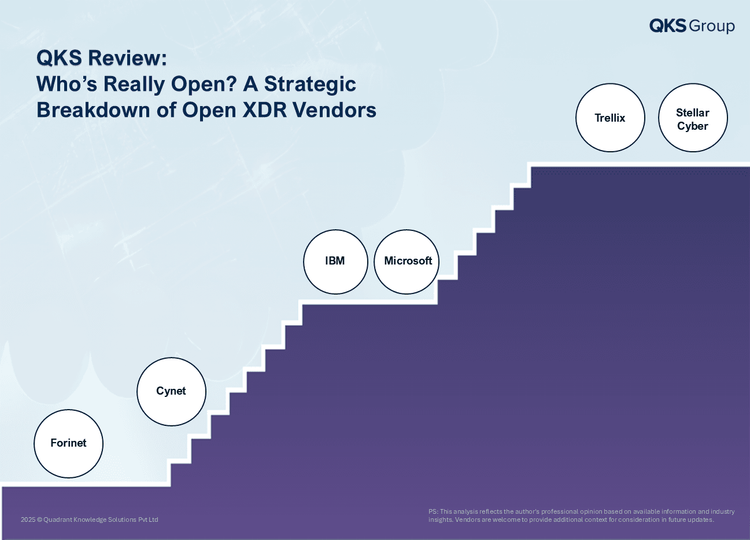
Not all Open Extended Detection and Response platforms are created equal. While several vendors now claim "openness," their actual integration depth, architectural flexibility, and operational alignment vary widely. Based on our evaluation across openness, scalability, and SOC enablement, here’s how the landscape shapes up:
1. Born Open XDR Platforms
(Stellar Cyber, Trellix)
These platforms are architected for integration from day one. They ingest diverse telemetry without bias, correlate data intelligently, and enable streamlined, automated response across the SOC. Ideal for security teams building a modern, best-of-breed architecture.
2. Enterprise Grade Open XDR Providers
(IBM, Microsoft)
Modular, mature, and enterprise-tested these platforms deliver Open XDR capabilities at scale. While partial to their own ecosystems, both vendors support broad third-party integration and offer deep threat visibility and compliance-readiness.
3. Hybrid/Natively tilted Vendors Embracing Open XDR
(Fortinet, Cynet)
These vendors are evolving toward openness but remain rooted in native ecosystems. While their platforms now support third-party integration, openness may be gated by licensing, architecture, or product dependencies.
Final Take: Choosing the Right Open XDR Vendor
The Open XDR landscape in 2025 reveals clear strategic divides. At the forefront are Born-Open platforms like Stellar Cyber, and Trellix, which deliver true vendor-agnostic integration, native analytics, and automated response across a wide array of security tools. These platforms are ideal for security teams pursuing a best-of-breed strategy, enabling rapid integration, detection at scale, and future-ready SOC operations without being locked into a proprietary stack.
Enterprise-Grade vendors, including IBM and Microsoft, offer scalable and modular Open XDR architectures built on years of infrastructure maturity. They excel in regulated industries where integration, compliance, and governance must coexist with performance. While some ecosystem bias exists, their platforms offer strong support for hybrid and multicloud environments, making them strategic fits for large, complex organizations already invested in their respective ecosystems.
Finally, Hybrid or natively-tilted vendors such as Fortinet and Cynet offer operational simplicity and speed — especially for SMBs or mid-market organizations already embedded in their ecosystems. However, their Open Extended Detection and Response claims are limited by shallow third-party integration and a preference for native stack optimization. These platforms may offer short-term efficiency but come with long-term trade-offs in flexibility and extensibility.
Ultimately, Open XDR isn’t just a product decision — it’s an architectural choice. Enterprises must evaluate not just what the platform includes, but what it allows. The right Open XDR partner will enhance, not replace, your existing ecosystem — unifying visibility, speeding up response, and aligning with your security strategy for the road ahead.
Disclaimer:
This blog is based on independent research and publicly available information. The insights presented reflect the views of QKS Group and are for informational purposes only. While we strive for accuracy, we do not guarantee completeness or absolute correctness. Vendors are welcome to provide clarifications or updates. If any vendor listed in this analysis wishes to provide additional context or clarification, we welcome a briefing call and will consider incorporating relevant updates. This analysis is not intended to disparage any vendor but to provide an informed, balanced perspective. We encourage open and constructive dialogue to foster transparency and a deeper understanding of the industry.
Author: Ayush Patidar, Analyst - Security Software at QKS Group
Vendors: