

23.06.2025
QKS Review
QKS Review: Who Listens Best? Evaluating Observability Platforms on Feedback-Driven Optimization and Continuous Improvement
Author:
Harsha K


Executive Summary:
As the observability market faces rising pressure from user experience demands, rising operational complexity and real-time performance requirements, organizations are moving beyond traditional log aggregation, and metrics-based monitoring tools.
This review blog by QKS Group assesses whether observability platform vendors are truly innovating to meet these demands - or merely making incremental updates.
What Modern Observability Platforms Should Deliver:
Today’s platforms must offer more than core features. Critical next-gen capabilities include:
- AI-driven adaptive feedback loops for automated remediation
- Continuous user-driven tuning for alert relevance and signal-to-noise ratio
- Embedded collaboration tools for DevOps and SRE workflows
Key Findings:
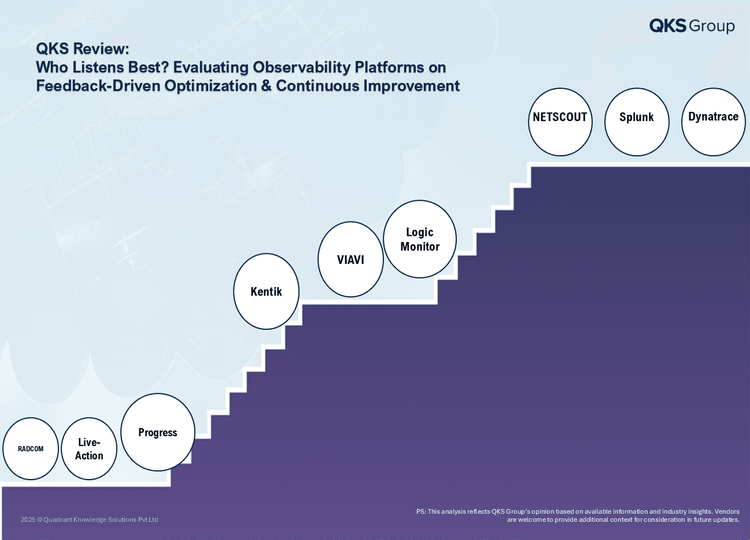
- Leading vendors (NETSCOUT, Splunk, Dynatrace) stand out with comprehensive, enterprise-grade solutions.
- Capable vendors (LogicMonitor, VIAVI, Kentik) show promise in niche areas but lack breadth or global scale.
- Lagging vendors (Progress, Live-Action, RADCOM) remain focused on outdated features and risk losing relevance.
Introduction
In the evolving landscape of IT operations, observability is no longer just about visibility it’s about responsiveness to feedback. As infrastructures scale and automation matures, organizations require platforms that not only detect issues but also learn from them. This blog critically evaluates how leading observability vendors implement feedback loops to support continuous improvement, optimize alerting logic, and fine-tune automated operations.
Feedback loops in observability are critical to transforming operations from reactive to proactive optimization. By continuously refining alert thresholds, correlation logic, and root cause analysis (RCA) through operator input, these loops enhance system intelligence and adaptability. They reduce alert fatigue by filtering noise based on real-world experience, improve mean time to identify (MTTI) by learning from incident history, and ensure that automated decisions remain transparent and auditable essential for compliance. Vendors that embed robust feedback mechanisms empower IT teams to achieve more resilient, efficient, and accountable digital operations.
Leaders
Dynatrace
Dynatrace excels with its AI-powered Davis assistant, which continuously learns from system behavior and operator feedback to refine root cause analysis and automate issue resolution. Its ability to close the feedback loop with minimal manual intervention makes it ideal for complex, dynamic environments. However, its tightly integrated AI models may offer limited flexibility for teams seeking deeper customization or transparency in decision logic.
Splunk
Splunk combines robust telemetry ingestion with advanced analytics and strong ITSM integrations, enabling it to adapt alerting and triage processes based on operational feedback. Its powerful correlation and event handling tools make it a top choice for enterprise-scale observability. Still, the platform's complexity and configuration overhead can pose a barrier to smaller teams or rapidly evolving environments.
NETSCOUT
NETSCOUT’s nGeniusONE platform stands out in network-centric environments by integrating expert-guided diagnostics with service-aware feedback mechanisms. Its strength lies in historical analysis, service dependency mapping, and highly auditable alert tuning. The platform, however, is more network-focused and may lack built-in agility for app-native or DevOps-heavy use cases.
Followers
LogicMonitor
LogicMonitor offers AIOps functionality with dynamic thresholds and feedback-driven event suppression. Its AI assistant, Edwin, helps interpret alerts and guide operational decisions, creating a semi-automated feedback loop. However, its RCA and learning mechanisms still require manual validation, limiting fully autonomous continuous improvement.
VIAVI
VIAVI’s Observer platform combines packet-level visibility with user experience scoring and contextual correlation. It supports operator-verified diagnostics and detailed auditing. While highly effective in providing forensic depth, its feedback integration tends to be manual and better suited for traditional network operations rather than dynamic cloud-native environments.
Kentik
Kentik delivers strong performance in ISP, CDN, and cloud path monitoring, with intelligent alert grouping and visual diagnostics. Its strength is in network and flow data analytics augmented by user-tuned alerting. Yet, its application-layer feedback correlation and automation capabilities are relatively limited, making it more tactical than strategic in feedback loop maturity.
Aspirants
LiveAction
LiveNX offers intuitive visual correlation for traffic flows and QoS metrics, helping operators understand root causes visually. It provides basic alert refinement and reporting. However, the platform lacks AI-driven automation or closed-loop feedback capabilities, relying heavily on manual interaction and static thresholds.
RADCOM
RADCOM is well-suited for telecom environments, integrating SLA-based alert tuning and service-aware diagnostics. Its microservices-based observability is optimized for 5G and virtualized cores. While effective in telco, it lacks broad enterprise feedback frameworks and remains limited outside carrier-grade deployments.
Progress (WhatsUp Gold)
Progress (WhatsUp Gold) offers cost-effective infrastructure monitoring with customizable alerting and role-based event handling. It supports basic feedback through threshold tuning and manual alert verification. Still, it lacks the automation, AI, or service intelligence found in more advanced platforms, positioning it as an entry-level option for observability.
Conclusion
Feedback loops are the intelligence layer of modern observability. Vendors who enable continuous tuning, cross-layer correlation, and operational feedback integration empower IT teams to achieve not just uptime but smart, sustainable performance. While leaders like Dynatrace, Splunk, and NETSCOUT are setting the bar, others are evolving rapidly to close the loop.
Disclaimer:
This blog is based on independent research and publicly available information. The insights presented reflect the views of QKS Group and are for informational purposes only. While we strive for accuracy, we do not guarantee completeness or absolute correctness. Vendors are welcome to provide clarifications or updates. If any vendor listed in this analysis wishes to provide additional context or clarification, we welcome a briefing call and will consider incorporating relevant updates. This analysis is not intended to disparage any vendor but to provide an informed, balanced perspective. We encourage open and constructive dialogue to foster transparency and a deeper understanding of the industry.
Author: Harsha K, Senior Analyst - IT Infrastructure Management at QKS Group
Co-Author: Kaushik V, Analyst - Enterprise Networking at QKS Group
Vendors: