

24.06.2025
QKS Review
QKS Review: When "Low-Code" Isn’t Low Enough: Real User Perspectives on Usability, Customer Support, and Value Proposition of Enterprise-grade Platforms
Author:
Abhishek Anant Garg


Executive Summary:
Low-code platforms promise simplicity, speed, and cost-efficiency but real-world user experiences often tell a more nuanced story. As enterprise adoption scales, usability, customer support, and pricing clarity have become the core pillars of platform satisfaction.
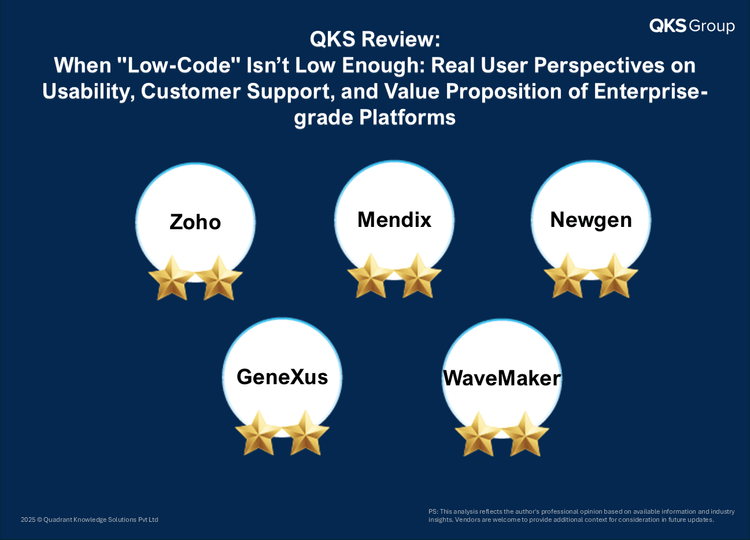
This review blog by QKS Group assesses whether five prominent low-code vendors: Zoho, Mendix, Newgen, GeneXus, and WaveMaker, truly deliver on these promises, based on direct user feedback and ground-level insights.
What Modern Low-Code Platforms Should Deliver:
Beyond feature sets, successful low-code platforms must enable long-term adoption through:
• Intuitive interfaces and minimal learning curves for business users and developers
• Accessible, reliable support and rich, updated documentation
• Clear, scalable value propositions aligned to enterprise needs
Key Findings:
• Leading vendors, Zoho, Mendix, and Newgen score high on usability and customer enablement, offering user-friendly onboarding, strong support ecosystems, and value-oriented pricing models that scale with business growth.
• Lagging vendors, GeneXus and WaveMaker, despite technical strengths, fall short on usability and learning support—creating friction during onboarding, increasing reliance on self-guided troubleshooting, and raising concerns over return on investment.
Why These Vendors and These Factors?
The vendors in focus for this analysis represent a spectrum of approaches, geographies, and target audiences within the enterprise low-code development landscape. These vendors reflect a balanced mix of legacy modernization, rapid development platforms, and business-centric models. Across this variety, three core factors stand out as universally critical to user satisfaction and platform success:
- Ease of use,
- Robust support and documentation
- Value Proposition
These aren't just marketing checkboxes, they determine how quickly teams onboard, how independently they can build, and whether long-term value outweighs licensing and operational expenses. With those stakes in mind, let’s explore how each vendor measures up from the user’s perspective.
Platforms where Simplicity Meets Support and Value:
1. Zoho: Zoho has built a reputation for simplicity with Zoho Creator, and that reputation is well-earned among its user base. Customers often highlight how quickly non-technical users can start building usable applications, owing to its intuitive drag-and-drop interface and prebuilt templates. Documentation is another strong point, zoho focuses on providing clear up-to-date documentation, coupled with responsive support that helps users resolve issues without third-party consultants. Value wise, Zoho remains highly accessible, especially for small and mid-sized businesses, offering flexible plans that scale affordably with usage. This combination of user-friendliness, robust help resources, and pricing transparency makes Zoho Creator a go-to platform for organizations looking to empower business teams with minimal IT overhead.
2. Mendix: Mendix positions itself as a high-productivity platform, and it largely delivers on that front. Developers consistently report a smooth learning curve aided by structured tutorials, embedded training, and a highly active community. The onboarding process is guided, reducing friction and enabling teams to get productive early. In terms of support, Mendix offers tiered service models with comprehensive documentation and professional response times, particularly in enterprise environments. Though it's not the most affordable option, its cost is generally perceived as justified by the value it returns in productivity and scalability. For large-scale digital transformation projects, Mendix strikes a favorable balance between platform richness and usability.
3. Newgen: Newgen comes from a strong enterprise content and process management background, and its low-code platform reflects that maturity. Customers appreciate how Newgen combines deep domain knowledge with usability features that simplify complex process modeling. The platform includes extensive training resources and documentation, especially tailored for regulated industries. Support is responsive, and Newgen often takes a consultative approach with clients, ensuring success in large-scale rollouts. While not pitched at the budget end of the market, Newgen’s total cost of ownership is often seen as lower than competitors once you factor in its process-centric accelerators and ready integration capabilities.
Platforms where Promise Falls Short:
1. GeneXus: GeneXus offers a powerful code generation engine that supports multiple environments that allow developers to extend the capability of the platform and design the applications exactly to the project requirements, still users frequently encounter friction. Its interface, while functional, is considered not intuitive enough and difficult to navigate, especially for those unfamiliar with its proprietary modeling language. The documentation has been called sparse and sometimes poorly translated, and support lacks the depth users expect from an enterprise platform.
These issues compound when costs are evaluated, many customers from smaller enterprises report that the platform feels overpriced for what it delivers in terms of usability and learning support. For a tool promising speed and efficiency, GeneXus often demands a steep ramp-up of resources and considerable effort for onboarding and has longer payback period.
2. WaveMaker: WaveMaker aims to serve professional developers with a blend of visual and code-driven tools, but its usability experience is mixed. While the drag-and-drop environment offers flexibility, users often find it buggy or unintuitive when building more complex UIs. Documentation and learning resources are limited, and many customers report turning to mediums like forums to solve basic integration problems. The platform’s cost structure, particularly for small or mid-sized businesses, is another sticking point. Pricing tiers escalate rapidly and combined with the effort needed to customize and maintain apps, many users feel the return on investment is lacking. WaveMaker’s ambitions are clear, but the execution appears to leave many users in need of extra support.
Conclusion: What buyers should look out for?
In the low-code space, marketing claims can seem promising: faster builds, lower costs, and business-user empowerment. But platform realities often reveal a different story. As this analysis shows, vendors like Zoho, Mendix, and Newgen have aligned their platforms towards the customer expectations in terms of usability, support, and value generation. In contrast, GeneXus and WaveMaker demonstrate that a powerful platform capable of enterprise grade development isn’t enough without smooth onboarding, comprehensive guidance, and cost transparency. For buyers and users alike, the key takeaway is to never evaluate a low-code platform on its feature sheet alone. Dig into real user experiences, and prioritize ease of use, documentation depth, and financial scalability as make-or-break criteria for long-term success.
Disclaimer:
This blog is based on independent research and publicly available information. The insights presented reflect the views of QKS Group and are for informational purposes only. While we strive for accuracy, we do not guarantee completeness or absolute correctness. Vendors are welcome to provide clarifications or updates. If any vendor listed in this analysis wishes to provide additional context or clarification, we welcome a briefing call and will consider incorporating relevant updates. This analysis is not intended to disparage any vendor but to provide an informed, balanced perspective. We encourage open and constructive dialogue to foster transparency and a deeper understanding of the industry.
Author: Abhishek Anant Garg, Analyst at QKS group
Vendors: