

18.07.2025
QKS Review
QKS Review: Triaging SIEM Vendors: From Leaders to Challengers on Alert Prioritization and SOC Efficiency
Author:
Venkatesh Kopparthi


Executive Summary:
As the Security Information and Event Management (SIEM) market faces rising pressure from alert overload, SOC skill shortages, and increasing demands for faster incident response, organizations are moving beyond traditional log-centric Security Information and Event Management (SIEM) tools.
This review blog by QKS Group assesses whether Security Information and Event Management (SIEM) vendors are truly innovating to meet these demands - or merely making incremental updates.
What Modern SIEM Platforms Should Deliver:
Today’s platforms must offer more than basic log aggregation and rule-based alerting. Critical next-gen capabilities include:
• AI/ML-driven triage and contextual risk scoring for alert prioritization
• Integrated UEBA for dynamic threat detection across user and entity behaviors
• Automated correlation and response through SOAR and agentic workflows
Key Findings:
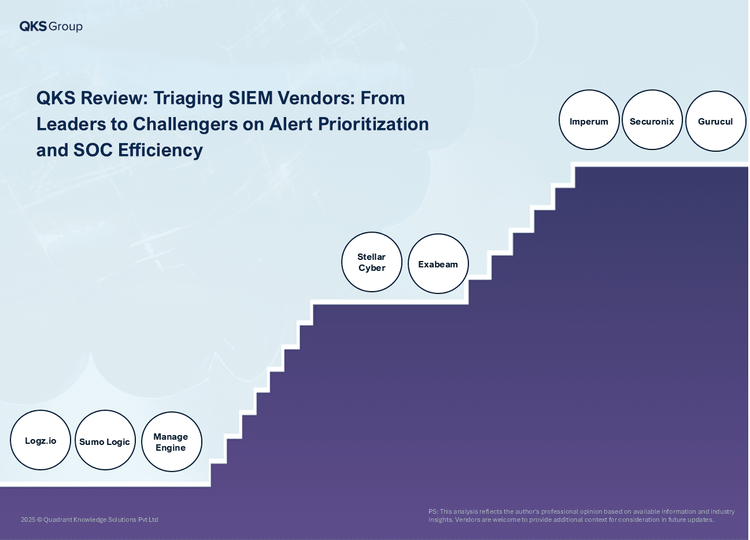
• Leading vendors (Gurucul, Securonix, Imperum) stand out with advanced UEBA, intelligent risk scoring, and hyperautomated SOC capabilities.
• Capable vendors (Exabeam, Stellar Cyber) provide strong behavioral analytics and alert correlation, though some require tuning or lack deep automation.
• Lagging vendors (ManageEngine, Sumo Logic, Logz.io) rely on legacy triage models or minimal contextual prioritization, risking fatigue and slower response.
Introduction
Large enterprises operate in heterogeneous IT environments that generate a flood of security alerts from firewalls, EDR, IDS, cloud security tools, and countless other sources. This sheer volume of signals can quickly overwhelm Security Operations Center (SOC) teams, leading to alert fatigue where critical warnings are buried under a mountain of false positives or low-priority events. Effective alert triage and robust threat prioritization are essential for organizations to cut through this noise, concentrate on genuine threats, and ensure timely incident response. This review examines how major security vendors from advanced SIEM and UEBA leaders to next-generation autonomous SOC platforms are tackling this problem, highlighting their strengths and practical limitations, and exploring what large enterprises should press them on to ensure these solutions truly move the needle.
Leaders
Gurucul
Gurucul is known for its advanced security analytics platform that places strong emphasis on behavior-based threat detection and user and entity behavior analytics (UEBA). Its approach relies on machine learning to baseline normal activity across diverse environments and detect deviations that could signal insider threats or external attacks. The platform features over 3,000 pre-built models spanning behavioral, access, and anomaly dimensions specifically designed to reduce noise and prioritize high-fidelity alerts. Gurucul's enterprise-class risk engine consolidates telemetry, analytics, and behavioral modeling into unified risk scoring that helps security teams prioritize investigation and response. This goes beyond static rules to identify unknown threats by detecting when users deviate from normal baselines. The platform's real-time anomaly and risk detection spans enterprise and cloud platforms, networks, mobile endpoints, IoT, and business applications, providing comprehensive coverage for modern hybrid environments.
However, achieving optimal performance in large, complex, legacy-heavy infrastructures demand significant effort to fine-tune models and ensure ingestion from all critical systems. The platform’s effectiveness ultimately hinges on how accurately and continuously these risk scores are calibrated to reflect the organization's unique threat landscape. Enterprises should evaluate the expertise needed for initial configuration and ongoing tuning, assess integration with existing security workflows, and understand the training required for SOC analysts to leverage advanced risk scoring in day-to-day triage.
Securonix
Securonix offers a cloud-native SIEM with integrated UEBA and a security data lake architecture specifically designed to improve threat detection and prioritization in complex enterprise environments. Its machine learning models baseline user and entity behavior across on-premises and multi-cloud environments to detect subtle deviations that may indicate insider threats or compliance violations. By correlating activity across disparate systems using threat chain models, Securonix reduces the number of discrete alerts, consolidating them into fewer, higher-fidelity incidents that allow SOC teams to focus on what matters most. The Unified Defense SIEM platform provides 365 days of searchable data in a single-tier storage model, eliminating performance issues seen with traditional tiered architectures. Continuous threat content updates from Securonix Threat Labs and a Snowflake-powered security data lake deliver virtually unlimited capacity and faster performance. Still, large organizations often encounter complexities customizing risk scores and tuning policies to align with operational realities and evolving regulatory obligations. Integration with specialized legacy systems or adapting pre-built threat models to unique environments can also present hurdles.
Enterprises should explore how easily the platform integrates with their specific tools and data sources, how flexibly it supports risk model customization aligned to asset criticality, what level of vendor support is available for iterative tuning, and how the consumption-based pricing model aligns with long-term retention and analysis needs.
Imperum
Imperum offers a purpose-built autonomous SOC platform, explicitly designed to replace the need for separately deployed SIEM, SOAR, UEBA, and TIP systems by consolidating these functions into a single, hyperautomation-first architecture. At the heart of Imperum’s design is the use of domain-specific language models (DSLMs) and agentic AI, embedding machine learning directly into detection, investigation, and response workflows. This allows Imperum to proactively merge telemetry, threat intelligence, and behavioral analysis right at the point of data collection, while also correlating alerts at the playbook level identifying multi-step attack patterns and automating investigations across related signals.
Its vendor-agnostic integration fabric leverages imported API definitions (like Postman collections), enabling rapid creation of connectors across over 400,000 documented endpoints. Combined with support for REST, GraphQL, WebHooks, SOAP, SYSLOG, WebSocket, SSH, Telnet, and email protocols, this makes it adaptable to both modern SaaS and legacy enterprise systems. Unlike many SIEM deployments that struggle to unify post-ingestion data, Imperum’s hyperautomated approach focuses on upfront normalization combined with playbook-driven correlation, reducing noise and surfacing high-fidelity incidents more effectively. The platform supports a hybrid operational model, blending fully autonomous investigations that accelerate triage and drive down Mean Time to Detect (MTTD) and Mean Time to Respond (MTTR) with analyst-guided workflows accessible via its mobile application. It also offers on-premises AI deployment for full data sovereignty.
However, large enterprises must carefully evaluate how well Imperum integrates with their existing toolsets, the maturity and relevance of its autonomous playbooks for their specific threat scenarios, the transition to hyperautomated triage, and the governance and training required to adapt.
Emerging Players
Exabeam
Exabeam delivers a modern SIEM that pivots on a behavior-based TDIR (Threat Detection, Investigation, and Response) model with its New-Scale SIEM platform. Machine learning baselines normal activity across diverse environments and automatically categorizes, aggregates, and enriches security alerts so analysts can dismiss or escalate with new efficiency. Exabeam Alert Triage centralizes visibility into all alerts, automatically enriching them with host, IP, severity, related anomalies, and overall user/entity risk scores. The platform can search petabytes of data in seconds and process logs at sustained speeds over one million events per second, integrating with 500+ products and nearly 8,000 parsers. TDIR Use Case Packages provide prescriptive, end-to-end workflows, though typically require tuning to fit enterprise-specific threat models and SOC processes. Despite these strengths, customizing dashboards and refining advanced queries to avoid alert overload in large environments demands careful planning. Enterprises should assess whether Exabeam can unify visibility across all hybrid assets, how effectively its behavioral analytics reduce alert fatigue in their context, what professional services might be required for optimization, and how well its ML models adapt to their unique threat landscape.
Stellar Cyber
Stellar Cyber takes a distinct approach with its Open XDR platform, unifying SIEM, NDR, UEBA, SOAR, and more under a single AI-driven system powered by Multi-Layer AI technology. This combines machine learning, Graph ML, generative AI, and hyperautomation to prioritize and correlate threats while reducing detection-to-response times. The platform is architected to handle ingestion ranges of >10 TB/day, automatically detecting common threats and compressing massive telemetry into thousands of alerts daily. Its Correlation AI leverages Graph ML to assemble related signals into hundreds of contextual cases per day, dramatically lowering analyst workloads. Stellar Cyber provides over 400 out-of-the-box alert types requiring no initial configuration, auto-correlating them into prioritized cases. With over 400 bi-directional integrations and open extensibility, it aims for rapid deployment.
However, integration breadth must be matched by depth to avoid shallow connectors that miss critical details, and managing real-time enterprise-scale data requires diligent tuning to prevent overwhelming even sophisticated AI. Enterprises must assess how robustly Stellar Cyber integrates with their critical systems, how well its multi-layer AI minimizes false positives in their environment, and what tuning is needed to sustain effectiveness as threats evolve.
Established Challengers
ManageEngine Log360
ManageEngine's Log360 has grown from a unified SIEM into a broader security analytics platform, combining log management, UEBA, SOAR, and compliance capabilities. Its strength lies in centralized visibility and straightforward log collection across on-prem and cloud, simplifying audits and regulatory reporting. Vigil IQ, its new TDIR engine, uses advanced analytics to improve detection and response while reducing false positives. The platform offers over 80 predefined correlation rules, custom rule builders, an Incident Workbench for contextual analysis, dark web monitoring via Constella, and adaptive thresholds that automate alert noise reduction. Its API-driven architecture now supports customizations at scale. However, despite these advances, Log360 has traditionally served SMB and mid-market customers. Large enterprises with huge data volumes and sophisticated threat prioritization needs may face scaling or performance considerations. Additionally, while it offers UEBA and advanced correlation, granularity for highly specialized threats may lag behind focused enterprise vendors. Organizations should evaluate Log360’s scalability under enterprise ingest and query loads, how well its detection content adapts to their threat landscape, the ease of tuning prioritization mechanisms, and the level of professional services available for complex deployments.
Sumo Logic
Sumo Logic's Cloud SIEM is a cloud-native platform built to ingest and analyze vast volumes of security data, critical for multi-cloud enterprises. It integrates machine learning, UEBA, and threat intelligence with anomaly detection, entity relationship graphs, and MITRE-aligned Insight Engines. The platform includes historical baselining that establishes behavioral norms in minutes, multiple threat intel feeds via STIX/TAXII, Detection-as-Code for DevSecOps, and AI Insight Summaries to accelerate response. An AI assistant also enables natural language search and troubleshooting. While it supports major compliance packs like PCI DSS, HIPAA, GDPR, and SOX, complex forensic investigations or highly tailored regulatory reports may still demand deeper customization. Running advanced models across large datasets can reveal performance ceilings, and a steep learning curve around data modeling and rule creation may slow early SOC operations. Consumption pricing also requires close oversight in environments with long retention. Enterprises should validate Sumo Logic’s query speeds under projected loads, assess dashboard flexibility for SOC metrics, test AI impact on alert fatigue, and plan for the expertise needed to tune normalization and maintain cost efficiency.
Logz.io
Logz.io offers a SaaS SIEM built on open-source observability (notably OpenSearch), augmented with AI-driven capabilities for faster detection and triage. Its AI Agent delivers automated root cause analysis, cutting troubleshooting by up to 70%, with chat-based interfaces that enrich alerts and accelerate investigations. The Cloud SIEM also provides preconfigured detection rules, structured workflows, threat intel dashboards, and correlation that highlights attack sequences from noisy logs. While its managed approach streamlines operations, reliance on public cloud may not suit strict data residency mandates, and large-scale specialized use cases often require customization beyond typical turnkey deployments. Like other consumption-based platforms, cost discipline is essential. Enterprises should evaluate Logz.io’s fit for data sovereignty requirements, how well its AI features adapt to their threat scenarios, operational impacts of managing varied data sources over long retention, and its ability to scale with growing data volumes and complexity.
Conclusion
For large enterprises, effectively managing the deluge of security alerts and ensuring critical threats rise above the noise is not just a technical requirement it is an existential imperative for the SOC. The vendors reviewed here represent a wide spectrum of approaches: from Gurucul’s advanced behavioral analytics and dynamic risk scoring, and Securonix’s blend of cloud-native scale with content-driven prioritization, to Imperum.io’s autonomous hyperautomation approach. Meanwhile, players like Exabeam, Stellar Cyber, ManageEngine, Sumo Logic, and Logz.io each offer unique balances of behavioral insights, scalability, and integration depth to tackle alert fatigue. Selecting the right platform demands rigorous evaluation not only of features or ingest volumes, but of how well a solution aligns with your architecture, threat landscape, and SOC workflows to decisively cut through the noise and elevate what truly matters.
Disclaimer:
This blog is based on independent research and publicly available information. The insights presented reflect the views of QKS Group and are for informational purposes only. While we strive for accuracy, we do not guarantee completeness or absolute correctness. Vendors are welcome to provide clarifications or updates. If any vendor listed in this analysis wishes to provide additional context or clarification, we welcome a briefing call and will consider incorporating relevant updates. This analysis is not intended to disparage any vendor but to provide an informed, balanced perspective. We encourage open and constructive dialogue to foster transparency and a deeper understanding of the industry.
Author: Venkatesh Kopparthi, Analyst - Security Analytics and Automation at QKS Group
Vendors: