

17.07.2025
QKS Review
QKS Review: Tracking the Bottom Line: A Comparative Analysis of Financial Management Features in Modern PPM Tools
Author:
Ashray Gadekar


Executive Summary:
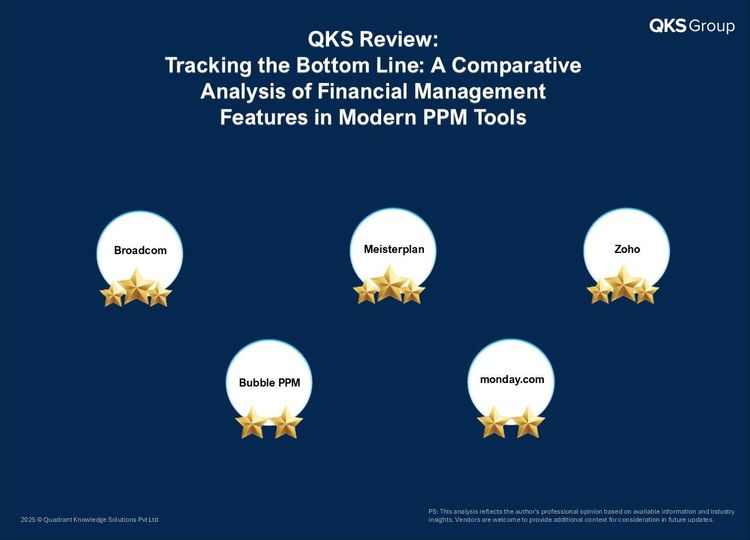
As the Banking, Financial Services, and Insurance (BFSI) sector faces growing pressure around auditability, regulatory alignment, and capital optimization, organizations are moving beyond traditional project tracking tools. They now demand Project Portfolio Management (PPM) platforms that embed financial governance at their core. This comparative analysis by QKS Group explores how five PPM vendors: Broadcom Clarity, Meisterplan, Bubble PPM, monday.com, and Zoho Projects address financial planning, cost control, and investment governance in increasingly complex portfolio environments.
What Modern Financial PPM Should Deliver
Modern PPM platforms must offer more than task management. Key next-gen financial capabilities include:
• Scenario-based budgeting to evaluate trade-offs and funding strategies.
• Integration with ERP and accounting systems for compliance and consistency.
• Configurable financial structures that support CAPEX/OPEX visibility, departmental roll-ups, and real-time forecasting.
Key Findings
Broadcom Clarity delivers an enterprise-grade financial framework with multi-dimensional cost structures, time-phased modeling, and strong ERP integration. It is especially well-suited for large, compliance-driven organizations needing robust audit trails and formal capital governance. Meisterplan supports agile financial decision-making with lightweight budget tracking and cost-benefit scenario modeling. It offers an effective solution for BFSI organizations that prioritize strategic alignment and financial flexibility without the overhead of deep ledger systems. Bubble PPM focuses on milestone-based funding and phase-gate financial controls. It is ideal for structured investment oversight, especially in capital-heavy BFSI initiatives like infrastructure upgrades or transformation programs.monday.com provides configurable cost tracking and formula-driven budget fields through an intuitive interface. While it lacks native portfolio-wide financial roll-ups, its integrations and visual boards suit decentralized teams managing agile initiatives. Zoho Projects supports basic budget and time tracking, with added value from its broader ecosystem (Zoho Books, Zoho Analytics). Though it doesn’t offer strategic financial governance natively, it enables mid-sized BFSI teams to align operational execution with financial control through ecosystem synergy.
Financial Discipline is key enabler in the Banking, Financial Services, and Insurance (BFSI) sector, where portfolio decisions are linked to capital allocation, risk oversight, and regulatory compliance. Project Portfolio Management (PPM) platforms are increasingly expected to go beyond traditional planning and execution support to offer financial governance capabilities, from forecasting and budget tracking to cost-benefit analysis and funding optimization.
Modern PPM platforms increasingly incorporate essential financial management features, recognizing that successful project execution hinges not only on timelines but also on fiscal discipline. Tools like Broadcom Clarity, Meisterplan, Bubble PPM, monday.com, and Zoho Projects offer five key capabilities: budget tracking, time tracking, integration with financial systems, scenario modeling, and customizable financial structures. These features provide a strategic foundation for linking portfolio execution with financial governance.
Budget and time tracking enable organizations to monitor project spend and resource effort in real time, while ERP/accounting integrations ensure data consistency and compliance. Scenario modeling allows decision-makers to simulate financial outcomes before making investment shifts, and configurable financial structures (e.g., CAPEX/OPEX, department-level budgets) support diverse planning frameworks. In industries like BFSI, where financial oversight, auditability, and regulatory alignment are critical, these capabilities help optimize capital allocation and enforce funding accountability.
This blog takes a focused look at how five Project Portfolio Management (PPM) vendors: Broadcom Clarity, Meisterplan, Bubble PPM, monday.com, and Zoho Projects handle the financial management dimension of portfolio execution. Each represents a distinct operational model and technical design philosophy, making them ideal for comparative analysis.
These platforms were selected to represent a diverse spectrum of financial maturity, implementation scale, and industry adaptability. Broadcom Clarity exemplifies an enterprise-grade solution built for highly regulated, multi-layered environments with deep financial governance. Meisterplan offers a lean and adaptive approach suitable for strategy-first financial steering. Bubble PPM is tailored for structured investment governance with a focus on milestone-driven budget allocation. monday.com and Zoho Projects were included as flexible, modular platforms popular among mid-market teams and functional departments within larger enterprises. Their adoption in emerging digital and agile programs, particularly within BFSI’s innovation and operations arms makes them increasingly relevant for decentralized financial control.
Collectively, these vendors span enterprise to mid-market use cases and offer varying levels of financial granularity, allowing for a comprehensive evaluation of how financial management is being handled across modern PPM ecosystems.
Broadcom Clarity: Enterprise-Scale Financial Management
Broadcom Clarity provides a mature and structured approach to financial management. Its capabilities extend beyond simple budget entry, offering comprehensive tools for forecasting, financial baselining, and variance analysis. Project and portfolio managers can configure line-item budgets and track time-phased values (TSVs) for more granular visibility. The platform supports actuals capture, cost reconciliation, and financial adjustments, which is valuable in dynamic investment environments like BFSI.
Integration with ERP and general ledger systems is a strong point, allowing Clarity to function effectively as a financial hub for project-related expenditure. With support for both CAPEX and OPEX categorization, and multi-currency handling, Clarity aligns well with compliance and audit standards in financial institutions. Some organizations may find the system’s initial configuration effort substantial, especially if customizing financial hierarchies or integrating with external reporting tools. However, this effort is often offset by the platform’s ability to deliver deeply auditable and transparent financial records.
Meisterplan: Lean Budget Steering with Scenario Agility
Meisterplan offers a streamlined model of financial governance designed to support decision-making and scenario-based portfolio management. It focuses on helping leadership teams assess strategic value against budget constraints, allowing for rapid reprioritization of projects based on cost-benefit trade-offs. Budget input fields allow users to track estimated costs and expected benefits, supporting financial visibility at the planning stage.
One of the platform’s key advantages lies in its scenario modeling engine, which simulates the financial impact of deferring, rescoping, or cancelling initiatives. This functionality is especially useful in BFSI organizations managing change programs where funding availability fluctuates or approval cycles are layered. While Meisterplan does not provide detailed financial ledger management, it integrates well with external ERP or analytics systems for users needing deeper granularity. For organizations with lean portfolio governance structures, this level of financial control is often sufficient to maintain strategic alignment without excessive administrative overhead.
Bubble PPM: Investment Governance with Embedded Cost Controls
Bubble PPM provides a balanced financial layer that supports strategic decision-making alongside portfolio execution. Its budgeting tools are configured to align with stage-gate funding models, enabling organizations to release financial commitments based on project maturity or performance. Users can track funding status by project phase and connect those figures to performance indicators or risk thresholds.
This setup is particularly beneficial in capital-intensive BFSI projects, such as infrastructure upgrades or digital transformation initiatives where milestone-based disbursements are common. Bubble also allows financial fields to be tailored to organizational workflows, including multi-year funding windows or cost categorization aligned with departmental structures. While it may not offer the full financial reporting depth of larger enterprise systems, its focus on investment accountability and progress-based funding makes it a useful solution for firms that prioritize decision governance alongside financial tracking.
monday.com: Configurable Budget Views for Agile Teams
monday.com offers financial tracking through its flexible board system, where users can create custom budget columns, use formulas to calculate variances, and automate alerts when thresholds are exceeded. This low-code configurability supports adaptation to a range of budgeting processes, whether at the project level or across teams.
The platform also supports integrations with accounting and financial planning tools such as QuickBooks, Excel, and Power BI, allowing organizations to expand its financial capabilities through external systems. While monday.com does not offer native support for consolidated portfolio financials or standardized capital/operating budget separation, its visual dashboards and real-time collaboration features provide value for operational project tracking and cost awareness. This approach is suitable for smaller BFSI teams or departments within larger institutions that are managing tactical initiatives where simplicity and responsiveness are prioritized.
Zoho Projects: Financial Controls through Ecosystem Synergy
Zoho Projects includes essential cost tracking capabilities, such as estimated vs. actual budgets, billing rates, and time tracking. Its value increases significantly when integrated with the broader Zoho ecosystem, particularly tools like Zoho Books (for accounting) and Zoho Analytics (for BI and dashboarding). This ecosystem approach allows organizations to centralize financial and operational data, enabling stronger alignment between project execution and financial controls.
The platform’s native time-tracking and workload management functions assist in effort-based costing, which can be valuable for teams engaged in client-facing or resource-intensive projects. While Zoho Projects may not provide out-of-the-box strategic financial planning or advanced portfolio-level financial roll-ups, its integration flexibility enables organizations to build a connected financial environment, particularly effective in mid-sized BFSI settings with existing investments in Zoho applications.
Use Cases for Financial Management in BFSI Contexts
Across BFSI institutions, financial management in Project Portfolio Management (PPM) serves different purposes depending on organizational scale and portfolio complexity:
Retail Banking often requires strong capital expenditure tracking for branch modernization, IT infrastructure, and compliance upgrades. Tools like Broadcom Clarity and Bubble PPM serve well here by supporting milestone-based budgeting and clear audit trails.
Insurance firms managing complex change portfolios can benefit from Meisterplan’s scenario modeling, helping prioritize strategic initiatives in line with solvency and regulatory capital availability.
Investment firms or fintech innovation units, which run leaner project teams, may find monday.com or Zoho Projects adequate for operational cost tracking and agile budgeting within controlled business environments.
For large BFSI IT departments managing internal chargebacks or cross-functional budgeting, tools offering resource-based costing and integrated time tracking, such as Zoho or Clarity help align effort with expenditure more effectively.
Conclusion
Tools such as Broadcom Clarity, Meisterplan, Bubble PPM, monday.com, and Zoho Projects represent distinct approaches to this evolution. While their depth and scope vary, each contributes to advancing the integration of financial discipline into portfolio execution. For BFSI organizations, selecting the right platform depends on the level of financial control required, the complexity of the portfolio, and the broader technology ecosystem in place. Each tool plays a distinct role in enabling project leaders, finance teams, and strategy officers to monitor spending, adjust plans, and ensure alignment with financial objectives, a capability that is only growing in importance in the BFSI sector.
The future of these features is poised for advancement through AI-driven forecasting, automated cost adjustments, and tighter alignment with business value frameworks such as OKRs. As portfolio management shifts toward agility and strategic responsiveness, financial features in Project Portfolio Management (PPM) tools will evolve into intelligent, predictive systems that not only track spend but guide high-impact investment decisions across the enterprise.
Disclaimer:
This blog is based on independent research and publicly available information. The insights presented reflect the views of QKS Group and are for informational purposes only. While we strive for accuracy, we do not guarantee completeness or absolute correctness. Vendors are welcome to provide clarifications or updates. If any vendor listed in this analysis wishes to provide additional context or clarification, we welcome a briefing call and will consider incorporating relevant updates. This analysis is not intended to disparage any vendor but to provide an informed, balanced perspective. We encourage open and constructive dialogue to foster transparency and a deeper understanding of the industry.
Author: Ashray Gadekar, Analyst - Strategic Portfolio Management at QKS Group
Vendors: