

07.01.2026
QKS Review
QKS Review: The WIAM Balance Shift: Challengers Rising, Leaders Holding Ground
Author:
Andrew Aken


Executive Summary:
As the Workforce Identity and Access Management (WIAM) market faces rising pressure from remote work proliferation, cloud adoption, and compliance mandates, organizations are moving beyond traditional directory-based authentication and siloed access control tools.
This review blog by QKS Group assesses whether WIAM vendors are truly innovating to meet these demands or merely making incremental updates.
What Modern WIAM Should Deliver:
Today’s platforms must offer more than core authentication. Critical next-gen capabilities include:
• Context-aware authentication and dynamic access orchestration
• Granular identity governance and policy enforcement across hybrid environments
• Seamless integration with HR systems, cloud platforms, and Zero Trust architectures
Key Findings:
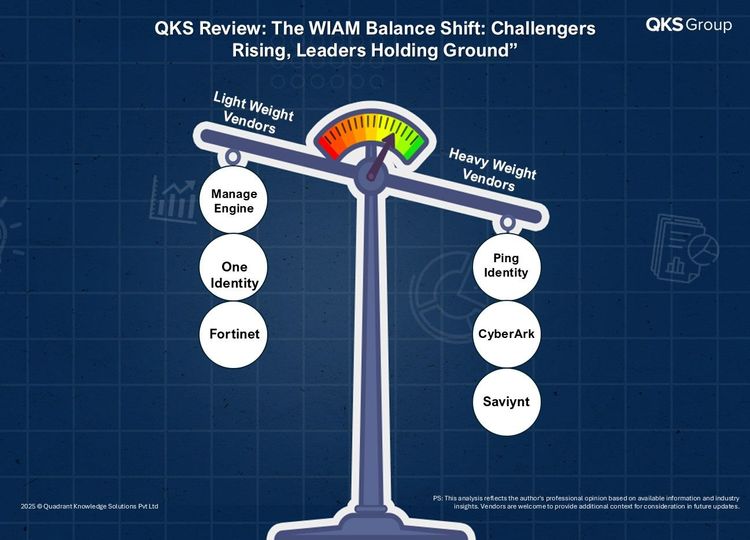
• Leading vendors Ping Identity, CyberArk, and Saviynt stand out with comprehensive, enterprise-grade solutions that deliver strong security, compliance, and integration depth.
• Capable vendors ManageEngine, Fortinet, and One Identity show promise in remote access enablement and modular delivery but lack advanced analytics, identity lifecycle depth, or cloud-native agility.
• Lagging vendors are not deeply addressed in this analysis but are characterized by limited orchestration, governance gaps, and outdated deployment models.
Introduction: How Workforce Identity and Access Management (WIAM) Is Playing a Crucial Role in the Remote Workforce The shift to remote and hybrid work has reshaped the identity landscape. Static roles and perimeter-based access models no longer suffice. Organizations now face a surge in remote access points, unmanaged devices, and dynamic workforce needs. Workforce IAM has evolved from a backend IT utility to a frontline security layer, managing who accesses what, from where, and under what conditions. In this reality, a WIAM solution must balance security, usability, and adaptability and not every vendor is ready.
Heavyweight Vendors:
Vendors with higher market presence, broader capabilities, and strategic influence
Ping Identity:
Ping delivers a robust platform with centralized authentication, single sign-on (SSO), adaptive multi-factor authentication (MFA), and directory services. It supports diverse enterprise environments cloud, on-prem, and hybrid with seamless integration into HRIS systems and custom applications.
What Shines:
Ping excels in contextual authentication, dynamically adjusting policies based on device posture, behavioural analytics, and access location critical for a distributed workforce. Its strong developer tools and orchestration capabilities enhance flexibility.
CyberArk:
While best known for privileged access management (PAM), CyberArk’s WIAM offerings include workforce MFA, SSO, and identity security intelligence. Its Identity Security Platform is designed to enforce least-privilege access across hybrid IT environments.
What Shines:
CyberArk’s strength lies in unifying PAM and IAM, offering deep visibility into user behavior and threat detection even for non-privileged workforce accounts. Its just-in-time access capabilities are ideal for dynamic remote work scenarios.
Saviynt:
Saviynt offers an integrated platform for identity governance, access requests, role management, and risk-based access controls tailored to both on-prem and cloud applications.
What Shines:
Saviynt’s value is in granular governance and compliance-first Workforce Identity and Access Management (WIAM), with automated access certifications, policy violations alerts, and risk scoring critical for regulated remote work environments.
Lightweight Vendors in WIAM
ManageEngine:
ManageEngine’s Self-service Plus and Identity Manager Plus provide password management, SSO, and basic access controls, aimed at SMBs and mid-market organizations. Its products integrate well with Active Directory and Microsoft 365.
Challenges:
ManageEngine struggles with scalability, advanced analytics, and dynamic access policies. While cost-effective, it lacks enterprise-grade features like identity orchestration, risk-based authentication, and federated identity management for large, remote workforces.
Fortinet:
Fortinet integrates identity and access management (IAM) into its broader security fabric through FortiAuthenticator and FortiToken, focusing on secure access, authentication, and identity verification within a unified cybersecurity ecosystem. Its offerings support multifactor authentication (MFA), single sign-on (SSO), and integration with FortiGate firewalls and third-party platforms, particularly in network-driven and OT environments.
Challenges:
Fortinet’s IAM capabilities are primarily infrastructure-centric and less comprehensive in governance, identity lifecycle management, and access certification. The platform lacks advanced identity intelligence and contextual risk-based access features, making it less suitable for complex enterprise identity strategies. Additionally, user experience and cloud-native integration maturity lag behind leading identity-focused vendors.
One Identity:
One Identity offers IAM capabilities including account provisioning, access requests, policy enforcement, and privileged access controls. Its modular platform supports hybrid environments and integrates with third-party systems.
Challenges:
One Identity faces issues with UI complexity and implementation agility. Its integration depth and cloud-native maturity may lag behind more specialized vendors in fast-moving remote deployment scenarios.
Final Verdict
In the race to secure the modern workforce, heavyweight vendors offer depth, compliance, and scale but often at the cost of speed and simplicity. Lightweight vendors are bridging critical gaps with nimble, user-friendly solutions suited to remote and hybrid environments. Enterprises must align vendor selection with their operational model, IT maturity, and risk posture. In Workforce Identity and Access Management (WIAM), “more” is not always “better” adaptability now defines leadership.Top of Form
Disclaimer:
This blog is based on independent research and publicly available information. The insights presented reflect the views of QKS Group and are for informational purposes only. While we strive for accuracy, we do not guarantee completeness or absolute correctness. Vendors are welcome to provide clarifications or updates. If any vendor listed in this analysis wishes to provide additional context or clarification, we welcome a briefing call an n d will consider incorporating relevant updates. This analysis is not intended to disparage any vendor but to provide an informed, balanced perspective. We encourage open and constructive dialogue to foster transparency and a deeper understanding of the industry.Bottom of Form
Author: Andrew Aken,AVP – Research at QKS Group
Vendors: