

29.08.2025
QKS Review
QKS Review: The Split in ALM for Regulated Industries: Enterprise Giants vs. Focused Specialists
Author:
Anoch Mane


Executive Summary:
As regulated industries such as medical devices, automotive, and aerospace face mounting compliance scrutiny, safety standards, and demands for digital traceability, organizations are moving past generic Application Lifecycle Management (ALM) platforms. The question now is whether vendors are engineering compliance-first ALM ecosystems or layering regulated workflows onto legacy toolchains.
What Modern Regulated ALM Should Deliver
- End-to-end traceability across requirements, risks, tests, and changes
- Preconfigured compliance support for standards like FDA 21 CFR Part 11, ISO 26262, IEC 62304, and ISO 13485
- Configurable change and configuration management workflows with auditability
- Integration with PLM, DevOps, and MBSE ecosystems for a continuous digital thread
- AI-enabled insights to improve requirements quality, predict risks, and automate validation
Key Findings
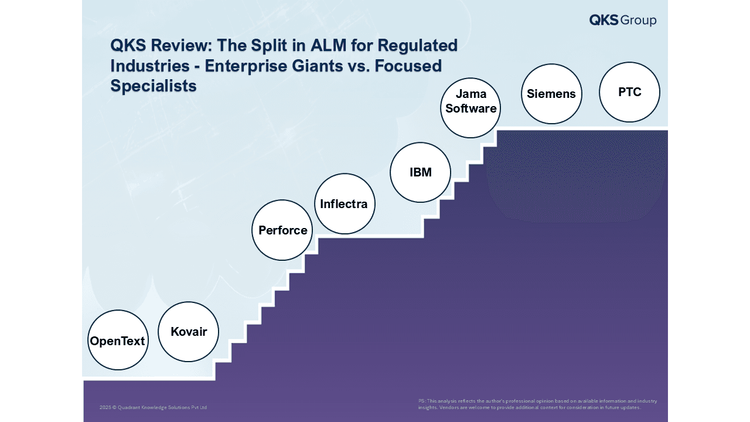
- Siemens, IBM, and PTC anchor the enterprise giant segment with ecosystem depth and digital thread continuity, but complexity and slower adoption cycles reduce agility for smaller teams.
- Jama Software, Inflectra, and Perforce stand out as focused specialists, offering usability, compliance-first design, and modern traceability, though they must expand ecosystem maturity and scale.
- OpenText and Kovair play the role of mid-tier pragmatists, providing affordable or integration-friendly platforms, yet they face challenges in differentiation and sustaining relevance against both large ecosystems and agile innovators.
In 2025, regulated industries face a defining split in Application Lifecycle Management (ALM). On one side stand the enterprise giants, armed with deep ecosystems, broad portfolios, and global reach. On the other, focused specialists deliver agility, usability, and compliance-first value at speed. Between them, pragmatic vendors provide cost-effective or integration-centric options that appeal to mid-sized organizations. The stakes are high: medical device firms, aerospace leaders, and automotive innovators cannot afford misaligned tools when compliance audits and safety certifications determine product survival.
Market Forces and Macro Trends
Regulated industries have unique demands that break traditional ALM molds. Compliance with FDA 21 CFR Part 11, ISO 26262, DO-178C, and IEC 62304 requires live traceability across requirements, risk, test, and release. Legacy discrete-manufacturing-oriented ALM often falters when confronted with iterative workflows, recipe-driven development, and the regulatory burden of life sciences or aerospace. At the same time, sustainability pressures, digital engineering adoption, and the push for real-time impact analysis mean organizations cannot wait for annual upgrades or lengthy implementation projects. Giants promise integrated digital threads across PLM, MBSE, and ALM. Specialists, however, promise rapid onboarding, modern UI/UX, and compliance packages tailored to industry contexts. Mid-tier pragmatists balance affordability, integration, and reliability, but often struggle to match either pole in depth or innovation.
Enterprise Giants - Scale, Integration, and Complexity
Siemens - Deep integration with PLM but complex rollouts
Siemens positions Polarion Application Lifecycle Management (ALM) as the compliance-driven backbone of its broader industrial software ecosystem, linking requirements directly with Teamcenter PLM and MBSE tools. Its strength lies in enabling a continuous digital thread for complex programs in automotive and aerospace, where long lifecycle visibility is non-negotiable. However, adoption comes with higher implementation complexity, longer rollout times, and reliance on Siemens’ ecosystem. Polarion resonates most with enterprises prioritizing integration at scale, though it adapts less readily to lightweight Agile practices where usability and speed are critical.
IBM - Enterprise governance leader with usability trade-offs
IBM’s Engineering Lifecycle Management suite continues to anchor regulated ALM programs for global enterprises. Its long history and structured workflows make it a trusted choice for safety-critical programs spanning decades, ensuring audit readiness and compliance. The trade-off lies in user experience and deployment speed, as teams often cite complexity compared to leaner, cloud-first alternatives. IBM remains strong for buyers needing long-term governance across large portfolios but can appear heavyweight for smaller regulated teams focused on fast compliance gains.
PTC – Traceability powerhouse with enterprise-first orientation
PTC’s Codebeamer has become a trusted Application Lifecycle Management (ALM) solution for automotive and medical device manufacturers that prioritize live traceability and risk management. Tightly aligned with Windchill PLM, it creates a regulated digital thread from requirements through compliance validation. Its capability depth is undeniable, but the platform can feel heavy for smaller organizations, with licensing models more favorable to large enterprises. PTC aligns well with OEMs requiring full integration across product engineering, while leaner firms may find agility better served elsewhere.
Focused Specialists - Usability and Compliance First Agility
Jama Software - Usability-driven compliance specialist
Jama Connect has won significant ground as a requirements-centric platform built for regulated industries. Its hallmark is Live Traceability paired with AI-driven requirement quality checks and industry-specific compliance templates. The result is rapid onboarding, easier user adoption, and faster compliance outcomes. The limitation lies in breadth: Jama depends on integrations rather than owning the full ecosystem, which can be a strength for openness but a weakness against vertically integrated giants. For mid-market regulated firms prioritizing usability, Jama continues to stand out.
Inflectra - Affordable compliance suite for the mid-market
Inflectra’s SpiraPlan/ SpiraTeam provides an integrated suite covering requirements, testing, and project management with compliance-oriented features like e-signatures and audit trails. Its competitive edge lies in affordability, concurrent licensing, and preconfigured templates for standards such as Part 11 and ASPICE. This makes it a practical choice for regulated SMBs and mid-market firms seeking quick ROI. The trade-off is ecosystem breadth, as Inflectra lacks the global visibility and large-scale recognition of enterprise vendors, which can limit its reach in high-stakes procurement.
Perforce - Certified reliability with modular adoption
Helix ALM, building on its TestTrack heritage, differentiates itself through TÜV SÜD certification for ISO 26262, easing tool qualification in automotive and safety-critical environments. Its modular licensing and integrated requirements-test-defect architecture make it attractive to SMBs and mid-sized enterprises that need reliability without ecosystem lock-in. While its user interface is less modern than some newer entrants, Helix ALM is regarded as a dependable solution with strong vendor support, particularly for customers that value compliance stability over flashy features.
Mid-Tier Pragmatists – Legacy Strength and Integration-First Approaches
OpenText – Legacy strength in test management but lagging modernization
OpenText ALM/QC continues to serve as a backbone for enterprises that standardized on its tools, with proven capabilities in test lifecycle management and defect tracking. However, modernization has been uneven, with slower adaptation to Agile and DevOps-oriented workflows. Its relevance persists where organizations remain tied to its ecosystem, but in regulated industries seeking full digital threads, OpenText faces challenges in repositioning itself against more compliance-aligned offerings.
Kovair – Integration-first player with interoperability edge
Kovair approaches ALM through its Omnibus integration middleware, enabling regulated organizations to connect requirements, testing, and DevOps pipelines across disparate ecosystems. This strategy appeals to organizations reluctant to commit to a single vendor platform. However, Kovair’s global visibility and depth of compliance-specific features remain narrower than leaders in this space. Its strength lies in enabling interoperability, especially for mid-sized organizations balancing legacy tools with modern ALM demands.
Future Outlook and Strategic Questions
The split in ALM is accelerating. Enterprise giants promise integration and scale but risk frustrating buyers with complexity and cost. Specialists win on agility and usability but must prove staying power and ecosystem maturity. Mid-tier players provide pragmatic bridge solutions yet face long-term pressure to sharpen their regulated value proposition.
The critical questions now are:
- Whether enterprise giants can adapt their heavyweight?
- Platforms for agile compliance, whether specialists like Jama and Helix can sustain differentiation as giants invest in usability and AI?
- Whether mid-tier players like OpenText and Kovair can maintain relevance in the face of sharper competition?
Closing Argument
The ALM market for regulated industries is no longer a uniform field. Giants, specialists, and pragmatists are diverging, forcing buyers to make sharper choices. Global OEMs will continue to find value in the ecosystems of large vendors. Compliance-driven SMBs will prioritize speed and usability offered by specialists. For those caught in between, mid-tier platforms remain a stopgap, but their long-term role is uncertain. In 2025, the winners will not be defined by feature lists alone but by how well they align with compliance realities, time-to-value expectations, and usability demands of regulated teams.
Disclaimer:
This blog is based on independent research and publicly available information. The insights presented reflect the views of QKS Group and are for informational purposes only. While we strive for accuracy, we do not guarantee completeness or absolute correctness. Vendors are welcome to provide clarifications or updates. If any vendor listed in this analysis wishes to provide additional context or clarification, we welcome a briefing call and will consider incorporating relevant updates. This analysis is not intended to disparage any vendor but to provide an informed, balanced perspective. We encourage open and constructive dialogue to foster transparency and a deeper understanding of the industry.
Author: Anoch Mane, Principal Analyst - Operational Technology Software at QKS Group
Vendors: