

06.10.2025
QKS Review
QKS Review: The Rise of Business-Aligned IT Portfolios through Application Portfolio Management
Author:
Nipuna M


Executive Summary:
As the Application Portfolio Management (APM) market faces rising pressure from cloud modernization, SaaS sprawl, technical-debt reduction, cost/FinOps governance, and AI-readiness, organizations are moving beyond traditional inventory-only catalogs and spreadsheet-driven tools.
This review blog by QKS Group assesses whether APM platform vendors are truly innovating to meet these demands or merely making incremental updates.
What Modern APM Should Deliver:
Today’s platforms must offer more than core features. Critical next-gen capabilities include:
- Unified portfolio graph with automated discovery: Continuous ingestion of usage, cost, risk, and lifecycle data across on-prem and SaaS estates.
- Business value, risk, and TCO modeling with scenarios: Decision support that links applications to capabilities, KPIs, and modernization roadmaps.
- Open integrations and AI-assisted insights: Native ties to ITSM/CMDB, cloud, CI/CD, and PPM plus guidance for rationalization, consolidation, and investment prioritization.
Key Findings:
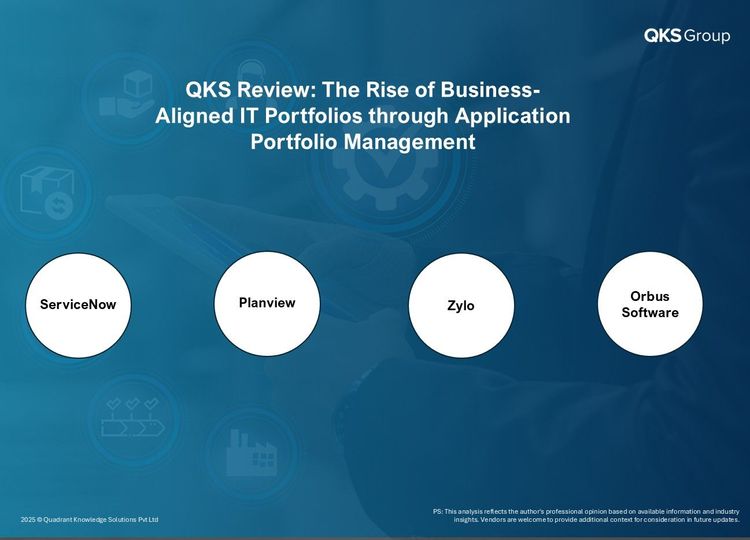
- Leading vendors (Orbus Software, Planview) stand out with comprehensive, enterprise-grade solutions that connect strategy-to-execution and provide strong scenario modeling.
- Capable vendors (ServiceNow, Zylo) show strength in operational telemetry and SaaS portfolio optimization respectively, though each is sharper in its core lane than across every APM use case.
Orbus Software: Architecture-Driven Portfolio Insights
Orbus Software, through its OrbusInfinity platform, emphasizes enterprise architecture-driven portfolio management. By integrating application inventories with business capabilities, processes, and strategic goals, it provides a unified view of IT landscapes. OrbusInfinity enables organizations to model interdependencies, assess risks, and evaluate opportunities for rationalization. Its visualization and analytics capabilities allow decision-makers to clearly see redundancies and gaps while linking IT assets to business outcomes. While strong in architectural mapping and scenario modeling, OrbusInfinity requires a structured setup and governance framework to fully leverage its insights. Organizations without dedicated enterprise architecture teams may face a steep learning curve and require significant configuration to realize its full potential.
ServiceNow: Integrated IT and Business Alignment
ServiceNow approaches Application Portfolio Management through its IT Financial Management and IT Business Management modules, tightly integrated with its ITSM and CMDB ecosystems. The platform provides real-time data on application usage, cost, and health, allowing IT teams to prioritize investments based on business value and operational impact. Its dashboards support decision-making across multiple layers of the organization, from executives to IT managers. Despite its operational strengths, the complexity of configuration and integration can challenge enterprises, particularly those lacking mature IT process governance. Initial adoption and cross-team alignment may require significant effort, potentially delaying full ROI.
Zylo: SaaS Portfolio and Strategic Optimization
Zylo has built its niche in managing SaaS-heavy portfolios, addressing the challenges of shadow IT, subscription optimization, and cost transparency. The platform delivers insights on usage patterns, contract terms, and compliance risks, helping organizations align SaaS investments with business priorities. Zylo’s strength lies in real-time analytics for SaaS rationalization, enabling executives to eliminate redundancies and optimize licensing spend while maintaining compliance. Zylo’s focus on SaaS may limit visibility for on-premises or complex enterprise applications. Organizations seeking a holistic APM view across all application types may need complementary solutions to fill the gaps.
Planview: Strategy-to-Execution Alignment
Planview’s APM solution emphasizes linking IT assets to enterprise strategy and portfolio outcomes. Its platform combines application inventories with project and portfolio management, providing visibility into cost, risk, and value delivered by each system. Planview enables scenario modeling, portfolio optimization, and continuous monitoring to support strategic IT decisions. While powerful, Planview’s broad feature set requires significant configuration and ongoing governance. Organizations without mature PMO or portfolio management practices may find the platform complex to implement and maintain effectively.
Conclusion:
The evolution of Application Portfolio Management platforms reflects a broader shift from purely technical IT management to strategic business alignment. Vendors that combine comprehensive portfolio visibility, analytics, and actionable insights enable organizations to rationalize applications, optimize costs, and align IT investments with business objectives. OrbusSoftware and Planview lead with architecture and strategy-driven perspectives, ServiceNow excels in operational and lifecycle visibility, and Zylo provides specialized SaaS-focused optimization. Enterprises adopting APM today are increasingly seeking solutions that not only catalog IT assets but also provide a clear line of sight from technology decisions to business outcomes, ensuring IT delivers measurable strategic value.
Disclaimer:
This blog is based on independent research and publicly available information. The insights presented reflect the views of QKS Group and are for informational purposes only. While we strive for accuracy, we do not guarantee completeness or absolute correctness. Vendors are welcome to provide clarifications or updates. If any vendor listed in this analysis wishes to provide additional context or clarification, we welcome a briefing call and will consider incorporating relevant updates. This analysis is not intended to disparage any vendor but to provide an informed, balanced perspective. We encourage open and constructive dialogue to foster transparency and a deeper understanding of the industry.
Author: Nipuna M, Analyst - Project & Portfolio Management at QKS Group
Vendors: