

16.06.2025
QKS Review
QKS Review: The Process PLM Contenders - Can They Meet the Compliance-First Mandate?
Author:
Anoch Mane


Executive Summary:
As the Process PLM market faces rising pressure from global regulatory complexity, sustainability imperatives, and batch-level formulation agility, organizations are moving beyond CAD-centric tools.
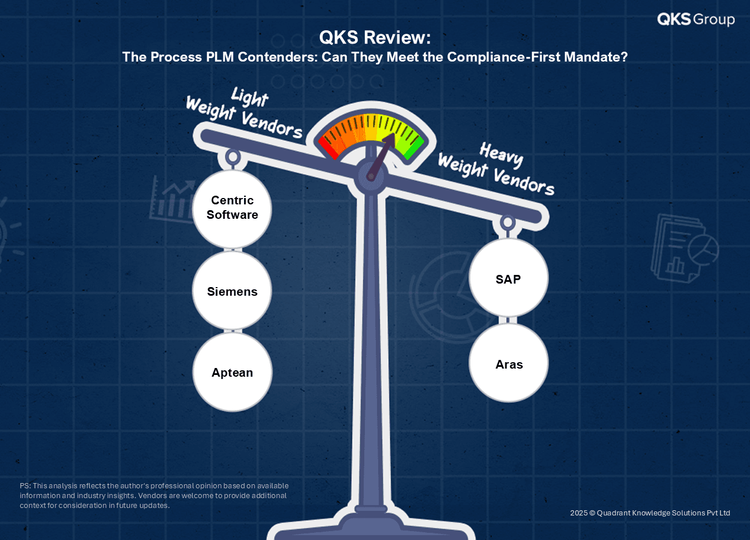
This review blog by QKS Group evaluates whether platforms like SAP, Siemens, Aras, Aptean, and Centric are ready to support the compliance-first, traceability-driven transformation required by modern process industries.
What Modern Process PLM Should Deliver:
- Ingredient-level formulation, traceability, and documentation workflows
- Embedded compliance and regulatory logic for diverse global markets
- Seamless integration with ERP, QA, and sustainability platforms
Key Findings:
- Aras and SAP are making strategic progress with flexible compliance workflows and traceability-first architecture.
- Centric and Aptean show promise in user-centric design and ERP alignment but need deeper regulatory automation.
- Siemens still reflects discrete DNA, with heavy engineering bias limiting adoption in agile process environments.
In 2025, Process PLM is being redefined. The old systems built around CAD files and static BOMs are struggling to keep up with what modern process industries actually need, which is compliance at the ingredient level, faster label updates, sustainability tracking, and flexible formulation management. For companies in food, chemicals, cosmetics, and pharma, this shift isn’t just about software but about staying compliant and competitive.
As compliance fatigue grows and supply chains remain volatile, manufacturers are demanding PLM platforms that go beyond managing drawings. They want systems that model formulation variants, automate documentation, manage label claims, and integrate seamlessly with quality, ERP, and regulatory systems. In this new era, PLM is no longer an engineering tool, it’s a compliance engine.
Why Discrete PLM Won’t Save the Process Industry
Most legacy PLM systems were built for the predictable world of discrete manufacturing. But in the process industries, development is iterative, regulatory needs vary by market, and formulation changes must be traceable to the micro level. Discrete-centric platforms struggle with:
- Non-linear product development cycles
- Real-time regulatory and sustainability modelling
- Batch-based traceability
- Specification management at the ingredient level
- Agile labelling and regional claim variations
The next wave of Process PLM leaders will offer:
- Embedded compliance workflows
- Formulation and variant management
- Recipe-to-BOM synchronization
- Digital labelling and regulatory claim automation
- Ingredient-level traceability
- Sustainability and regulatory data modelling
Vendors in race
SAP: ERP Muscle with Growing Process PLM Ambitions
SAP continues to anchor its PLM vision in S/4HANA and the promise of end-to-end integration across procurement, manufacturing, and compliance. This enterprise-wide foundation supports data continuity, auditability, and process governance at scale. SAP’s digital manufacturing capabilities and ability to link quality, material master, and compliance data across functions give it an edge in traceability and risk management for regulated environments.
The vendor has started to increase its focus on batch traceability, product genealogy, and labelling workflows tailored for food, chemicals, and pharmaceuticals. SAP is also investing in PLM cloud innovations through its Business Technology Platform and offering integration with compliance engines. However, process PLM usability and iterative formulation modelling still rely on custom configurations or third-party plugins. Until SAP introduces prebuilt formulation-first UI elements and native compliance logic, it will remain more of a PLM enabler than a standalone PLM system.
Siemens: Engineering Heavyweight, Process Lightweight
Siemens Teamcenter offers depth in lifecycle management and system scalability. Its architecture supports secure deployments and multi-domain workflows. However, its DNA is unmistakably discrete. Teamcenter's configuration and variant tools are suited for mechanical assemblies, not batch-based formulations.
For process industries, where recipe versioning, regulatory dossier generation, and formulation trials require real-time flexibility, Teamcenter feels rigid. Implementation is complex and adapting it for process-specific needs such as dynamic labelling or ingredient compliance resource-intensive. Siemens has yet to deliver a process-native layer that speaks the language of R&D, regulatory affairs, or marketing.
Aras: Flexible Platform, Still Enhancing Process Industry Depth
Aras brings strength in configurability and low-code modelling. Its ability to support custom workflows for compliance documentation, specification change management, and cross-functional collaboration makes it appealing to process manufacturers looking for adaptable systems. Pharma and chemical firms use Aras to manage versioned specs and approval chains, especially where integration with quality systems is a priority.
Aras supports lifecycle controls and regulatory flagging (such as-halal, kosher, food safety certification, etc.) at the formulation level, improving governance across cross-functional teams. The platform is built for SaaS from the start, easing updates and scalability. However, some organizations may find that deeper pre-configured process templates are still limited, requiring planning during implementation. The vendor is increasingly focusing on reusable modules to accelerate process-specific deployments.
Aptean: Vertical Promise, Process Execution Gaps
Aptean presents itself as a vertical-focused solution provider for process-heavy industries such as food, beverages, and consumer goods. Its PLM (offering part of the broader Aptean Food & Beverage ERP suite) is designed with regulatory compliance, labelling, and specification management in mind. The integration with its ERP suite offers a potentially seamless experience for companies looking to simplify system landscapes.
However, Aptean's PLM platform lacks the functional richness and technical flexibility demanded by global-scale, compliance-intensive operations. There is limited support for dynamic formulation versioning, multi-region labelling, or advanced audit readiness capabilities. The user experience is tied heavily to ERP-first workflows, which constrains R&D-driven innovation. Additionally, its architecture can be less adaptable in scenarios that require quick changes to formulation, sustainability tracking, or traceability setups which often requires more hands-on support from the vendor.
Aptean’s strength lies in pre-configured industry templates and ease of integration within its own ecosystem. But to compete with best-in-class PLM offerings, it must invest in modular expansion, regulatory automation, and user-centric customization capabilities.
Centric PLM: Brand-Centric, evolving in process industry
Centric PLM dominates in fashion and retail with its fast, visual, and collaborative UX. Its market expansion into food, cosmetics, and nutraceuticals positions it well for brand-driven product teams. Centric enables quick line planning, digital go-to-market tools, and supplier collaboration.
While Centric’s user-centric interface and speed-focused platform offer clear benefits for consumer product companies, process industries require added regulatory depth. Centric’s roadmap shows progress, but core capabilities like advanced formulation logic, compliance traceability, and regulatory automation are still maturing. As the demands of food and pharma sectors intensify, Centric has the opportunity to evolve from an intuitive front-end to a more functionally complete compliance platform.
Future Outlook: Strategic Questions Ahead
- Can SAP evolve from an ERP-centric PLM to a formulation-first platform?
- Will Siemens unbolt itself from CAD-first logic and serve batch industries with purpose-built modules?
- Can Aras scale its process capabilities beyond configurability into native, reusable apps?
- Will Aptean move beyond ERP-aligned templates and invest in deeper process-specific PLM functionality?
- Is Centric willing to invest beyond marketing UX to support regulatory and formulation complexity?
Closing Argument: The Process Industry Has Moved On
The process industry is demanding more than digital twins, it wants digital truth. Compliance is not a feature. It’s a foundation. Most legacy vendors are still retrofitting. Aras is showing signs of native flexibility but needs deeper vertical investments. SAP is actively evolving but still needs to push further into prebuilt process features. Siemens remains powerful but poorly aligned. Aptean and Centric have potential but haven’t proven it where it counts.
The next leader in Process PLM won’t win by scaling old logic. It will win by embedding process DNA into every layer of the platform.
Disclaimer:
This blog is based on independent research and publicly available information. The insights presented reflect the views of QKS Group and are for informational purposes only. While we strive for accuracy, we do not guarantee completeness or absolute correctness. Vendors are welcome to provide clarifications or updates. If any vendor listed in this analysis wishes to provide additional context or clarification, we welcome a briefing call and will consider incorporating relevant updates. This analysis is not intended to disparage any vendor but to provide an informed, balanced perspective. We encourage open and constructive dialogue to foster transparency and a deeper understanding of the industry.
Author: Anoch Mane, Analyst - Operational Technology Software at QKS Group
Vendors: