

28.08.2025
QKS Review
QKS Review: The End of APM Silos: Why DEM 2.0 Is a Strategic Imperative
Author:
Manish Chand Thakur


Executive Summary:
As the enterprise observability market faces rising pressure from increasingly complex, cloud-native digital environments and the shift of performance bottlenecks to the user's edge, organizations are moving beyond traditional Application Performance Monitoring (APM) tools. This review blog by QKS Group assesses whether Digital Experience Monitoring (DEM) 2.0 vendors are truly innovating to meet these demands - or merely making incremental updates.
What Modern Digital Experience Monitoring (DEM) Should Deliver:
Today’s platforms must offer more than core features. Critical next-gen capabilities include:
- Real User Monitoring (RUM) & Synthetic Monitoring: For comprehensive insight into actual and simulated user journeys.
- Endpoint and Network Visibility: To trace performance issues beyond the application layer to the user's device and network.
- AI-Powered Diagnostics & Business Outcome Mapping: For proactive problem resolution, predictive insights, and aligning technical performance with business KPIs.
Key Findings:
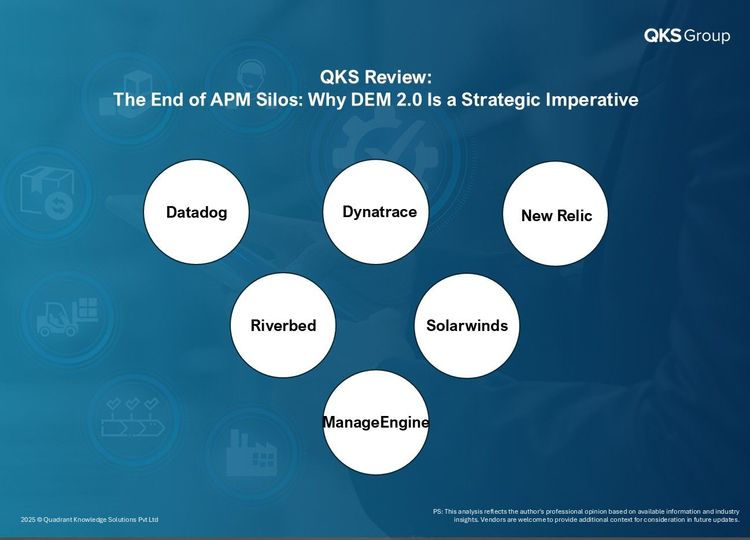
- Leading vendors (Datadog, Dynatrace, New Relic, Riverbed) stand out with comprehensive, enterprise-grade solutions, particularly driven by their advanced AI capabilities.
- Capable vendors (SolarWinds, ManageEngine) show promise in niche areas or offer valuable hybrid approaches for transitioning organizations but may have limitations in breadth of integration or specific cloud-native coverage compared to the leaders.
Introduction: Beyond Traditional APM
Application Performance Monitoring (APM) has been the cornerstone of enterprise observability, focusing on backend metrics such as CPU utilization, memory consumption, and response times. But in today’s complex, cloud-native digital environments, APM alone can’t paint the full picture. Increasingly, users access services across various devices, browsers, and network conditions. The majority of performance bottlenecks now arise outside the application tier - in the user’s device, the ISP path, third-party services, or browser render times.
This creates a significant disconnect: IT sees "healthy" systems, but users experience slowdowns. Monitoring backend systems without capturing their effect on real user experience is no longer viable. Digital Experience Monitoring (DEM) closes this gap by providing real-time visibility into user journeys, measuring performance at the point of user interaction.
This evolution has led to DEM 2.0, a new generation of tools that unify traditional APM with experience-centric telemetry. This approach integrates synthetic testing, real user monitoring (RUM), endpoint diagnostics, and AI-powered analysis into a single platform, enabling proactive optimization of digital experiences. The shift signifies a redefinition of the enterprise perimeter, acknowledging that the cloud is the new data center, the Internet is the new network, and SaaS is the new application stack. DEM 2.0 embraces an "outside-in" approach, recognizing that traditional APM lacks visibility into these increasingly critical external factors.
From APM to DEM 2.0: Core Pillars
Unlike traditional Application Performance Monitoring, which starts at the infrastructure and application layer, DEM 2.0 begins at the user interface and works backward. It relies on multiple methods to create a panoramic view of the experience:
- Real User Monitoring (RUM): Tracks actual user interactions across websites and mobile apps in real-time. It captures granular data like page load time, JavaScript errors, user paths, and device types, offering authentic, real-world insights into user behavior and friction points. Beyond technical metrics, RUM is crucial for understanding user behavior for customer retention, acquisition, and sales revenue, pinpointing issues like cart abandonment, and informing website/app design based on observed habits. It functions via embedded JavaScript or monitoring code.
- Synthetic Monitoring: Uses automated scripts to simulate user journeys (e.g., logins, checkouts) on a scheduled basis from diverse locations and networks. This proactive approach identifies and prevents issues before they impact real users. Benefits include continuous monitoring for intermittent problems, SLA validation, performance optimization, and integration into CI/CD pipelines to prevent regression. It supports browser tests for user journeys and API tests for critical endpoints.
- Endpoint and Network Visibility: Extends observability to devices, ISPs, and local networks. By analyzing latency, bandwidth, CPU utilization, and application load times on user machines, teams can trace issues back to root causes that sit outside the core application.
- AI-Powered Diagnostics: AI and machine learning are used to detect anomalies, suggest root causes, and predict potential disruptions. These insights accelerate response times and help avoid over-alerting by providing context-sensitive alerts. Advanced AI techniques like Machine Learning, Deep Learning, Natural Language Processing (NLP), and Computer Vision contribute to its predictive capabilities, allowing systems to anticipate issues before they manifest.
- Business Outcome Mapping: By correlating technical metrics with business KPIs like conversion rate, cart abandonment, or employee productivity, DEM 2.0 translates performance data into business value. This ensures that engineering priorities align with user satisfaction and financial outcomes.
The real strength of Digital Experience Monitoring (DEM) 2.0 comes from how its five core pillars are unified and interconnected. This integrated approach shifts IT operations from a reactive "break-fix" model to a proactive, predictive, and business-aligned "assurance" model, anticipating and preventing issues and elevating IT's contribution to revenue and customer satisfaction.
Full-Stack Observability Leaders
Vendors like Datadog, Dynatrace, and New Relic exemplify the convergence of traditional observability with DEM 2.0. They go beyond infrastructure monitoring to surface user-facing consequences in real-time, enabling unified troubleshooting across DevOps, SRE, and business teams.
- Datadog integrates RUM, synthetic monitoring, session replay, and application traces within a unified platform. Its AI engine, Watchdog, proactively surfaces anomalies that impact user experience. Session Replay shows not only that an error occurred, but how the user encountered it which is critical for root-cause diagnosis. Datadog provides end-to-end tracing across distributed systems and auto-generates service overviews, supporting seamless correlation between frontend user sessions, synthetic tests, and backend traces.
- Dynatrace offers deterministic AI through its Davis engine, combining frontend RUM and synthetic data with deep backend traces. Davis AI automatically detects and prioritizes problems, auto-generates baselines, and sends precise alerts, eliminating alert floods. Dynatrace auto-discovers services and dependencies, allowing visualization of frontend error impact on downstream systems without manual tagging. Dynatrace also features predictive analytics and robust user behavior analytics as well as Session Replay to show exactly what a user did through a video-like session recording.
- New Relic has restructured its platform to offer full-stack visibility with embedded RUM, synthetic checks, session analytics, and Application Performance Monitoring - all integrated with New Relic AI. This includes AI-powered predictions for time-series metrics and "Response Intelligence" for causal analysis and suggested remediation. The platform correlates browser behavior, mobile telemetry, and backend trace data to detect and resolve user-impacting issues, offering instant contextualized observations and "Blast radius" analysis of affected systems.
- Riverbed (Alluvio Aternity) excels in end-to-end visibility, tracing user experience issues from the endpoint and network through to the application backend, including deep code-level tracing and distributed transaction visibility for cloud-native microservices. The platform monitors application usage, screen render times, and device health from the user's viewpoint, enhanced by a Digital Experience Index for benchmarking. While strong in user-to-code visibility, some organizations might find its integrations for extremely diverse or niche cloud-native services less exhaustive compared to vendors focused purely on broad, full-stack cloud-native APM.
The competitive edge among these leaders is increasingly driven by the depth and practical application of their AI capabilities. AI isn't just a feature; it's a central differentiator for intelligent analysis, correlation, prediction, and even automated remediation, directly impacting Mean Time to Resolution (MTTR) and operational efficiency. Furthermore, these platforms are evolving into comprehensive IT operations hubs, integrating capabilities beyond traditional monitoring like Service Management, AIOps/Automation Workflow, and AI-powered productivity, indicating a strategic move towards autonomous, self-healing IT environments.
Bridging APM and Digital Experience Monitoring in Hybrid Platforms
Vendors like SolarWinds, ManageEngine, and Riverbed are blending DEM capabilities into their traditional Application Performance Monitoring portfolios. This hybrid approach is valuable for organizations transitioning from legacy monitoring without overhauling their entire tool chain.
- SolarWinds has built a consolidated observability solution that includes synthetic testing (via Pingdom), real user monitoring, and backend metrics. It connects front-end events like slow login pages with backend metrics such as database latency. User-centric dashboards provide experience scores and service maps, making it easier for teams to correlate performance with outcomes. While it is known for fast onboarding and ease of use, limitations in integration and advanced UX diagnostics can restrict its utility in enterprise-wide DEM strategies.
- ManageEngine (Site24x7) combines synthetic path testing and RUM with advanced features like session replay and journey heatmaps. The platform supports enterprise-scale deployments and is used across small, mid, and large enterprises. However, some users report limitations in scaling configurations and correlating telemetry across teams, suggesting room for deeper integration in more complex environments.
Final Thoughts: Why DEM 2.0 Matters
As digital experiences become the primary touchpoint between businesses and users, monitoring strategies must evolve from infrastructure observability to experience observability. DEM 2.0 delivers on this promise by capturing performance across every touchpoint: user clicks, browser delays, network paths, API latencies, and device responsiveness. It’s no longer enough to ensure that an app is running. The new bar is whether it’s delivering an efficient, seamless, and productive experience - on every device, in every location, under real-world conditions.
Vendors are responding by embedding RUM, synthetic monitoring, and AI into unified platforms. Whether full-stack providers like Datadog and Dynatrace, or focused players like Riverbed, the shift is clear: Digital experience is the new SLA.
Disclaimer:
This blog is based on independent research and publicly available information. The insights presented reflect the views of QKS Group and are for informational purposes only. While we strive for accuracy, we do not guarantee completeness or absolute correctness. Vendors are welcome to provide clarifications or updates. If any vendor listed in this analysis wishes to provide additional context or clarification, we welcome a briefing call and will consider incorporating relevant updates. This analysis is not intended to disparage any vendor but to provide an informed, balanced perspective. We encourage open and constructive dialogue to foster transparency and a deeper understanding of the industry.
Author: Manish Chand Thakur, Senior Analyst - Privacy Management At QKS Group
Amandeep S. Khanuja, Associate Director & Principal Analyst At QKS Group
Vendors: