

10.07.2025
QKS Review
QKS Review: The Ecosystem Edge: How Extensibility Differentiates Low-Code Platforms
Author:
Abhishek Anant Garg


Executive Summary:
As low-code platforms evolve into enterprise-wide transformation enablers, the need for extensibility has become paramount. Organizations now require platforms that not only simplify development but also integrate seamlessly across ecosystems, empower developer collaboration, and support continuous innovation.
This review blog by QKS Group evaluates how leading low-code vendors are architecting extensibility to meet these rising demands and whether their platforms are open, scalable, and ecosystem-ready or limited by architectural silos.
What Modern Low-Code Platforms Should Deliver:
Today’s platforms must offer more than rapid development capabilities. Critical extensibility features include:
• SDKs and plugin frameworks that support professional-grade extensions
• Reusable integration assets and low-code fusion collaboration
• Marketplace ecosystems that drive scalability and external innovation
Key Findings:
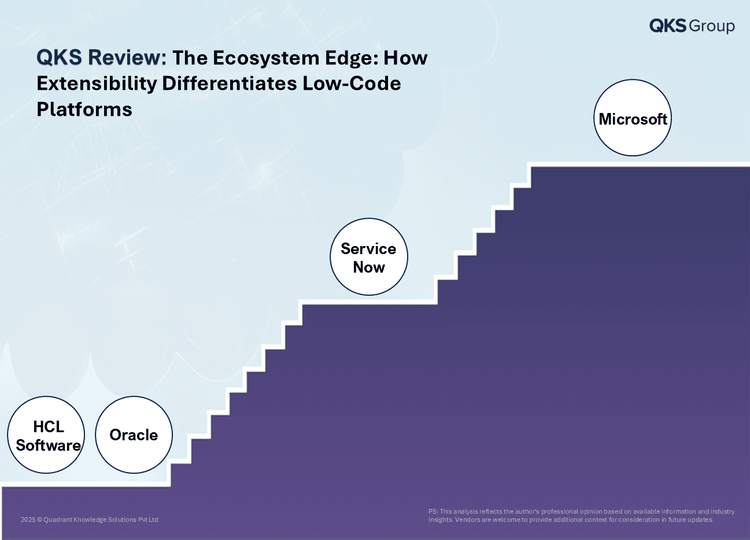
• Leading vendor, Microsoft Power Platform leads with comprehensive extensibility, tight Azure integration, and robust DevOps alignment making it ideal for large-scale fusion development and hybrid enterprise environments.
• Capable vendor, ServiceNow App Engine offers controlled extensibility with scriptable logic and reusable UI components, well-suited for organizations prioritizing governance and workflow automation.
• Lagging vendors, Oracle APEX and HCL Volt MX deliver strong extensibility within their own infrastructure stacks but lag in open ecosystem engagement and community-driven innovation limiting scalability across diverse enterprise landscapes.
Introduction:
In an enterprise context, low-code platforms are no longer judged solely on development speed or UI flexibility. Today, extensibility defines a platform's long-term value: Can professional developers insert custom code seamlessly? Can citizen developers use advanced building blocks created by others? Can external systems be integrated without bottlenecks? And crucially, does the platform support an innovation ecosystem beyond its core vendor?
These questions have risen in importance as low-code becomes embedded in mission-critical processes. A platform that can only deliver what it ships out-of-the-box may solve short-term problems but risks becoming a strategic liability. Enterprises now demand platforms that offer:
- Modular, reusable components
- SDKs and plugin architectures
- Open, well-documented APIs
- Marketplace-driven app sharing
- Integration with external tools, cloud services, and developer workflows
The extent to which a platform supports these elements signals its readiness for real-world enterprise complexity.
To assess how today’s leading vendors are meeting these extensibility expectations, we examine four enterprise-focused low-code platforms, each with distinct design philosophies, technical strengths, and ecosystem approaches. The following analysis dissects their extensibility strategies to help organizations understand where each vendor stands in enabling long-term platform scalability and developer empowerment.
The Leaders: Open Ecosystem Thinking and Developer Empowerment
Microsoft Power Platform: Fusion Development at Scale
Microsoft Power Platform stands out for its multi-layered extensibility model. Developers can use Power Apps Component Framework (PCF) for custom controls, build server-side logic via Dataverse plug-ins, and expose or consume external APIs using custom connectors. These features ensure that applications are not limited by the boundaries of built-in capabilities.
The platform enables seamless collaboration between citizen and professional developers through the concept of fusion development. With tight integration across Azure services, Power Platform users can trigger workflows, consume AI models, or extend logic through Azure Functions, Logic Apps, or custom APIs, all while maintaining low-code simplicity for business users.
Its extensibility is further strengthened by mature DevOps support, GitHub integration, and Azure DevOps pipelines, making it suitable for enterprises with established delivery practices. AppSource provides a wide repository of reusable solutions and connectors, and Microsoft's global partner network sustains continuous ecosystem innovation. The platform exemplifies composability at enterprise scale.
Analyst Verdict: Power Platform sets the benchmark for extensibility by blending code-first power with low-code productivity. Its alignment with Azure makes it ideal for Microsoft-centric enterprises scaling low-code across hybrid teams.
The Middle Ground: Structured Extensibility with Governance Layers
ServiceNow App Engine: Scriptable, Secure, Workflow-Centric Extensibility
ServiceNow App Engine offers extensibility through a robust scripting model. Developers can build custom logic using JavaScript, define reusable logic modules with Script Includes, and enhance automation flows using custom actions in Flow Designer. These capabilities allow extension of pre-built workflows or creation of entirely new ones aligned with enterprise-specific processes.
The platform’s extensibility also spans UI customization. With the Next Experience framework, developers can craft bespoke user components as web components. These are reusable in UI Builder, enabling flexible visual development that aligns with enterprise branding and interaction models. Advanced users can even integrate third-party frameworks like React for richer UX.
Despite its flexibility, ServiceNow enforces strong governance. Role-based access, scoped applications, and App Engine Management Center provide enterprise IT with full oversight. The IntegrationHub further supports custom and prebuilt spokes for external orchestration, though onboarding new developers into the proprietary model can take time. Still, its governance-compliant extensibility remains enterprise-ready.
Analyst Verdict: ServiceNow offers enterprise-grade extensibility with a strong emphasis on control and standardization. Best suited for organizations with mature governance practices and complex workflow automation needs.
The Laggards: Constrained by Architectural Silos or Legacy Bias
Oracle APEX: Database-Centric Power with Narrow Ecosystem Surface
Oracle APEX delivers high extensibility for Oracle Database users. Developers can extend functionality using PL/SQL routines, integrate business logic within triggers, or enhance UI behavior via JavaScript and custom HTML. Its plug-in architecture allows creation of new item types, actions, and region templates tailored to specific enterprise needs.
Recent versions have introduced more extensibility pathways. APEX now includes a workflow engine where custom plug-ins can define new activity types. External API consumption has improved with OpenAPI import and REST Data Sources. Developers can also expose business logic via ORDS, allowing APEX apps to act as service providers in hybrid architectures.
However, APEX remains tightly bound to Oracle infrastructure. It lacks a public-facing marketplace for reusable components and has limited third-party development momentum. While technically flexible, its extensibility reach is largely confined to Oracle-native contexts, reducing its utility as a broad ecosystem platform in multi-vendor enterprise environments.
Analyst Verdict: APEX delivers strong extensibility for Oracle-centric use cases but falls short as an open, ecosystem-scale low-code platform.
HCL Volt MX: Full-Stack Flexibility, Ecosystem Gap
HCL Volt MX offers extensibility through a unified no-code to pro-code stack. Developers can enrich Leap-built forms with custom HTML and JavaScript or build entire micro-apps in Iris using standard languages. Backend extensibility is powered by Foundry, allowing developers to orchestrate data services, build custom integrations, and inject server-side logic.
The platform’s multi-experience engine allows deployment across web, mobile, and wearable interfaces from a single codebase. Developers can customize UI, inject native device code, and manage complex app modules under a single framework. Foundry also handles enterprise integration through REST APIs, legacy connectors, and event orchestration models.
Yet Volt MX lacks a vibrant external ecosystem. There is minimal visibility of reusable components, marketplace plug-ins, or community-built accelerators. While the underlying architecture is extensible, HCL's ecosystem strategy has not matured enough to support scalable reuse or open innovation. This limits the platform’s extensibility from a collaborative enterprise perspective.
Analyst Verdict: Volt MX offers a technically robust full-stack platform, but its lack of marketplace dynamics and limited external engagement weakens its extensibility posture.
Strategic Recommendations: Designing for Extensibility Maturity
- Evaluate SDK Depth and Plugin Models: Seek platforms with mature, versioned SDKs and reusable plugin architectures to enable scalable extension.
- Check for Reusable Integration Assets: Assess whether connectors, flows, and components can be created once and reused across teams.
- Balance Governance with Developer Freedom: Look for platforms that support guardrails but do not over-constrain how extensions are created and deployed.
- Assess Marketplace and ISV Engagement: A vibrant app marketplace signals healthy external innovation and reduces custom development burdens.
- Prioritize Cross-System Integration: Favor platforms with strong REST support, API management, and external service orchestration capabilities.
Conclusion: Extensibility as the Platform Differentiator
As low-code platforms shift from pilot projects to production-grade portfolios, extensibility emerges as the defining feature separating tools from ecosystems. Platforms that support modularity, reuse, integration, and community contribution enable organizations to adapt faster, innovate broader, and build more sustainably.
Microsoft Power Platform leads with a deeply integrated and extensible environment suitable for multi-role collaboration. ServiceNow App Engine provides structured extensibility for controlled environments. Oracle APEX and Volt MX offer extensibility within their domains but lag in ecosystem dynamics.
In the new enterprise reality, extensibility is not just an IT requirement, it's a strategic enabler. The winners will be those platforms that scale not just with code, but with community, connectivity, and composability at their core.
This blog is based on independent research and publicly available information. The insights presented reflect the views of QKS Group and are for informational purposes only. While we strive for accuracy, we do not guarantee completeness or absolute correctness. Vendors are welcome to provide clarifications or updates. If any vendor listed in this analysis wishes to provide additional context or clarification, we welcome a briefing call and will consider incorporating relevant updates. This analysis is not intended to disparage any vendor but to provide an informed, balanced perspective. We encourage open and constructive dialogue to foster transparency and a deeper understanding of the industry.
Author: Abhishek Anant Garg, Analyst – Application Development & Deployment at QKS Group
Vendors: