

24.06.2025
QKS Review
QKS Review: SOAR Playbook Automation: Complex to Simplistic Solutions for Automated Response
Author:
Venkatesh Kopparthi


Executive Summary:
As the Security Orchestration, Automation, and Response (SOAR) market faces rising pressure from alert fatigue, skill shortages, and increasing demand for operational efficiency, organizations are moving beyond traditional manual or semi-automated incident response tools.
This review blog by QKS Group assesses whether Security Orchestration, Automation, and Response (SOAR) vendors are truly innovating to meet these demands - or merely making incremental updates.
What Modern SOAR Platforms Should Deliver:
Today’s platforms must offer more than basic playbook automation. Critical next-gen capabilities include:
• Low-code/no-code playbook creation for broader team accessibility
• Scalable orchestration with deep third-party integrations and scripting support
• Intelligent alert triage and adaptive response tied to MITRE ATT&CK or threat intel Key Findings:
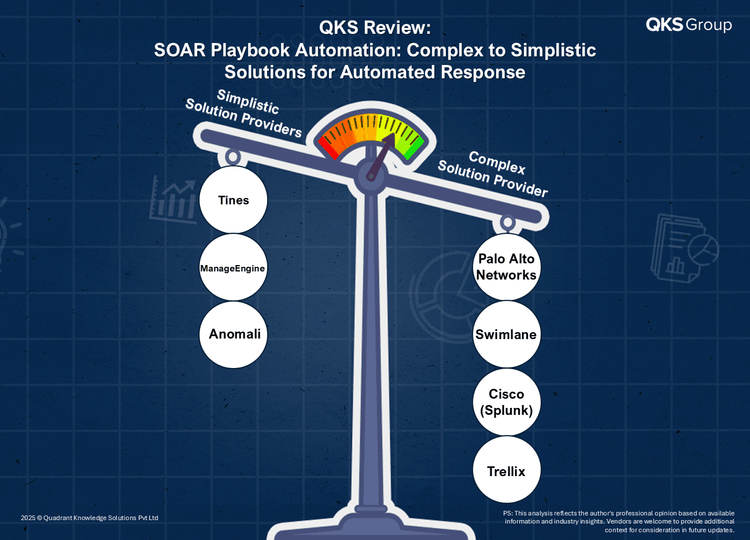
• Leading vendors (Palo Alto Networks, Swimlane, Cisco/Splunk, Trellix) stand out with scalable, enterprise-grade SOAR platforms offering powerful automation, deep integrations, and flexible playbook customization.
• Capable vendors (Tines, ManageEngine) provide simplified and cost-effective automation, ideal for mid-market or resource-limited SOC teams, though with some limitations in customization or breadth.
• Lagging vendors (Anomali) remain narrowly focused on threat intelligence workflows, limiting their ability to serve as comprehensive SOAR solutions
Introduction
In today's hyperactive threat landscape, Security Operations Centers face an overwhelming pile of alerts and incidents. Security Orchestration, Automation, and Response (SOAR) platforms promise salvation through playbook automation, but the reality often falls short of expectations. As organizations grapple with choosing the right platform, understanding the nuances of each vendor's approach becomes crucial for success.
Complex Solution Providers
Palo Alto Networks' Cortex XSOAR stands as a leader to what's possible when automation meets enterprise-grade architecture. With its comprehensive playbook automation capabilities and support for both drag-and-drop editing and custom scripting in Python and JavaScript, XSOAR offers depth. The platform has over 700 of marketplace integrations and a microservices architecture that ensures scalability. However, this power comes with complexity. Organizations must carefully consider whether their analysts can maintain and update complex playbooks over time, and whether the complexity justifies the advanced capabilities. The high total cost of ownership also raises questions about long-term sustainability.
Swimlane's Turbine takes a different approach, reimagining SOAR through a low-code lens. Its visual playbook editor democratizes automation, making complex workflows accessible to analysts without deep technical expertise. The platform's modular component design and cloud-native architecture support impressive claims of handling 25 million daily actions per customer a key distinction, as many vendors report similar numbers across their entire customer base rather than per deployment.
While Turbine’s ease of use is a clear strength, questions naturally arise about how well the low-code approach scales with increasing automation demands, and how transparent the pricing model is as usage grows. Swimlane addresses these concerns by emphasizing that Turbine is designed not just for accessibility, but also for scale. Beyond the drag-and-drop interface, it supports advanced scripting through Python, JSONATA, and developer-level tools, enabling teams to build sophisticated workflows.
Another consideration for many organizations is the ability to go beyond pre-built components and tailor workflows to their specific requirements. According to Swimlane, there are no restrictions on what can be built within Turbine. The level of customization depends on each team’s internal expertise and time investment or whether they choose to engage a Swimlane technical account manager to support more advanced or specialized implementations.
Cisco (Splunk)SOAR brings its own strengths to the table, offering over 300 third-party integrations and 2,800 automated actions. Its dual approach providing both visual and Python-based playbook building offers flexibility that many competitors lack. The platform's alignment with the MITRE ATT&CK framework demonstrates its security-first mindset. However, organizations need to consider whether their teams can handle the Python requirements for advanced workflows, and if tight coupling with the Splunk ecosystem might limit their options in the future.
Trellix Helix playbook automation stands as an emerging player by offering 400 pre-built playbooks and 650 security tool integrations. The platform's structured case management interface and enterprise SOC support makes it attractive for organizations already invested in the Trellix ecosystem. However, teams should question whether the pre-built playbooks offer enough flexibility for their specific needs, and how well the platform handles custom integrations.
Simplistic Solution Providers
Tines has carved out its niche by taking the no-code approach to its logical conclusion. Their story-based playbook structure emphasizes rapid deployment and intuitive workflow creation, making it ideal for teams that prioritize speed over complexity.
While this simplicity is a core strength, it raises valid concerns around whether such a design can scale to support more complex automation demands over time. Tines clarifies that despite being no-code, the platform is capable of handling sophisticated workflows and advanced conditional logic. In one case, a large enterprise consolidated hundreds of legacy playbooks into more streamlined stories, significantly reduced onboarding time, and extended platform usage across multiple technical and non-technical teams demonstrating both depth and adaptability.
Another point of evaluation is how the story-based model translates into pricing scalability as organizations expand usage. Tines addresses this by adopting a platform-fee model rather than the more common user-based approach. With tiered usage limits and feature buckets aligned to an organization’s workflow maturity, the model is designed to support predictable growth without sudden jumps in cost as automation scales.
ManageEngine’s Log360 SOAR serves a wide range of organizations from mid‑market to enterprise by offering a unified SIEM+SOAR platform. Key strengths include a rich Incident Workbench for contextual investigations, predefined and customizable playbooks via a drag‑and‑drop interface, and embedded ticketing with ITSM integrations. Built‑in orchestration features automate standard remediation tasks such as account suspension, firewall adjustments, and process termination. Powered by the Vigil IQ engine, Log360 enhances threat detection with UEBA, MITRE ATT&CK correlation, and automated response workflows. While it may not match the breadth of top‑tier dedicated SOARs, Log360 delivers a robust, cost‑effective solution that scales with growing organizational needs.
Anomali Security Analytics steps into the SOAR field as a challenger, honing in on threat intelligence (TI) automation with support from AI and a cloud-native data lake, but offering a narrower scope compared to leaders like Cortex XSOAR or Splunk SOAR. Its design centers on TI workflows and includes integrations with tools like McAfee and Splunk, yet it lacks the depth for broader orchestration and non-TI incident response. Organizations may find its specialized focus limits its ability to handle diverse security tasks, often necessitating additional solutions. The need to manage its AI-driven features and address non-TI processes could complicate adoption. In the dynamic threat landscape, Anomali presents a focused but incomplete option for teams seeking a full SOAR experience.
Looking Forward
The SOAR landscape continues to evolve, with vendors pushing toward low-code/no-code solutions, enhanced AI capabilities, and greater scalability through cloud-native architectures. However, organizations face the challenge of balancing powerful automation with usability, cost considerations, and their team's capabilities. Success lies not in choosing the most powerful or the easiest-to-use platform, but in finding one that aligns with specific organizational needs, resources, and growth trajectory. When evaluating SOAR platforms, organizations must look beyond feature lists and marketing claims to understand how each platform's approach to automation aligns with their team's capabilities and security goals. The promise of SOAR remains compelling, but achieving success requires careful consideration of each vendor's strengths, limitations, and long-term viability in an increasingly complex security landscape.
Disclaimer:
This blog is based on independent research and publicly available information. The insights presented reflect the views of QKS Group and are for informational purposes only. While we strive for accuracy, we do not guarantee completeness or absolute correctness. Vendors are welcome to provide clarifications or updates. If any vendor listed in this analysis wishes to provide additional context or clarification, we welcome a briefing call and will consider incorporating relevant updates. This analysis is not intended to disparage any vendor but to provide an informed, balanced perspective. We encourage open and constructive dialogue to foster transparency and a deeper understanding of the industry.
Author: Venkatesh Kopparthi, Analyst - Security Analytics and Automation at QKS Group
Vendors: