

08.09.2025
QKS Review
QKS Review: Qlik vs Alteryx One – Two Distinct Routes to Data Intelligence Portfolio Deep Dive: End-to-End vs Analyst-Centric
Author:
Prabhat Mishra


Executive Summary:
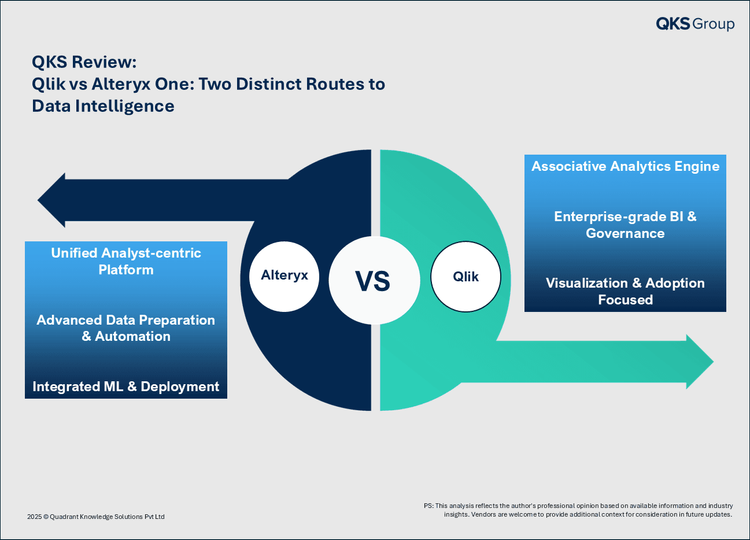
With enterprises rethinking their data and analytics strategies, Qlik and Alteryx One emerge as two distinct yet increasingly comparable options. Both vendors have broadened their portfolios significantly, yet their philosophies diverge: Qlik focuses on delivering governed, enterprise-scale BI, while Alteryx One empowers analytics teams with automation, data prep, and operationalized machine learning.
What Enterprises Should Expect from These Platforms:
Modern analytics and data intelligence platforms must balance accessibility for business users with advanced automation for analytics teams. Key differentiators now include:
- End-to-end integration across ingestion, preparation, and visualization
- Built-in governance, metadata management, and compliance
- Embedded AI/ML capabilities for predictive insights and automated workflows
Key Findings:
- Qlik excels as an end-to-end platform for governed, interactive analytics—making it ideal for organizations prioritizing enterprise BI adoption and real-time insights at scale.
- Alteryx One shines as an analyst-first platform, now re-architected for enterprise deployment, enabling rapid data preparation, ML model deployment, and workflow automation.
- While Qlik dominates in visualization and business adoption, Alteryx One offers deeper control for analytics teams focused on operationalizing intelligence.
- The two platforms converge in scope but differ in identity. Enterprises may find them complementary depending on whether their core bottleneck lies in surfacing insights broadly or accelerating their creation.
Are Qlik and Alteryx direct competitors, or are they solving different problems along the data value chain? With the launch of the Alteryx One Platform, the comparison becomes even more relevant. Both vendors have significantly broadened their capabilities to serve the evolving needs of data-driven organizations. Yet, their strengths, focus areas, and user personas remain distinct.
This blog compares the two across architecture, analytics depth, integration capabilities, and strategic fit for enterprises and mid-sized businesses.
Qlik has grown from a visualization-first company into a full-fledged data intelligence platform. At the core of its portfolio is Qlik Sense, which is built on an associative analytics engine that supports real-time, in-memory exploration. Beyond analytics, Qlik has added robust data integration through its acquisitions of Talend and Attunity, enabling real-time replication, transformation, and orchestration of data from various sources. It also supports augmented analytics via Insight Advisor, which surfaces AI-generated suggestions, patterns, and outliers. Qlik’s enterprise offerings include governed self-service, role-based access, data cataloging, alerting, and flexible deployment options across on-prem, cloud, or hybrid environments.
In essence, Qlik delivers a single platform from raw data ingestion to interactive visualization, designed for scalability, governance, and wide business adoption.
Alteryx One Platform, the company’s new unified architecture, consolidates its previously modular products, like Designer, Server, Connect, and Promote, into a cloud-first, enterprise-scale solution for data preparation, analytics, and machine learning. The platform retains Alteryx’s intuitive drag-and-drop workflow builder, making it easy for analysts to clean, blend, and analyze data without code. But now, it’s layered with advanced orchestration, governance, and deployment capabilities built natively into the cloud.
Alteryx One includes prebuilt connectors for a variety of cloud data warehouses and apps, embedded ML tooling, centralized workflow management, and a metadata-rich catalog to promote reuse and compliance. It also supports full lifecycle deployment from authoring and versioning to scheduling, monitoring, and collaboration on a unified interface.
While Qlik prioritizes delivering insights to business users through dashboards, Alteryx One empowers analytics teams to automate the complex tasks such as transformations, enrichments, and predictive modelling at enterprise scale.
Capability Comparison: Who Does What Better?
Data Integration & Preparation:
Alteryx has long been strong in data prep, and Alteryx One amplifies that. It allows users to build complex, reusable workflows with built-in tools for cleansing, joining, enrichment, and more. The no-code interface is intuitive for analysts and domain experts, yet powerful enough to support advanced use cases like spatial and predictive analytics. Qlik, while enhanced by Talend, approaches integration from a real-time data movement and transformation lens. It's ideal for continuous data replication, transformation pipelines, and delivering analytics-ready data into Qlik’s engine.
Users preferAlteryx One for analyst-driven data prep and choose Qlik for governed, real-time integration into enterprise pipelines.
Analytics & Visualization:
Qlik’s core strength lies in its associative analytics model and responsive dashboarding. Users can click on any field and see related insights update dynamically across all visualizations. It supports pixel-perfect dashboards, governed metrics, and multi-layered data exploration, all within a highly governed environment. Alteryx One offers lightweight visualizations and can produce charts or reports, but it's not designed for interactive dashboarding. Most Alteryx outputs are meant for export, report generation, or downstream use in tools like Power BI or Qlik itself.
Qlik dominates in interactive, self-service BI. Alteryx One is best for behind-the-scenes computation and process automation.
Advanced Analytics & Machine Learning:
Alteryx One integrates pre-built ML tools, autoML, and supports R/Python for extensibility, making it an ideal platform for teams that need to prototype and deploy predictive models quickly. It also supports versioning, deployment, and monitoring of models in production. Qlik, on the other hand, focuses on consuming ML outcomes rather than building models natively. It integrates with external ML engines and supports ML inference within dashboards but offers limited native modeling functionality.
Alteryx One is better for developing and operationalizing analytics. Qlik excels at embedding those insights into business workflows.
User Experience & Collaboration:
Qlik offers a rich experience for both analysts and business users. Dashboards are intuitive to consume, and developers can build sophisticated apps with advanced scripting. Its governance and permission models make it suitable for large-scale deployment. Alteryx One, while historically analyst-centric, has now added multi-user collaboration, shared workspace environments, and deployment controls. The platform still skews toward analysts and analytics engineers, but its reach is expanding.
Qlik is more suited for cross-functional teams sharing dashboards. Alteryx One gives analytics teams a powerful, unified workspace.
Strategic Focus and Market Alignment
Qlik’s Go-to-Market:
Qlik is positioning itself as a full-spectrum Active Intelligence platform, delivering fresh, actionable insights via integrated data pipelines and dashboards. With Qlik Cloud, the company is driving adoption of analytics-as-a-service, especially for regulated industries and large enterprises with hybrid deployments. Its pitch is simple: reduce tool sprawl by handling everything, from ingestion to visualization, under one governed platform.
Alteryx’s Evolved Strategy:
Alteryx One marks a strategic shift from siloed analytics modules to a platform-first approach. The focus is on enterprise-grade automation, scaling self-service across departments, and supporting cloud-native architectures. Alteryx is increasingly competing for the attention of data platform teams and analytics COEs, not just individual analysts. The Designer Cloud along with tighter DevOps controls, and integration with modern data stacks shows Alteryx is betting big on enterprise cloud modernization.
Who Should Choose What?
Choose Qlik if your goal is to empower hundreds or thousands of users with governed dashboards and real-time visual analytics. It’s ideal for organizations needing interactive, secure, and scalable business intelligence with centralized data governance.
Choose Alteryx One if your organization is focused on automating complex data prep and analytics processes at scale, especially if your teams consist of business analysts, analytics engineers, and data scientists who want to build, deploy, and maintain data workflows without constant IT dependency.
Qlik and Alteryx One represent two evolving but still differentiated philosophies. Qlik brings clarity through visualization, offering an accessible, interactive interface for the entire business. Alteryx One brings control through automation, helping analytics teams streamline everything from data prep to ML deployment.
As the data intelligence market shifts toward unified platforms, these two vendors are converging in scope, but not in identity. Your choice should reflect your core bottleneck: is it surfacing insights to more people? Or accelerating the creation of those insights in the first place?
In many cases, the answer is both. Fortunately, Qlik and Alteryx One can coexist to support a truly modern analytics architecture, where every step, from raw data to decision-making, is optimized for speed, scale, and intelligence.
Although, in my opinion, most analysts deeply embedded in the AI and Analytics space, might choose Alteryx’s suite over Qlik. The platform enables analytics teams to move beyond reactive dashboards and into proactive, automated intelligence. Its seamless integration of data prep, ML, governance, and deployment speaks directly to the operational demands of modern enterprises.
Disclaimer:
This blog is based on independent research and publicly available information. The insights presented reflect the views of QKS Group and are for informational purposes only. While we strive for accuracy, we do not guarantee completeness or absolute correctness. Vendors are welcome to provide clarifications or updates. If any vendor listed in this analysis wishes to provide additional context or clarification, we welcome a briefing call and will consider incorporating relevant updates. This analysis is not intended to disparage any vendor but to provide an informed, balanced perspective. We encourage open and constructive dialogue to foster transparency and a deeper understanding of the industry.
Author: Prabhat Mishra, Analyst - Enterprise AI at QKS Group
Vendors: