

26.06.2025
QKS Review
QKS Review: Proactive vs. Reactive: Are OT Security Vendors Preparing for the Future or Just Patching the Past?
Author:
Kunal Kumar


Executive Summary:
As the Operational Technology (OT) security market faces rising pressure from sophisticated, multi-stage cyberattacks, surging ransomware incidents, and increasing nation-state activity, organizations are moving beyond traditional reactive vulnerability management tools.
This review blog by QKS Group assesses whether OT security vendors are truly innovating with proactive, anticipatory defences or merely reinforcing outdated, reactive approaches that patch threats after they strike.
What Modern OT Security Platforms Should Deliver:
Today’s platforms must offer more than core detection and patching. Critical next-gen capabilities include:
- AI/ML-driven predictive threat detection and behavioural analytics.
- Deception technologies such as honeypots and decoys to lure attackers.
- Resilience-building measures like zero-trust architecture and autonomous mitigation.
Key Findings:
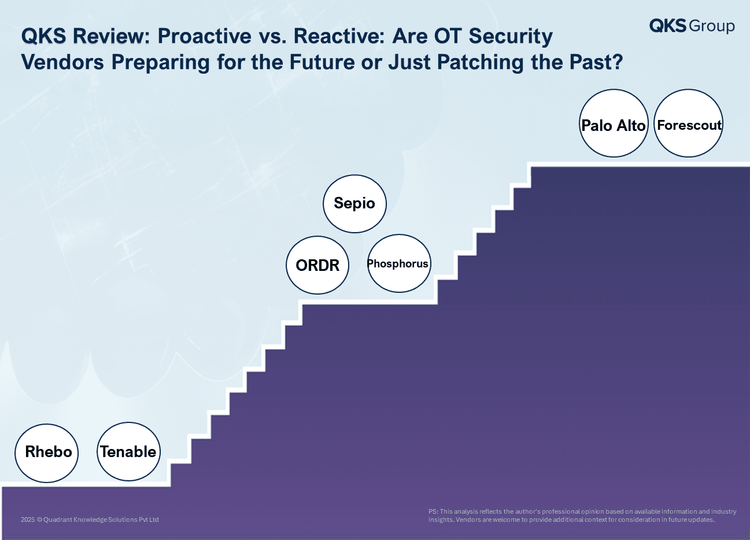
- Leading vendors (Forescout, Palo Alto Networks) stand out with strong AI and automated detection capabilities. However, limited or absent deception technologies hinder their ability to proactively mislead or trap attackers before damage occurs.
- Capable vendors (Phosphorus, Sepio, ORDR) showcase niche innovations, Phosphorus excels in proactive lifecycle management and deception simulation, while Sepio leads in hardware-layer visibility. Yet gaps in breadth, deception depth, or resilience limit their ability to serve as holistic, proactive solutions.
- Lagging vendors (Tenable, Rhebo) rely on traditional reactive frameworks like passive anomaly detection or vulnerability scanning. Their lack of AI-driven prediction, deception mechanisms, or zero-trust measures makes them ill-equipped for today’s rapidly evolving OT threat landscape.
Introduction: The OT Security Dilemma, Are Vendors Truly Future-Ready?
In 2024, the operational technology (OT) landscape faced unprecedented cyber threats, with nearly 70% of industrial firms reporting OT cyberattacks, as per one of the major cybersecurity solution providers. This surge in attacks underscores a critical question: Are OT security vendors genuinely preparing for future threats, or are they merely reacting to incidents as they occur?
These incidents highlight the pressing need for a paradigm shift from reactive security measures such as patching known vulnerabilities to proactive strategies that anticipate and neutralize threats before they materialize.
Overview of the Evolving OT Threat Landscape
The past year witnessed a significant escalation in cyber threats targeting OT systems. Notably, ransomware attacks on the industrial sector surged by 87%, with manufacturing being the hardest hit. Additionally, nine distinct threat groups were active in OT operations, four of which demonstrated capabilities to develop and test specific attacks on industrial control systems (ICS), mentioned by one of the leading OT security providers.
The Shift from Reactive to Proactive Security
Traditionally, OT security has been reactive, focusing on patching known vulnerabilities after incidents occur. However, the sophistication of modern threats necessitates a proactive approach. This involves predictive threat intelligence, deception technology, and AI-driven detection mechanisms designed to anticipate and neutralize threats before they materialize. For instance, integrating lifecycle management with risk management offers a comprehensive strategy that proactively addresses vulnerabilities, equipping OT systems to better anticipate future threats.
Are Current OT Security Vendors Prepared?
Despite advancements, there's scepticism about whether current OT security vendors are genuinely future-ready or merely catching up with existing threats. The disconnect between security investments and actual risk mitigation raises concerns about the effectiveness of these solutions.
What Does Proactive Security Mean in an OT Environment?
Proactive security in OT involves anticipating potential threats and implementing measures to prevent them. This strategy focuses on preventing cyberattacks before they impact internal networks, akin to receiving a vaccine to prevent illness.
Key Technologies and Strategies:
- Predictive AI and Behavioural Analytics: Utilizing machine learning to identify anomalies and predict potential threats based on behaviour patterns.
- Deception Technology: Deploying honeypots and decoys to mislead attackers and gather intelligence on their tactics.
- Real-Time Threat Hunting: Continuously monitoring systems to detect and neutralize threats as they emerge.
Limitations of Traditional Reactive Security
Reactive security approaches often address threats post-incident, leading to potential operational disruptions and financial losses. This method is insufficient against advanced persistent threats that require immediate detection and response.
Vendor Deep Dive: Who is Leading the Proactive OT Security Revolution?
A critical evaluation of few of the OT security vendors reveals varying degrees of commitment to proactive security measures.
Evaluation Metrics:
- Use of AI/ML for Predictive Threat Detection: Assessing the integration of artificial intelligence and machine learning in identifying potential threats before they occur.
- Implementation of Deception Technology: Evaluating the deployment of honeypots and decoys to detect and mislead attackers.
- Automated Threat Hunting and Intelligence-Sharing Capabilities: Analysing the automation of threat detection processes and the sharing of intelligence across platforms.
- Integration with Threat Intelligence Feeds and Real-Time Risk Assessments: Reviewing the incorporation of external threat data and real-time risk analysis into security protocols.
- Resilience-Building Measures: Examining the adoption of zero-trust architectures and self-healing security systems to enhance resilience.
Reality Check: Are Vendors Practicing What They Preach?

Dominant Players:
- AI/ML for Predictive Detection: Employs advanced AI algorithms to forecast and identify emerging threats, enhancing proactive defence capabilities.
- Deception Technology: Currently platform offers minimal deception mechanisms such as honeypots or decoys.
- Automated Threat Hunting: Utilizes automated systems to continuously monitor and detect anomalies within OT environments.
- Threat Intelligence Integration: Integrates with various threat intelligence feeds to provide real-time risk assessments and updates.
- Resilience Measures: Supports zero-trust architectures and offers features aimed at enhancing system resilience against attacks.
- AI/ML for Predictive Detection: Leverages machine learning to analyse network traffic and predict potential threats before they manifest.
- Deception Technology: Does not currently offer deception-based security features.
- Automated Threat Hunting: Provides automated threat detection and response mechanisms to swiftly address security incidents.
- Threat Intelligence Integration: Incorporates global threat intelligence to inform security measures and real-time assessments.
- Resilience Measures: Emphasizes zero-trust principles and offers robust network segmentation to enhance security posture.
Capable Players:
- AI/ML Predictive Detection: Uses Layer‑1 fingerprinting + ML for real-time identification of rogue and shadow OT assets.
- Deception Technology: None currently.
- Automated Threat Hunting: Features traffic‑independent, continuous asset discovery and monitoring.
- Threat Intel Integration: Uses OSINT and proprietary threat feeds to assign risk scores dynamically.
- Resilience Measures: Strong alignment with Zero‑Trust Architecture, dynamic policy enforcement, granular device control across multiple layers.
- AI/ML Predictive Detection: Its Intelligent Active Discovery (IAD) uses sophisticated ML to detect xIoT devices with high accuracy.
- Deception Technology: Offers decoy-based simulations demonstrated in labs (e.g., S4x24), leveraging honeypot-like techniques to lure and analyze threats.
- Automated Threat Hunting: Automates discovery, patching, credential rotation, configuration hardening, and continuous monitoring.
- Threat Intel Integration: Continuously gathers device posture, firmware vulnerabilities, and CVE data to feed real‑time threat models.
- Resilience Measures: Enables automated remediation and preventive hardening without hardware agents, supporting active defence postures.
- AI/ML for Predictive Detection: Utilizes AI and machine learning to monitor device behaviour and predict potential security issues.
- Deception Technology: Does not implement deception strategies within its security framework.
- Automated Threat Hunting: Employs automated systems to identify and respond to threats in real-time.
- Threat Intelligence Integration: Incorporates threat intelligence to provide context-aware security insights.
- Resilience Measures: Lacks comprehensive resilience measures such as zero-trust or self-healing capabilities.
Slow Movers:
- AI/ML for Predictive Detection: Offers limited AI capabilities, primarily focusing on identifying known vulnerabilities rather than predicting new threats.
- Deception Technology: Does not include deception technologies in its security offerings.
- Automated Threat Hunting: Provides basic automated scanning tools but lacks comprehensive threat hunting features.
- Threat Intelligence Integration: Integrates with various threat intelligence sources to enhance vulnerability assessments.
- Resilience Measures: Does not prominently feature resilience-building measures such as zero-trust architectures.
- AI/ML for Predictive Detection: Rhebo employs heuristic and statistical methods for anomaly detection in OT networks. The company expresses caution about the effectiveness of AI in OT security monitoring, recommending instead that AI/ML be applied within the central SIEM system of a broader security framework. Rhebo's monitoring and deep packet inspection (DPI) data can also be leveraged by external AI tools for further analysis.
- Deception Technology: Rhebo does not currently implement deception strategies within its security framework.
- Automated Threat Hunting: Rhebo's solutions feature automated intrusion and anomaly detection systems that continuously monitor OT networks, identifying and alerting on irregular behaviours and potential threats as they emerge.
- Threat Intelligence Integration: Rhebo supports integration with external security tools by providing forensic data in machine-readable formats. Additionally, its systems incorporate CVE listings, enabling operators to identify vulnerable firmware, devices, or systems within the OT infrastructure.
- Resilience Measures: Rhebo’s primary focus is on detection and monitoring rather than comprehensive resilience strategies. As such, its offerings do not include measures such as zero-trust architectures or self-healing capabilities.
The Hard Truth: OT Security’s Biggest Gaps in Proactive Defense
A significant concern is the potential misalignment between vendor claims and actual capabilities. Some solutions may be rebranded reactive defences rather than genuinely adaptive, proactive systems. This discrepancy can lead to a false sense of security, where investments do not correspond to effective risk mitigation.
Final Verdict: Who is Truly Future-Proofing OT Security?
Evaluating vendors based on their proactive versus reactive approaches reveals a spectrum of preparedness. While some are making strides toward anticipatory security measures, others lag, relying on traditional methods that may not suffice against sophisticated threats. Vendors must evolve, embracing innovative technologies and strategies to maintain relevance and effectiveness in the ever-changing threat landscape.
Forescout leads in asset visibility, but is that enough? Without advanced deception technology, can Forescout truly call themself a leader in proactive OT security?
Palo Alto Networks AI-powered security is impressive, but does it genuinely prevent attacks or just detect them faster? Where is the line between proactive security and glorified reactive detection?
Phosphorus delivers a proactive CPS platform featuring xIoT intelligent active discovery, machine-learning-based detection, decoy-driven deception simulations, automated hardening (credential rotation, config management), and real-time remediation/control. But does its comprehensive lifecycle approach position Phosphorus as one of the few truly anticipatory OT security leaders?
Sepio offers hyper-granular, hardware-layer visibility through physical-layer fingerprinting augmented with machine learning, enforcing zero-trust hardware access and automated rogue device mitigation. But with no deception layer, can Sepio’s dynamic enforcement and control compensate to make it a fully proactive contender?
ORDR claims to leverage AI and automation, but without deception technology or resilience-building measures, are they just another visibility tool rather than a true proactive security solution?
Tenable strength lies in vulnerability management, but are they really future-proofing OT security, or just scoring risks without actively mitigating them?
Rhebo emphasize anomaly detection but dismiss AI for predictive security. Can heuristic and statistical methods alone keep up with evolving cyber threats, or is their lack of focus on proactive security strategy holding them back from true innovation?
Looking Ahead: The Future of OT Security: What’s Next?
Customers should demand that vendors prioritize proactive security measures, integrating advanced technologies such as AI-driven threat detection, deception strategies, and zero-trust architectures. Traditional OT security models may become obsolete as emerging technologies redefine proactive defence mechanisms, necessitating a shift toward more dynamic and anticipatory security postures.
Disclaimer & Invitation:
This blog is based on independent research and publicly available information. The insights presented reflect the views of QKS Group and are for informational purposes only. While we strive for accuracy, we do not guarantee completeness or absolute correctness. Vendors are welcome to provide clarifications or updates. If any vendor listed in this analysis wishes to provide additional context or clarification, we welcome a briefing call and will consider incorporating relevant updates. This analysis is not intended to disparage any vendor but to provide an informed, balanced perspective. We encourage open and constructive dialogue to foster transparency and a deeper understanding of the industry.
Author: Kunal Kumar, Senior Analyst at QKS Group
Vendors: