

24.06.2025
QKS Review
QKS Review: OT Security Unveiled: Can Vendors Safeguard Our Critical Infrastructure?
Author:
Kunal Kumar


Executive Summary:
As OT cyber threats surge and the convergence of IT and OT environments accelerates, protecting industrial operations has become a business-critical priority. From ransomware targeting energy infrastructure to stealthy zero-day exploits in water utilities, today’s threat actors are more advanced and persistent.
This blog by QKS Group delivers a comparative review of leading OT security vendors evaluating whether their solutions go beyond compliance checkboxes to deliver resilient, scalable, and proactive protection for critical infrastructure.
What Modern OT Security Platforms Must Address:
Today’s platforms must offer more than core features. Critical next-gen capabilities include:
- Deep visibility across heterogeneous OT/IT/IoT environments, including legacy assets.
- Real-time threat detection, AI-powered analytics, and autonomous response.
- Integrated vulnerability management, risk prioritization, and compliance automation.
- Seamless deployment, scalability, and integration with existing tools.
Key Findings:
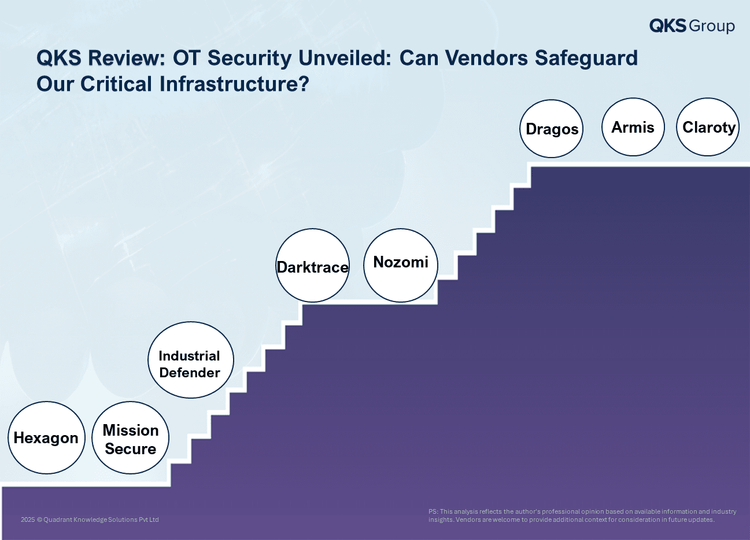
- Dominant players (Armis, Claroty, Dragos) offer robust, enterprise-ready platforms with rich threat intelligence, visibility, and vendor integrations. However, their premium pricing and deployment complexity limit accessibility for mid-tier or resource-constrained organizations.
- Capable players (Darktrace, Nozomi) deliver innovative approaches, Darktrace leads in AI-powered anomaly detection while Nozomi’s Vantage platform offers scalable cloud-based visibility, but gaps remain in usability, encrypted traffic handling, and real-time response.
- Slow movers (Industrial Defender, Mission Secure, Hexagon) serve niche needs like compliance and endpoint risk management but often lack real-time detection, proactive threat hunting, and broad integration leaving critical assets exposed to dynamic threat actors.
Introduction
In an era where digital transformation is reshaping industries, Operational Technology (OT) security has become a cornerstone of protecting critical infrastructure. OT systems, which manage physical processes in sectors like manufacturing, energy, and transportation, are increasingly targeted by cybercriminals due to their connectivity and the severe consequences of disruptions. The OT security market is projected to grow significantly, driven by rising cyber threats and the convergence of IT and OT environments. The SANS 2024 ICS/OT Cybersecurity Report notes that 83% of OT leaders experienced at least one security breach in the past three years, underscoring the urgency of robust solutions.
This blog provides a comparative analysis of key OT security vendors, categorized into dominant players (Armis, Claroty, Dragos), capable players (Darktrace, Nozomi), and slow movers (Industrial Defender, Mission Secure, Hexagon). Analysis is based on comparative evaluation on innovation, comprehensiveness, cost vs. value, scalability, and customer sentiments.
The Operational Technology Security Landscape
The 2021 Colonial Pipeline ransomware attack, which disrupted fuel supply across the U.S., exemplifies the real-world impact of OT vulnerabilities. Such incidents highlight the need for vendors that can deliver comprehensive, scalable, and effective solutions. But are the current market players up to the task? Let us examine the vendors, their offerings, and the gaps that might leave critical infrastructure exposed.
Vendor Overview
Dominant Players
Armis is well-known for its agentless, cloud-based platform, Armis Centrix, which provides comprehensive visibility into OT, IT, and IoT devices. Using passive traffic analysis and AI-driven analytics, it catalogues devices and monitors behaviour, leveraging a global knowledgebase of over five billion devices. Its strengths include scalable deployment, OT-specific controls, and robust risk management, enhanced by acquisitions like Silk Security. However, its agentless approach may miss attacks not visible in network traffic, and its enterprise-grade pricing can be a barrier for smaller organizations.
Given its agentless approach, how does Armis detect highly targeted attacks, such as zero-day exploits in device firmware, which do not manifest in network traffic?
Claroty excels in OT asset visibility and risk management, offering multi-modal discovery (passive, active, and agent-based) and customizable risk scoring. Its partnerships with Microsoft and Palo Alto ensure strong IT-OT integration. Claroty’s platform is OT-centric, translating vulnerabilities into actionable insights, but deployment complexity and high costs may deter some users. Mixed customer sentiment due to setup challenges is noted.
In OT environments with diverse legacy devices using proprietary protocols, how effective is Claroty's multi-modal discovery, and how does it simplify deployment complexity?
Dragos specializes in OT threat detection and response, boasting the largest private OT cyber threat intelligence team and top scores in MITRE ATT\&CK evaluations. Its platform, combined with Network Perception, provides dual-layer visibility and community-driven threat sharing via Neighborhood Keeper. Dragos serves major clients like U.S. power utilities but faces challenges with complex deployments and premium pricing, limiting its appeal for smaller sites.
Beyond threat detection, what robust support does Dragos provide for vulnerability management and remediation, especially for resource-constrained organizations?
Capable Players
Nozomi offers a comprehensive OT/IoT security suite with deep visibility and rapid threat detection, supported by its Guardian sensors and Vantage SaaS platform. It protects over 115 million assets. Its reliance on passive sensors can miss zero-day attacks without traffic patterns, and enterprise-grade pricing requires careful ROI consideration.
How does Nozomi address encrypted traffic or proprietary protocols that passive sensors may not decipher, particularly for zero-day attacks?
Darktrace employs self-learning AI to detect anomalies across IT and OT networks, offering autonomous response capabilities through its Antigena engine. It excels at identifying novel attacks like zero-days. However, its AI requires a lengthy learning period, potentially creating vulnerabilities, and its high cost and complexity may not suit smaller budgets.
During the AI’s initial learning period, what measures ensure protection against attacks that exploit this vulnerability window?
Slow Movers
Industrial Defender is a compliance and asset management specialist, offering deep configuration tracking and audit-ready reports for standards like NERC CIP. Its Risk Dashboard enhances vulnerability prioritization, but it lacks real-time threat detection and has a dated interface. It is cost-effective for regulated industries but falls short in dynamic threat environments.
With cyber threats evolving rapidly, how does Industrial Defender plan to enhance real-time threat detection to compete with more dynamic solutions?
Mission Secure (ServiceNow)
Mission Secure offers an OT-native cybersecurity platform emphasizing Zero Trust principles. It provides comprehensive asset and network visibility, anomaly and threat detection, policy enforcement, and Level 0 signal validation. The platform enables organizations to implement fine-grained cybersecurity policies, allowing or blocking connections based on conditions such as asset vulnerability scores, patch status, user profiles, or time of day.
While Mission Secure offers deep visibility and control, how does it address the challenges of integrating with existing OT environments without causing operational disruptions?
Hexagon's PAS Cyber Integrity is an OT/ICS risk and endpoint management solution designed for safer and more resilient industrial operations. It offers automated capabilities, including change detection on all OT endpoints, continuous vulnerability management with patch level assessments, and supports over 130 industrial automation systems.
Given Hexagon's focus on risk and endpoint management, how does it ensure real-time threat detection and response in rapidly evolving OT threat landscapes?
Comparative Analysis
Innovation
Dominant players like Armis and Dragos drive innovation with agentless security and OT-specific threat intelligence, respectively. Darktrace stands out with its AI-driven approach. Industrial Defender lags, focusing on incremental improvements rather than groundbreaking features.
Comprehensiveness
Claroty and Nozomi offer the broadest feature sets, covering asset discovery, threat detection, and vulnerability management. Armis and Dragos are close behind, with minor gaps in on-device scanning or IT convergence. Darktrace excels in detection but is lighter on compliance, while Industrial Defender are limited to specific use cases.
Cost vs. Value
Dominant players provide extensive features but at a premium, making them more suitable for large enterprises. Industrial Defender offers strong value for compliance-heavy organizations, while capable players require careful ROI evaluation due to high costs relative to their scope.
Scalability & Integration
Most vendors, particularly Dragos, Darktrace, and Nozomi, support large-scale deployments and integrate well with IT tools like SIEMs and firewalls. Armis and Claroty are also scalable, though Industrial Defender’s on-premises focus slightly reduce their flexibility.
Customer Sentiment
Armis and Nozomi receive high praise for visibility and support. Claroty and Dragos have mixed feedback due to complexity and cost, while Darktrace and slow movers face challenges with tuning and market presence.
Real-World Incidents: The Stakes of OT Security
Real-world incidents highlight the consequences of Operational Technology (OT) security failures and the importance of choosing effective vendors. The 2021 Colonial Pipeline ransomware attack is a prime example. The attack targeted the company’s IT systems, but out of caution, the pipeline’s OT systems were shut down, causing fuel shortages across the U.S. The incident cost millions in ransom and recovery efforts and damaged public trust.
Vendors like Dragos and Darktrace, with their advanced threat detection, could have identified and contained the ransomware early, potentially preventing escalation. Armis and Claroty’s comprehensive asset visibility might have enabled rapid isolation of affected systems, minimizing downtime. In contrast, slow movers like Industrial Defender, with their focus on compliance, may have been less effective in addressing such a dynamic threat.
Another example is the 2024 American Water Works breach, which disrupted customer portals and billing systems. This incident underscores the need for integrated IT-OT security and real-time monitoring, areas where dominant and capable players generally excel. These cases illustrate that while no vendor can guarantee immunity, those with robust detection, visibility, and response capabilities are better positioned to mitigate risks.
Choosing the Right Vendor: Key Considerations
Selecting an Operational Technology (OT) security vendor requires aligning their capabilities with organizational needs. Key factors to consider include:
- Asset Visibility: Comprehensive discovery of all devices, including legacy systems, is critical. Armis and Claroty lead here.
- Threat Detection and Response: Real-time detection of novel threats is essential. Dragos and Darktrace excel in this area.
- Vulnerability Management: Prioritizing and remediating vulnerabilities is key. Claroty and Nozomi offer strong solutions.
- Ease of Deployment: Complex setups can delay ROI. Nozomi’s SaaS model and Armis’s agentless approach simplify implementation.
- Scalability: Solutions must grow with the organization. Dragos and Darktrace are highly scalable.
- Cost-Effectiveness: Budget constraints matter. Industrial Defender provides value for compliance-focused needs.
- Integration: Seamless integration with IT tools enhances efficiency. Most vendors support this, with Dragos and Nozomi standing out.
- Support and Training: Responsive support and training are vital, particularly for complex solutions like Claroty and Dragos.
Beyond technology, a holistic security strategy is crucial. This includes regular staff training, incident response planning, and compliance with standards like IEC 62443 or NERC CIP. Organizations must also stay informed about emerging threats, such as AI-driven attacks or supply chain vulnerabilities, to ensure their security posture remains robust.
Conclusion
The Operational Technology (OT) security landscape is complex, with vendors offering diverse solutions to protect critical infrastructure. Dominant players like Armis, Claroty, and Dragos provide comprehensive, innovative platforms but may be overkill for smaller organizations due to cost and complexity. Capable players like Darktrace and Nozomi offer strong alternatives with unique features, such as AI-driven detection or cloud-based scalability. Slow movers like Mission Secure, Hexagon, and Industrial Defender cater to niche needs, such as compliance, but lack the breadth of their competitors.
Real-world incidents, like the Colonial Pipeline attack, highlight the catastrophic consequences of OT security failures and the need for robust solutions. The changing market dynamics requires vendors to address gaps, such as detecting non-network-based attacks or simplifying deployments, to better serve their clients. Ultimately, organizations must carefully evaluate their specific requirements in terms of size, industry, budget, and existing infrastructure when choosing a vendor. A proactive, holistic approach, combining technology, people, and processes, is essential to safeguard critical infrastructure in an increasingly threatening digital world.
Disclaimer:
This blog is based on independent research and publicly available information. The insights presented reflect the views of QKS Group and are for informational purposes only. While we strive for accuracy, we do not guarantee completeness or absolute correctness. Vendors are welcome to provide clarifications or updates. If any vendor listed in this analysis wishes to provide additional context or clarification, we welcome a briefing call and will consider incorporating relevant updates. This analysis is not intended to disparage any vendor but to provide an informed, balanced perspective. We encourage open and constructive dialogue to foster transparency and a deeper understanding of the industry.
Author: Kunal Kumar, Senior Analyst - Cyber Physical Security (CPS) at QKS Group
Vendors: