

01.07.2025
QKS Review
QKS Review: Networking’s Carbon Reckoning: Progress, Gaps, and the Road to Greener Infrastructure
Author:
Akshay Singh


Executive Summary:
Executive Summary
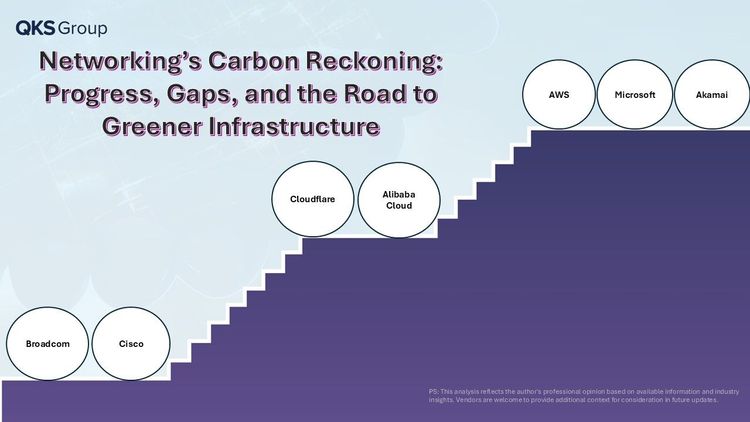
As the digital world keeps expanding, so does the energy it consumes—and in 2025, some tech companies started facing that reality head-on. Akamai, AWS, Alibaba Cloud, Cloudflare, and Microsoft rolled out efforts to make their networks and data centers more energy-efficient, from smarter routing to reusing server parts. But not everyone is moving at the same pace. Big names like Cisco and Broadcom still haven’t tackled the energy demands of their core networking gear, which plays a huge role in global emissions. If the industry wants to get serious about sustainability, it’ll take more than isolated fixes—it’ll require openness, collaboration, and a shift in how networks are designed from the ground up.
In early 2025, the networking industry began addressing its growing environmental impact, driven by the rising energy demands of data centres and the vast internet infrastructure that underpins the digital world. Leading technology providers such as Akamai Technologies, Alibaba Cloud, AWS, Cloudflare, and Microsoft introduced targeted sustainability initiatives, while major players like Cisco and Broadcom remained comparatively less active, highlighting both progress and gaps within the sector. This focus is critical, as networking equipment—including routers, switches, and servers—accounts for an estimated 2–4% of global carbon emissions, a figure expected to rise with increasing digital demand. The production and operation of such hardware, especially the energy-intensive cooling and processing systems in data centres, contribute significantly to greenhouse gas emissions. Addressing these challenges is essential to ensure that technological advancement aligns with environmental responsibility.
The Efforts of Pioneering Providers
Akamai- Akamai has made tangible progress in improving energy efficiency through its Akamai Connected Cloud platform. A notable initiative is the introduction of a Carbon Calculator, which allows customers to quantify emissions from their digital traffic and make informed decisions by aligning workloads with regions powered by renewable energy. While this reflects a proactive stance toward environmental responsibility, Akamai’s continued reliance on carbon offsets underscores the inherent challenges in achieving direct and measurable reductions in emissions across its infrastructure.
Alibaba Cloud- Alibaba Cloud has embedded sustainability within its operational framework by leveraging data-driven tools to manage and optimize energy consumption across its global cloud infrastructure. These capabilities enable dynamic adjustments to power usage based on real-time demand. However, the inconsistent deployment of these sustainability features across its geographic footprint limits the overall impact of Alibaba’s efforts, indicating a need for more uniform execution at scale.
Amazon Web Services (AWS): Amazon Web Services (AWS) has set an ambitious target of achieving carbon neutrality by 2040. It has integrated energy efficiency into its networking systems and offers tools such as the AWS Sustainability Insights dashboard, which enables customers to track and manage their environmental footprint. AWS is also increasing its use of renewable energy in select data centre regions. Nevertheless, given the immense scale and complexity of AWS’s global operations, maintaining consistent reductions across all regions remains a significant and ongoing challenge.
Cloudflare: Cloudflare takes a network-optimization approach to sustainability. It focuses on intelligent traffic routing to minimize energy use across its global footprint, favouring low-carbon paths wherever feasible. This method helps reduce unnecessary energy expenditure in data transmission. However, Cloudflare's dependence on third-party colocation data centres limits its ability to directly control the carbon footprint of its entire infrastructure, highlighting a structural constraint in its sustainability strategy.
Microsoft: Microsoft has adopted a multifaceted sustainability approach focused on operational efficiency and innovation. Through its GreenSKUs initiative, the company reuses and repurposes older server components in Azure cloud deployments, maintaining performance while reducing hardware waste. Microsoft further enhances energy efficiency by automatically reducing power consumption on servers that are idle or pending maintenance. In collaboration with Carnegie Mellon University and the University of Washington, Microsoft has also developed an industry-shared metric for evaluating data centre cooling impacts—one that incorporates energy, carbon, and water usage. In a notable demonstration of applied AI, Microsoft's Discovery platform identified a non-toxic coolant for data centres within just 200 hours, pointing to the growing role of artificial intelligence in accelerating sustainability research.
The Missing Piece
Amid this collective effort, Cisco, a towering figure in networking hardware and software with products like IOS and Nexus OS, remains a curious bystander. While it pledges net-zero emissions by 2040 across its operations, Cisco has yet to focus specific initiatives on reducing the energy demands of its network infrastructure. This gap stands out, given its widespread influence over enterprise and service provider networks, leaving a void where leadership could drive industry-wide change and highlighting an opportunity yet to be seized.
Broadcom, through VMware, has introduced initiatives aimed at reducing emissions by leveraging telemetry data to identify decarbonization opportunities. While these efforts align with broader digital transformation goals, the absence of publicly available quantitative data—such as actual emissions reductions—limits the ability to evaluate their real impact. Additionally, although VMware’s virtualization technologies are designed to improve energy efficiency, they may produce rebound effects, where increased efficiency results in greater overall usage, potentially negating environmental benefits. Beyond VMware, Broadcom’s wider operations show limited direct engagement with Scope 3 emissions, which represent the bulk of its environmental footprint due to the energy-intensive nature of semiconductor manufacturing.
Reflections on the Road Ahead
As digital infrastructure continues to expand, the environmental impact of networking must remain a central consideration for technology providers, policymakers, and end users alike. The efforts of companies like Akamai, Alibaba Cloud, AWS, Cloudflare, and Microsoft signal a meaningful shift toward embedding sustainability within the networking ecosystem. Their initiatives—ranging from intelligent traffic routing and energy-efficient server operations to data-driven emissions tracking—demonstrate the practical steps possible when sustainability is treated as an operational priority. However, the uneven commitment across the industry, particularly from foundational players like Cisco and Broadcom, reflects a broader hesitation to fully confront the complexity of carbon emissions within networking operations.
Moving forward, greater transparency around emissions data, especially Scope 3, will be essential to assess progress accurately and build trust. Industry stakeholders should also explore more aggressive design changes in networking hardware, including support for modular upgrades and greater power efficiency standards. Collaboration between hyperscalers, colocation providers, and hardware vendors will be key to closing structural gaps, such as the limited control over third-party data centres. Ultimately, achieving a sustainable networking infrastructure requires not just incremental improvements, but a coordinated, system-level transformation—one that balances performance, scale, and environmental responsibility.
Disclaimer:
This blog is based on independent research and publicly available information. The insights presented reflect the views of QKS Group and are for informational purposes only. While we strive for accuracy, we do not guarantee completeness or absolute correctness. Vendors are welcome to provide clarifications or updates. If any vendor listed in this analysis wishes to provide additional context or clarification, we welcome a briefing call and will consider incorporating relevant updates. This analysis is not intended to disparage any vendor but to provide an informed, balanced perspective. We encourage open and constructive dialogue to foster transparency and a deeper understanding of the industry.
Author: Akshay Singh , Analyst - Enterprise Networking at QKS Group
Vendors: